
Per se deception advertising is an ad practice that violates a specific statute or regulation and is unlawful for that reason alone, regardless of whether the advertiser meant to mislead anyone or whether a single customer was actually fooled. That single fact changes how these cases get built and how much exposure a business is carrying without knowing it. Under a per se rule, the violation itself is the injury.
For legal teams and marketers, this matters because per se claims flip the usual burden of proof:
- Strict liability mechanics. Plaintiffs don’t need to show intent to deceive or that a “reasonable consumer” was actually misled, just that a rule was broken.
- Real money on the line. Statutes like the New Jersey Consumer Fraud Act allow treble damages and attorneys’ fees once a per se violation is paired with an ascertainable loss.
- A plaintiff-friendly setup. Because the elements are narrower and more mechanical than the FTC’s deception standard, per se claims are often faster and cheaper to bring than to defend.
Key Takeaways
Per se deception advertising imposes liability the moment a specific regulation is violated, without requiring proof of intent or actual consumer confusion.
| Point | Details |
|---|---|
| Core definition | Per se deception means violating a specific statute or regulation is itself the unlawful act, regardless of intent. |
| Proof is narrower than FTC deception | Plaintiffs need a regulatory violation, an ascertainable loss, and causation, not a reasonable-consumer survey. |
| Common triggers are procedural | Missing license numbers, fake sale pricing, and bait-and-switch inventory are the most frequent per se traps. |
| Financial exposure is real | Statutes like the NJ CFA allow treble damages and attorneys’ fees once a violation and loss are shown. |
| Scancompliant supports the checklist work | Its scanning platform flags missing disclosures and risky claims before publication and keeps an audit trail for defense. |
Table of Contents
- What Does “Per Se” Actually Mean in Advertising Law?
- Per Se Liability vs. FTC Deception: What’s the Difference?
- Common Advertising Practices That Trigger Per Se Liability
- Where Do Per Se Advertising Rules Come From?
- What Are the Legal Consequences of a Per Se Violation?
- How Can Businesses Defend Against Per Se Claims?
- A Practical Compliance Checklist for Marketing Teams
- Can Compliance Tools Actually Catch Per Se Risk?
- Where Automated Scanning Fits Into Per Se Risk Reduction
- Frequently Asked Questions
- Sources
What Does “Per Se” Actually Mean in Advertising Law?
“Per se” is Latin for “by itself,” and in advertising law it means the violation of a specific regulatory requirement is unlawful on its own terms. You don’t need to prove the advertiser intended to trick anyone, and you don’t need survey data showing consumers were confused. The rule was broken. That’s the claim.
This is a fundamentally different animal from ordinary deception or fraud claims, which require a plaintiff to establish that a representation was false, that it was likely to mislead a reasonable person, and that the falsehood actually caused harm. Per se claims skip most of that. They convert a regulatory checklist into a legal cause of action.
Take the New Jersey Consumer Fraud Act as a working model, since it’s one of the clearest and most litigated per se frameworks in the country. Under the CFA, a plaintiff generally has to establish three things:
- A regulatory violation. The advertiser broke a specific rule, often one found in N.J.A.C. 13:45A, New Jersey’s general advertising regulations covering things like sale pricing, bait advertising, and required disclosures.
- An ascertainable loss. The consumer lost money or something of value because of the ad.
- A causal connection. The loss ties back to the violation, not to some unrelated factor.
What’s conspicuously absent from that list is intent and actual deception. A business can run an ad in complete good faith, with zero intent to mislead, and still face per se liability if the ad happened to omit a required disclosure. That’s the trap. Good Pine P.C.’s analysis of the NJ CFA makes this point directly: the focus is on whether the specific regulation was breached, not on the advertiser’s state of mind.
Per Se Liability vs. FTC Deception: What’s the Difference?
The federal standard and state per se rules are built on entirely different logic, and understanding the gap is the fastest way to see where your real exposure sits.
The FTC’s 1983 Policy Statement on Deception asks a fact-intensive question: would a representation, omission, or practice be likely to mislead a reasonable consumer acting reasonably under the circumstances, and is it material to their decision? That’s a “net impression” test. The FTC also weighs how an ad is formatted, since its enforcement policy on deceptively formatted ads warns that disguised sponsorship or misleading layout can be deceptive even when every individual claim is technically true.
Per se state rules skip that entire inquiry.
An FTC deception case can take months of survey research, expert testimony, and argument over what a “reasonable consumer” would believe. A per se case often comes down to one question: does the regulation require X, and did the ad include X? If not, the case is largely built.
Here’s where the two regimes diverge in practice:
- Proof burden. FTC deception requires evidence of likely consumer confusion and materiality. Per se claims require only the regulatory text and proof the ad didn’t comply.
- Typical evidence. FTC cases lean on consumer surveys, expert opinion, and net-impression analysis. Per se cases lean on the ad copy itself compared against the statute or regulation, line by line.
- Typical remedies. FTC actions often produce consent orders, injunctions, and corrective advertising requirements. State per se claims under statutes like the CFA can produce treble damages and fee-shifting, which private plaintiffs’ attorneys find far more attractive.
A practice can trigger per se liability without coming anywhere near an FTC deception case. A missing license number on a service ad, a “sale” advertised without a genuine prior regular price, or a bait-and-switch price point where inventory never existed at that price. These are procedural failures more than persuasive falsehoods, and that’s exactly why they slip past marketing teams trained to think about truthfulness in advertising rather than regulatory checklists.
Common Advertising Practices That Trigger Per Se Liability
Most per se violations aren’t clever schemes. They’re administrative details that got skipped during a campaign crunch. Here are the ones that show up most often in enforcement actions and private litigation:
- Advertising a price with no intent to honor it. A campaign promotes “$49 starter kits” but the business never stocked kits at that price or planned to sell at volume. This is the textbook version of what N.J.A.C. 13:45A’s general advertising rules are built to catch.
- Bait-and-switch tactics. The ad copy reads: “Limited stock, $19.99, while supplies last.” If “supplies” means three units at one location, the ad likely violates bona fide inventory requirements regardless of whether anyone complained.
- False sale or “regular price” claims. A “40% off” banner is meaningless, and potentially unlawful, if the item was never actually sold at the higher price for a genuine period beforehand.
- Missing mandatory disclosures. Ads for licensed services (contractors, health providers, financial products) that omit required license numbers or contract terms can violate a regulation on formatting alone, independent of the substantive claims made.
- Insufficient inventory for an advertised sale. Related to bait-and-switch but distinct: the regulation may require a specific quantity or duration commitment that the advertiser never met.
- Unsubstantiated comparative price claims. “Half the price of our competitors” without documentation to back the comparison can trigger per se rules that specifically govern comparative advertising claims.
State advertising regulations, not federal deception doctrine, are usually the ones policing these six items. That’s precisely why a campaign can pass a “is this true?” review and still create liability.
Where Do Per Se Advertising Rules Come From?
Knowing the term is one thing. Knowing which document to actually pull up when you’re building a compliance memo is another.
- FTC Policy Statement on Deception sets the federal baseline: representation or omission, reasonable consumer standard, materiality. Useful for contrast, not for per se analysis itself.
- FTC Enforcement Policy Statement on deceptively formatted ads addresses format and net impression, relevant when an ad’s presentation, not just its content, is at issue.
- New Jersey Consumer Fraud Act and N.J.A.C. 13:45A together form one of the most frequently cited state per se frameworks, with the administrative code supplying the specific advertising requirements that create liability when breached.
- NCLC’s Unfair and Deceptive Acts and Practices treatise dedicates a section specifically to per se deception, cataloging how different states structure these claims.
- 15 U.S.C. § 52 supplies the federal statutory hook tying false advertisements to unfair or deceptive acts, giving the FTC authority to enjoin dissemination.
If your business operates in multiple states, don’t assume New Jersey’s model is universal. Every state runs its own administrative code, and the specific disclosure requirements, inventory rules, and pricing regulations vary. Pull the actual state regulation, not a summary of it, before finalizing a compliance memo, and treat Good Pine’s practice note on NJ per se violations as a model for the kind of analysis you want done for each jurisdiction where you advertise.
What Are the Legal Consequences of a Per Se Violation?
The financial exposure here is real, and it’s often steeper than businesses expect from what looks like a paperwork problem.
- Injunctions. Courts or regulators can order an immediate stop to the offending campaign, sometimes before the underlying dispute is fully litigated.
- Corrective advertising. A business may be required to run ads correcting the prior misrepresentation, at its own cost.
- Restitution. Affected consumers can recover what they paid or lost because of the violation.
- Treble damages and attorneys’ fees. Under statutes like the NJ CFA, a plaintiff who proves a per se violation plus ascertainable loss can recover three times actual damages, plus their legal fees. That fee-shifting provision is a major reason plaintiffs’ counsel actively look for per se claims over harder-to-prove deception theories.
- Civil penalties. State attorneys general and consumer protection agencies can pursue penalties independent of any private lawsuit.
- Reputational cost. A public enforcement action or class action over “fake sale” pricing tends to travel further than the settlement amount ever does.
Because per se claims require less proof than a full deception case, they tend to settle faster and for larger amounts relative to the underlying harm. Enforcement can come from three directions at once: private plaintiffs (often through class actions), state attorneys general, and dedicated consumer protection agencies, which means the same ad campaign can face parallel exposure on multiple fronts.
How Can Businesses Defend Against Per Se Claims?
Defense counsel facing a per se claim have narrower options than in a typical deception case, but narrower doesn’t mean nonexistent.
- Contest statutory applicability. Argue the specific regulation cited doesn’t actually govern the ad in question, whether due to industry exemption, timing, or jurisdiction.
- Demonstrate compliance with the regulatory text. Sometimes the strongest defense is simply showing the disclosure was present, the inventory was real, or the license number was displayed exactly as required.
- Challenge ascertainable loss or causation. Even a genuine regulatory violation doesn’t create liability without a provable loss connected to that specific violation.
- Raise procedural defenses. Standing, statute of limitations, or preemption arguments can apply depending on the claim and jurisdiction.
Strategically, the calculus often shifts fast once treble damages are on the table. Early remediation, pulling the ad, issuing a corrective notice, documenting the fix, can materially change settlement posture even if it doesn’t eliminate liability. Review insurance and indemnity provisions early, since advertising injury coverage varies widely by policy. And preserve records: contemporaneous decision documentation, proof of inventory and pricing at the time the ad ran, and evidence of prompt corrective action all matter if a dispute escalates.
Pro Tip: Freeze the campaign the moment a potential per se issue surfaces internally, even before legal has finished its analysis. A voluntary pause, documented with a timestamp, is far better evidence in litigation than a campaign that kept running while lawyers debated the regulation.
A Practical Compliance Checklist for Marketing Teams
Run this against any campaign before it goes live, not after a complaint arrives:
- Verify required disclosures. Confirm license numbers, contract terms, and any mandatory regulatory language appear and are legible.
- Confirm bona fide inventory and pricing. Document that advertised quantities and “regular” prices reflect actual, verifiable sales history.
- Substantiate comparative claims. Any “cheaper than,” “faster than,” or percentage-off claim needs a documented basis before it runs.
- Validate underlying claim substantiation. Confirm references, data, or studies cited actually support the specific claim made in the ad.
- Check prominence and clarity of qualifiers. Fine print that contradicts the headline claim, or that’s too small to read, is a common per se trigger on its own.
Assign clear sign-off: marketing drafts, legal reviews for regulatory compliance, and compliance ops maintains the audit trail. Our regulatory review checklist walks through a fuller version of this workflow if you need a template to adapt.
Pro Tip: Keep a timestamped record showing that the advertised price and quantity were actually available on the day the ad launched, not just when it was drafted. That single piece of documentation is often the difference between a quick dismissal and a drawn-out per se claim.
Can Compliance Tools Actually Catch Per Se Risk?
Human reviewers are good at catching obviously false claims. They’re worse at catching the procedural gaps, a missing license number, an inventory disclosure that got trimmed for space, that create per se liability. That’s a volume problem, not a skill problem, when a team is reviewing dozens of ad variations across channels every week.
Structured tooling addresses this by running a risk-term library against every piece of copy, flagging missing mandatory disclosures, and checking inventory and pricing claims against documented records. The output should be a prioritized list of findings, not just a pass/fail stamp, so legal and marketing can triage what actually needs attention first.
The workflow matters as much as the tool. Automated scans should run before publication, flagged items should require an actual legal sign-off rather than an automatic override, and every review needs to leave a compliance trail that can be pulled up months later if a dispute arises.
Pro Tip: Prioritize tools that check procedural and administrative requirements, license IDs, required language, inventory proof, not just substantive truth claims. Per se liability lives in the paperwork details that “does this claim sound true?” reviews routinely miss.

A Practitioner’s View on Per Se Risk
The businesses that get burned by per se claims almost never intended to deceive anyone. They just treated a regulatory disclosure as a formatting afterthought instead of a legal requirement with teeth. That’s the actual gap worth closing: not better copywriting, but a review process that checks the boring, mechanical stuff with the same rigor as the headline claim. Fix the checklist problem and the treble-damages exposure mostly takes care of itself.
Where Automated Scanning Fits Into Per Se Risk Reduction
Per se exposure lives in the details a busy marketing team is most likely to skip under deadline pressure: a license number, a disclosure line, a pricing proof point. Scancompliant is built around exactly that gap. It scans live campaigns, product listings, and marketing documents for missing mandatory disclosures, flags risky pricing or comparative language, and prioritizes findings so legal and marketing teams know what to fix first instead of combing through every asset manually.

The platform’s risk-term database covers more than 1,000 flagged terms and phrasing patterns, and it has already been used to review content for over 200 brands in telehealth and DTC health marketing. Every scan leaves a documented compliance trail, which matters if a per se claim ever surfaces and you need to show the review actually happened. If your team is running campaigns across multiple states with different advertising regulations, that kind of prioritized, documented review cycle is the difference between catching a missing disclosure before launch and defending a treble-damages claim after the fact. Start a trial at Scancompliant’s platform page or check current pricing tiers to see which plan fits your review volume.
Frequently Asked Questions
What does “per se” mean in advertising law?
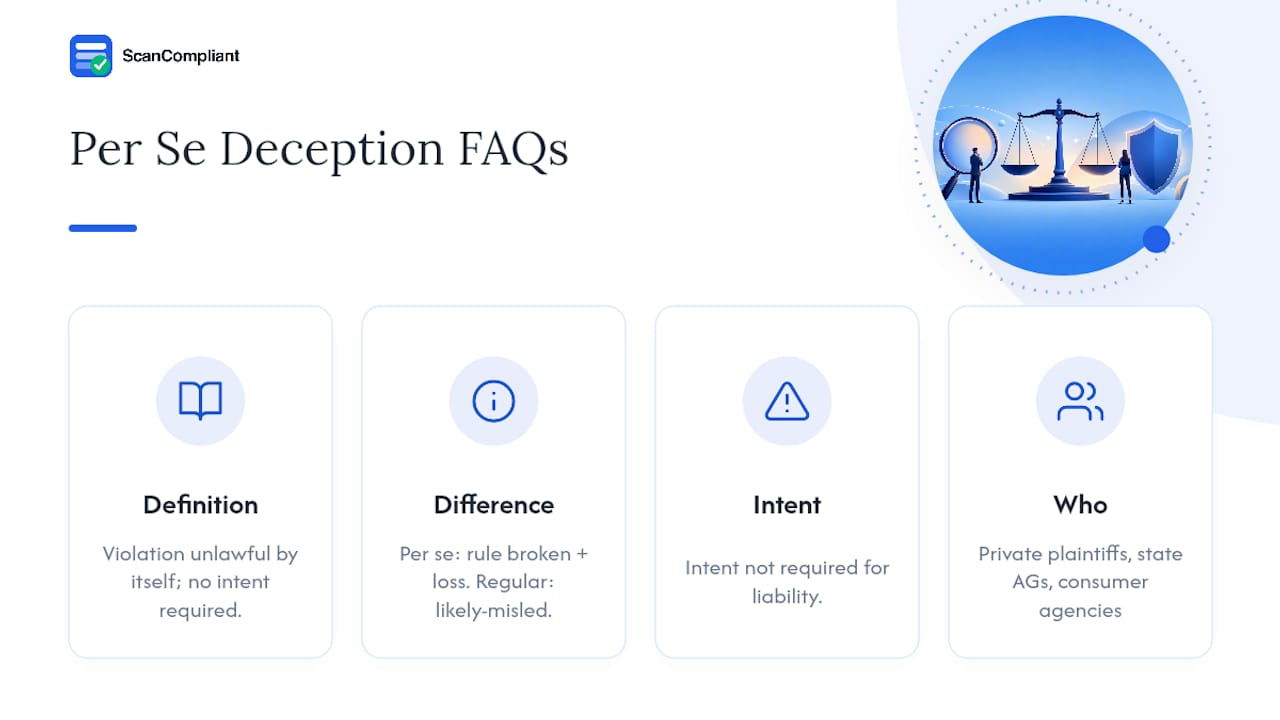
It means a violation of a specific statute or regulation is unlawful by itself, without needing proof of intent to deceive or evidence that a consumer was actually misled.
How is per se deception different from regular false advertising?
Regular false advertising claims, like those under the FTC’s deception standard, require showing a reasonable consumer was likely misled and that the claim was material. Per se claims only require proving the regulation was broken plus a resulting loss.
What are common examples of per se deception advertising?
Advertising a sale price without genuine prior pricing history, bait-and-switch inventory shortages, missing required license disclosures, and unsubstantiated comparative price claims are among the most frequent triggers.
What happens if a business is found liable for a per se violation?
Consequences can include injunctions, corrective advertising orders, restitution, civil penalties, and, under statutes like the NJ CFA, treble damages plus attorneys’ fees.
Does intent matter in a per se deception case?
No. Per se liability focuses on whether the regulation was violated, not on whether the advertiser meant to mislead anyone.
Who can bring a per se deception claim?
Private plaintiffs (often through class actions), state attorneys general, and consumer protection agencies can all pursue these claims, sometimes simultaneously.
This article is general information, not a substitute for advice from a qualified lawyer. Consult a qualified legal professional about your own circumstances before acting on anything here.
Sources
For memos, litigation prep, or campaign review, these are the primary documents worth keeping on hand:
- FTC Policy Statement on Deception
- Enforcement Policy Statement on Deceptively Formatted Advertisements – Federal Trade Commission
- New Jersey Division of Consumer Affairs – Statutes and Regulations
- 4.2.1 Per Se Deception | Unfair and Deceptive Acts and Practices | NCLC Digital Library
- U.S. Code, Title 15, Section 52 (False advertisements provision)
Start with the regulation itself before citing a summary of it. Per se claims live or die on exact statutory language, and a memo built on the primary text holds up far better than one built on a paraphrase.
Recommended
- Misleading Health Claims: A Compliance Guide for DTC Brands – scancompliant.com
- GLP-1 Marketing Compliance in 2026: What the FDA Warning Letter Wave Means for Your Brand — ScanCompliant
- Why Health Writing Carries Legal Risk for DTC Brands – scancompliant.com
- GLP-1 Marketing Compliance Scanner — Scan Your GLP-1 Website Before the FDA Does | ScanCompliant