
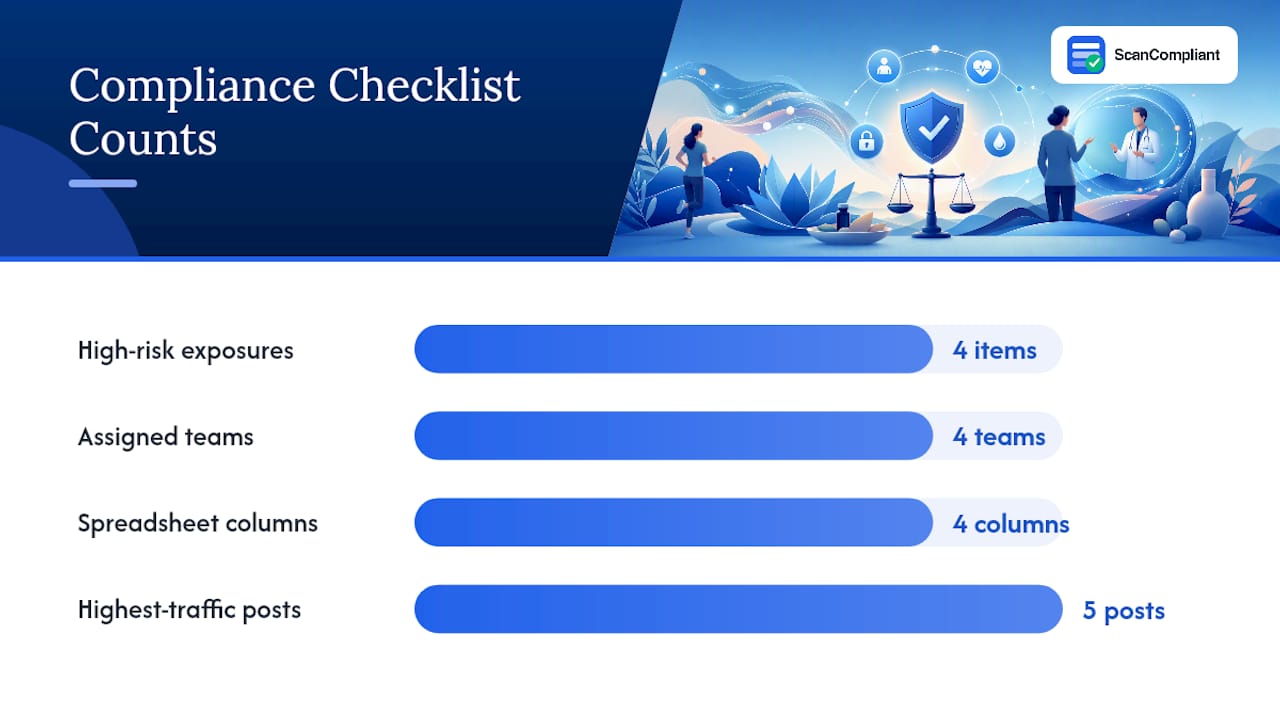
The highest-risk legal exposures in wellness blog content are unsubstantiated efficacy claims, implied disease-treatment messages, misused testimonials, and mischaracterized FDA status. If a published post contains any of these, the single immediate action is to add a conspicuous qualifying disclosure or take the post offline while you gather substantiation documentation. Here is what each team should do in the next 24 hours:
- Regulatory lead: Inventory every live post for “clinically proven,” “cures,” “treats,” or “prevents” language and flag each for substantiation review.
- Legal counsel: Confirm whether any testimonial implies a disease claim and whether paid endorsers are disclosed per FTC rules.
- Marketing team: Pause paid amplification on any flagged post until regulatory sign-off is documented.
- Content team: Add a DSHEA-compliant structure/function disclaimer to any supplement or health product post that lacks one.
Pro Tip: Create a shared spreadsheet with columns for claim text, claim type (express/implied/structure-function), substantiation status, and reviewer sign-off. Populate it today for your five highest-traffic posts. That single artifact is your first line of defense in an FTC informal inquiry.
Key Takeaways
Wellness blog legal issues consistently trace back to the same small set of failures: unsubstantiated claims, implied disease messages, and missing disclosures. Fix those three categories and you eliminate the majority of FTC/FDA enforcement exposure in your content program.
| Point | Details |
|---|---|
| Substantiation before publishing | Every efficacy claim needs documented evidence, often RCT-level, before the post goes live. |
| Net impression governs | The FTC reads the whole page: images, testimonials, and layout create implied claims even when body copy avoids disease language. |
| DSHEA disclaimer is mandatory | Structure/function claims on supplement posts require the FDA disclaimer, placed conspicuously, every time. |
| Remediation needs a paper trail | Document every corrective action with a ticket showing original claim, reason for change, and reviewer sign-off. |
| Scancompliant automates the first pass | The platform flags risk terms and implied claims in minutes, routing only high-risk findings to legal review. |
Table of Contents
- What are the most common wellness blog legal pitfalls?
- How do the FTC and FDA actually evaluate health claims?
- What should a pre-publication compliance checklist include?
- How do you remediate a live post that may be non-compliant?
- Which tools and controls speed safe publishing?
- What enforcement patterns should your team watch for?
- Compliance is a growth lever, not a tax on creativity
- How Scancompliant reduces enforcement risk before you publish
- Sources
What are the most common wellness blog legal pitfalls?
These are the violations that repeatedly appear in FTC and FDA enforcement activity against telehealth and DTC wellness brands.
- Unsubstantiated efficacy claims. Phrases like “clinically proven to reduce inflammation” require competent and reliable scientific evidence, which for many health claims means randomized, controlled human clinical trials. A single in-vitro study or a manufacturer’s internal test does not meet that bar.
- Implied disease claims. A headline reading “Finally, relief from chronic joint pain” does not use the word “treats,” but the FTC reads the net impression of the whole page, including images, testimonials, and layout. That headline is a disease claim.
- Misstated FDA status. Writing “FDA-registered facility” or “FDA-reviewed formula” in a way that implies FDA approval is a recurring trigger. DSHEA does not require pre-market FDA approval for supplements, and implying otherwise is both inaccurate and potentially deceptive.
- DSHEA structure/function pitfalls. A structure/function claim (“supports healthy joints”) is legal under DSHEA only when accompanied by the required FDA disclaimer: “This statement has not been evaluated by the Food and Drug Administration. This product is not intended to diagnose, treat, cure, or prevent any disease.” Omitting it, or burying it in a footer in 6-point type, is a common compliance failure.
- Testimonials that become disease claims. A customer quote saying “I stopped needing my prescription after two weeks” is an implied disease-treatment claim. FTC guidance is clear: a testimonial implying a disease-treatment effect requires the same scientific backing as an express claim, and paid endorsers must be disclosed.
- Third-party literature used without context. Citing a published study in a blog post makes the brand responsible for the accuracy of how that study is characterized. Overstating a study’s findings, or using a rodent study to support a human efficacy claim, is a substantiation failure.
- UGC used in promotion. Reposting a customer’s Instagram story or embedding a review in a blog post converts that user-generated content into the brand’s own advertising claim. FDA draft guidance confirms that firms remain responsible for UGC they prompt or use in promotion, even when the original post was organic.
How do the FTC and FDA actually evaluate health claims?
The FTC’s advertising substantiation policy requires that advertisers possess a reasonable basis for objective claims before disseminating them. Post-claim evidence, gathered after a blog post goes live, carries limited weight in enforcement discretion and does not substitute for prior substantiation.
For health claims, the FTC Health Products Compliance Guidance replaced the agency’s 1998 brochure and now applies across foods, supplements, OTC drugs, and other health products. The standard for many efficacy claims is randomized, double-blinded, controlled human clinical trials with statistically significant and clinically meaningful results.
Evidence checklist for each claim:
- Write out the claim exactly as it appears in the post.
- Identify the consumer takeaway, including any implied meaning created by surrounding images or testimonials.
- Determine the evidence level required: RCT for disease/efficacy claims; mechanistic or observational evidence may suffice for some structure/function claims, but document the reasoning.
- Map each piece of supporting evidence to the specific claim it backs.
- Retain study PDFs, reviewer notes, and the mapping document in a durable record.
The FTC and FDA coordinate under a liaison agreement. The FDA focuses primarily on product labeling; the FTC covers advertising, including blog content. Neither agency treats platform approval as a compliance clearance. A Meta ad that passes automated review can still trigger an FTC civil investigative demand. For telehealth brands specifically, the Federal Register guidance on presenting quantitative efficacy and risk information addresses how benefit and risk data must be framed in DTC promotional materials, including disclosure placement and quantitative claim presentation.
What should a pre-publication compliance checklist include?
A pre-publication review workflow should be auditable, role-specific, and attached to a content record that survives a regulatory inquiry.
- Claim inventory. List every factual assertion in the post, including those embedded in headlines, image captions, and pull quotes.
- Claim classification. Label each claim: express efficacy, implied disease, structure/function, or general wellness. Disease claims require RCT-level substantiation; structure/function claims require DSHEA disclaimer language.
- Substantiation mapping. Attach the specific study, meta-analysis, or regulatory document that backs each claim. Note the study design, sample size, and whether results are statistically significant and clinically meaningful.
- Disclosure and disclaimer check. Confirm DSHEA language is present and conspicuous for supplement posts. Confirm any quantitative efficacy claim meets Federal Register DTC presentation standards.
- Testimonial provenance. Document whether each testimonial is paid or unpaid, confirm disclosure language is present, and verify the testimonial does not imply a disease-treatment effect without substantiation.
- UGC moderation plan. If the post embeds user reviews or social posts, confirm each piece of UGC was not prompted by the brand and that no UGC implies a disease claim.
- Platform-specific copy variants. Note any copy changes made for Meta, Google, or TikTok ad versions and confirm those variants were also reviewed.
Sign-off roles: The copywriter confirms factual accuracy of the draft. The medical reviewer confirms no disease claims are made without substantiation. The regulatory lead confirms DSHEA and FTC compliance. Legal counsel reviews any high-risk claim categories. The publishing approver confirms all sign-offs are documented before the post goes live. Retain sign-off timestamps, reviewer notes, study PDFs, and version history for a minimum of five years, consistent with compliance documentation best practices.
Pro Tip: Tag high-risk posts in your CMS metadata with a “regulatory-review-required” flag. Set that tag to block publishing until a second reviewer clears it. The tag also makes it easy to pull a list of all flagged posts during an audit.
How do you remediate a live post that may be non-compliant?
Speed and documentation both matter here. A content compliance audit on a live post follows this sequence:
- Immediate triage. Add a conspicuous qualifying disclosure or take the post offline. Flag every downstream asset that references the post: paid ads, email campaigns, social reposts.
- Pause paid amplification on any ad set driving traffic to the flagged post.
- Revise claim language. Replace unsubstantiated efficacy language with substantiated structure/function language or remove the claim. Add citations and context for any study referenced.
- Add required disclaimers. Insert DSHEA language for supplement claims. Add a clear limitation statement for any emerging-science claim.
- Retract problematic testimonials. Remove or qualify any testimonial that implies a disease-treatment effect without substantiation. Document why it was removed.
- Create an internal remediation ticket. Record the original claim text, the reason for remediation, the corrective action taken, the reviewer who approved the change, and the date. This ticket is your evidence of good-faith corrective action.
- Escalate to legal counsel if the post has been live for more than 30 days, has significant paid traffic behind it, or contains a disease claim with no substantiation on file.
If the FTC sends an informal request or civil investigative demand, your remediation ticket and the original sign-off record are the documents that demonstrate you acted in good faith and had a compliance process in place.
Which tools and controls speed safe publishing?
Automated scanning and human review serve different functions. Neither replaces the other.
| Control type | What it catches | What it misses | Human review required? |
|---|---|---|---|
| Risk-term lexicon / forbidden-phrase scan | “Cures,” “prevents,” “FDA-approved” | Context-sensitive implied claims | No, but flags go to a reviewer |
| AI-powered claim detection | Implied efficacy language, mismatched evidence | Atypical testimonial framing, novel claim structures | Yes, for high-risk flags |
| CMS metadata flags | Posts missing sign-off or disclaimer tags | Content accuracy | Yes, before publish |
| Scheduled re-review | Outdated science claims | New enforcement guidance | Yes, quarterly |
Automated scanning surfaces risky language quickly but fails on context-sensitive implied claims and atypical testimonial representation. Human sign-off remains mandatory for high-risk claim categories. Integrate scanning into the CMS so it runs on every save, set severity thresholds that block publishing for the highest-risk tags, and export auditable sign-off logs for every post. A risk-prioritized compliance approach ensures your team spends review time where enforcement exposure is highest.
What enforcement patterns should your team watch for?
These are the claim types that most consistently appear in FTC warning letters and consent decrees targeting wellness and DTC health brands.
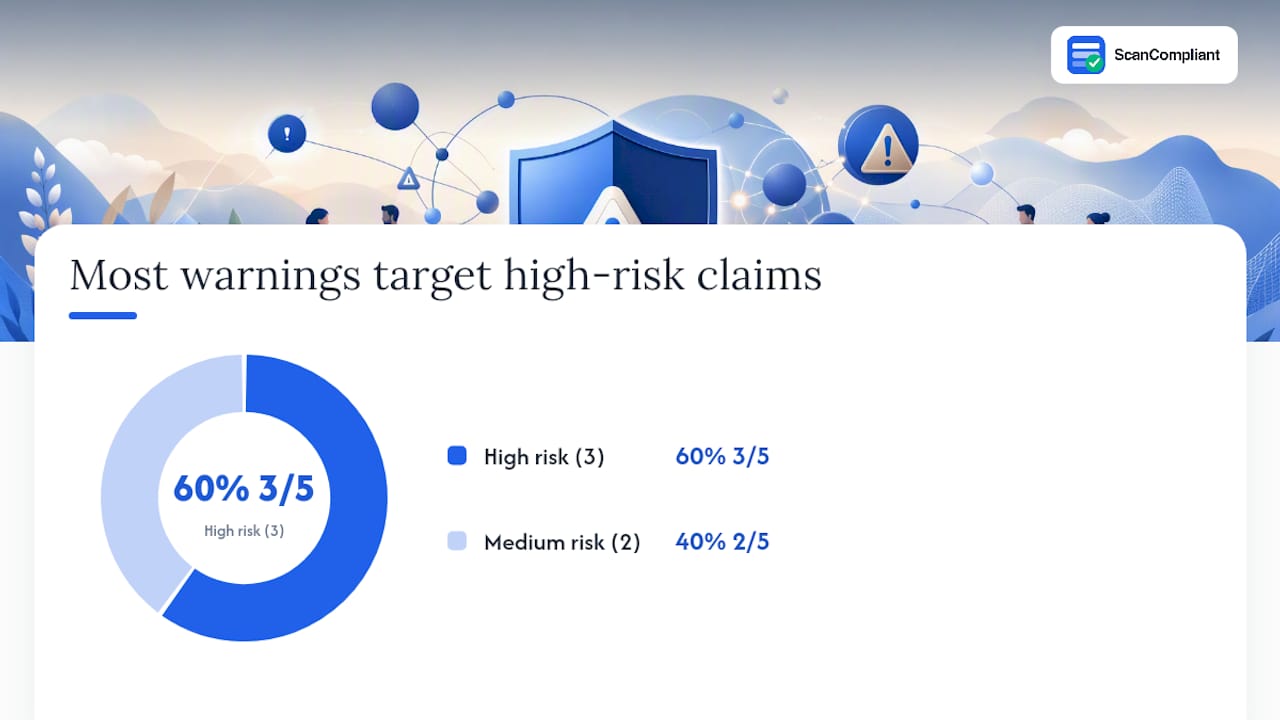
- High risk: Unsupported “clinically proven” or “scientifically proven” claims. The FTC has taken action against brands that used these phrases without RCT-level evidence. Consent decrees in this category have included multi-million-dollar civil penalties and mandated compliance monitoring programs.
- High risk: Implied disease-treatment claims in testimonials. Brands have faced enforcement when customer testimonials implied the product treated a diagnosed condition, even when the brand’s own copy avoided disease language.
- High risk: Undisclosed paid endorsements. The FTC’s endorsement rules require clear disclosure of material connections. Brands that paid influencers or provided free product without requiring disclosure have received warning letters and, in some cases, civil investigative demands.
- Medium risk: Misleading use of scientific literature. Citing a study that does not actually support the claim, or omitting a study’s limitations, is a recurring pattern in warning letters. The FTC examines whether the cited evidence actually supports the specific claim made.
- Medium risk: Implying FDA approval or endorsement. Phrases like “FDA-compliant,” “FDA-registered,” or “reviewed by the FDA” in a context that implies pre-market approval are common warning-letter triggers, particularly for supplement brands.
- Low risk (but rising): Platform-approved ads with non-compliant claims. Platform approval does not equal regulatory clearance. Brands that relied on Meta or Google ad approval as a compliance proxy have been surprised by FTC inquiries.
For a consolidated view of warning-letter triggers by claim type, the FDA warning letter trigger patterns documented in recent enforcement cycles are a useful internal reference.
Compliance is a growth lever, not a tax on creativity
The conventional framing in DTC marketing is that compliance slows content velocity. That framing gets the causality backwards. A single FTC civil investigative demand consumes more team hours than a year of pre-publication reviews. A consent decree that mandates a compliance monitor for 20 years reshapes every future marketing decision the brand makes.
The brands that treat substantiation as a content input rather than a legal obstacle end up with stronger claims, not weaker ones. If a claim cannot survive a substantiation review, it was never a claim worth making. And if the science genuinely supports the benefit, documenting that support takes minutes, not weeks, when the workflow is built correctly.
Scancompliant fits into that workflow at the point where human reviewers are most likely to miss something: the implied claim buried in a testimonial, the forbidden phrase in a headline variant, the missing DSHEA disclaimer on a post that went live before the process was formalized. Automation does not replace judgment. It makes judgment faster and more consistent.
How Scancompliant reduces enforcement risk before you publish
Scancompliant’s AI-powered platform scans blog posts, product pages, and social content against a database of more than 1,000 risk terms, flags implied claims human reviewers often miss, and suggests compliant rewrites in minutes. The platform generates an auditable sign-off trail for every scan, giving regulatory and legal teams the documentation they need if a regulator asks.

A team using Scancompliant can run a full claim scan on a new blog post, receive prioritized findings with plain-English explanations, and route only the high-risk flags to legal review, cutting review cycle time without cutting corners. For brands that publish frequently, that speed difference compounds into a material reduction in enforcement exposure over time. See how the platform fits your team’s workflow at Scancompliant or review subscription options to find the right tier for your team size.
Sources
This article is general information, not a substitute for advice from a qualified lawyer. Consult a qualified legal professional about your own circumstances before acting on anything here.