
Every piece of DTC health marketing content your team publishes needs a documented pre-publish compliance scan plus legal or regulatory sign-off before it goes live. That is the non-negotiable baseline. Three actions you can take in the next hour: run an AI-powered scan on your highest-traffic product pages for risky claim language; convert any product-outcome claim into a help-seeking or access-focused message where possible; and flag and hold any influencer copy that implies a specific clinical result. The FDA’s major-statement rule and the FTC Endorsement Guides both carry enforcement teeth, and Scancompliant is built specifically to catch the language that triggers them before it reaches a regulator.
Table of Contents
- How does FDA vs. FTC enforcement divide for DTC marketing?
- What content patterns trigger FDA, FTC, or platform enforcement?
- What are the rules by channel, with concrete examples?
- What evidence do you need to substantiate health claims?
- How do you control influencer content and consumer reviews?
- What do you do when the FDA or FTC flags your content?
- What does the end-to-end compliance timeline look like?
- What does FDA/FTC compliance actually cost?
- Key Takeaways
- Why automation changes the compliance risk calculus
- Scancompliant fits directly into this workflow
- Useful sources for your compliance team
How does FDA vs. FTC enforcement divide for DTC marketing?
FDA and FTC share jurisdiction over health advertising, coordinating through a formal liaison agreement. The split matters because your team needs to assign ownership clearly.
FDA owns labeling and product-claim accuracy for prescription drugs. If your ad names a specific drug and makes an efficacy claim, FDA’s Office of Prescription Drug Promotion (OPDP) is the relevant authority. The DTC major-statement final rule, effective November 20, 2024, sets binding standards for how risk information must be presented in TV and radio ads: readable text contrast, controlled audio pacing, and no distracting visuals during the disclosure window.
FTC owns advertising truthfulness, substantiation, and endorsements across all channels. The FTC Health Products Compliance Guidance requires that advertisers hold competent and reliable scientific evidence before a health claim goes live. FTC also defers to FDA’s scientific determinations, so a claim that fails FDA’s “significant scientific agreement” standard is presumed unsubstantiated under FTC law as well.
| Responsibility area | Primary owner | Sign-off required from |
|---|---|---|
| Clinical substantiation for product claims | Regulatory/Medical Affairs | Regulatory lead + Legal |
| Influencer and endorsement disclosures | Marketing/Legal | Legal |
| Privacy/pixel evaluation (HIPAA, state law) | Legal/Privacy | Privacy counsel |
| Audit trail and record retention | Regulatory/Compliance | Compliance officer |
| Consumer-review moderation policy | Marketing/Legal | Legal |
What content patterns trigger FDA, FTC, or platform enforcement?
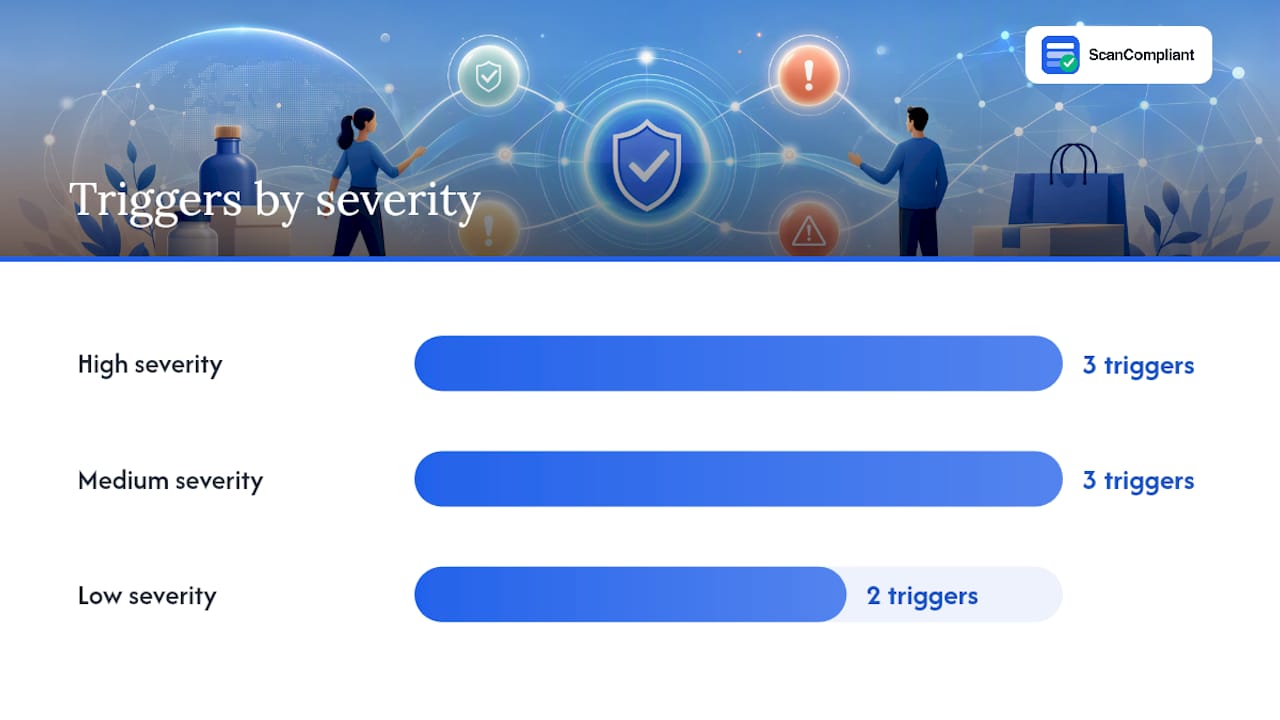
Think of this as a fast filter for creative review, organized by how quickly a finding can escalate.
High-severity triggers (hold and escalate to legal immediately):
- Naming an FDA-approved drug alongside efficacy language in a non-compliant format
- “Cure,” “cures,” or “cured” for any condition
- Implied equivalence between a compounded product and an FDA-approved reference drug
- Unsubstantiated outcome numbers (“lose 30 pounds in 30 days”)
Medium-severity triggers (flag for regulatory review before publish):
- Before-and-after imagery without typicality disclosures
- Testimonials implying results are typical without supporting data from randomized controlled trials (RCTs)
- Personalized health-state language (“If you have Type 2 diabetes, this is for you”)
Low-severity but common traps (remediate in copy before routing to legal):
- Casual performance words like “boost” or “optimize” that Meta and Google treat as medical claims in health verticals
- Privacy or data-use language that contradicts your published privacy policy
Pro Tip: Build a banned-phrase dictionary in your CMS or content tool. Terms like “cure,” “clinically proven,” and “FDA-approved” (when the product is not) should auto-flag before a writer even submits a draft.
What are the rules by channel, with concrete examples?
Channel context changes the compliance calculus significantly.
Web and product pages
Naming a prescription product on a product page triggers FDA product-advertising rules. The safest route for many telehealth brands is help-seeking creative: discuss the condition, direct the reader to a clinician, and avoid naming the drug. If you do name the drug, you must include adequate risk information and hold substantiation on file.
Paid social and search ads
Platform policy often enforces restrictions before FDA does. Meta prohibits before-and-after imagery and targeting based on inferred health conditions. Google restricts certain health-related ad formats by default. Safe patterns: access-focused CTAs (“Talk to a licensed provider”), educational framing, and condition-awareness messaging without product naming.
Influencer and social posts
The FTC’s plain-language influencer guide is clear: disclosures must be unavoidable and must match the format of the claim. A spoken claim needs an audible disclosure; a visual claim needs a visible one. Both together is dual-modality.
DTC TV and radio
The FDA’s CCN Q&A guidance specifies four primary standards: language comprehension, audio pacing, text contrast and duration, and avoidance of distracting elements during the major statement. Dual-modality presentation, where risk information appears both on screen and in audio simultaneously, is the compliance benchmark.
| Channel | Key rule | Sample compliant CTA |
|---|---|---|
| Web/product page | Help-seeking or full risk info | “Talk to your doctor about your options.” |
| Paid social | No before/after; no condition targeting | “Access licensed providers online.” |
| Influencer post | Dual-modality disclosure; typicality statement | “#Ad Results vary. Talk to a provider.” |
| DTC TV/radio | Major statement: clear, conspicuous, neutral | Audible + on-screen risk summary, no distractors |
| CAN-SPAM + FDA/FTC claim rules | Telehealth email compliance tips |
What evidence do you need to substantiate health claims?
The FTC Health Products Compliance Guidance sets the baseline: competent and reliable scientific evidence, held before the claim goes live. For most efficacy claims, that means RCTs. Observational data may support a claim only when paired with qualifying language (“in a preliminary study,” “results may vary”).
Structure/function claims for dietary supplements have different FDA notification requirements, but they still require substantiation under FTC standards. The FDA guidance on presenting quantitative efficacy and risk information recommends including absolute and relative frequencies, control-group data where applicable, and visual formats that improve consumer comprehension.
A claims registry is the operational tool that makes substantiation auditable. Every claim your team publishes should have a corresponding registry entry:
| Field | What to capture |
|---|---|
| Claim text | Exact language as published |
| Claim owner | Name and role of the person responsible |
| Evidence type | RCT, peer-reviewed paper, FDA-approved labeling |
| Study identifiers | PubMed ID, DOI, or internal study reference |
| Date reviewed | ISO 8601 format (YYYY-MM-DD) |
| Legal sign-off | Name, date, and signature of approving counsel |
| Retention period | Minimum 3 years; longer for prescription drug claims |
Store evidence files, consent forms, and RCT links directly alongside the claim ID. The compliance audit process for DTC brands should treat the registry as a living document, updated every time a claim is revised or retired.
How do you control influencer content and consumer reviews?
Contracts are your first line of defense. Every influencer agreement should require contemporaneous disclosure of any material connection, prohibit cure-language or comparative claims without documented substantiation, and mandate pre-approval of scripts before posting.
Monitoring cannot stop at contract signing. Run automated scans of creator posts after publication, sample ongoing content against the approved creative brief, and require creators to re-disclose if they post about the product again after the original campaign ends.
On consumer reviews, the FTC Endorsement Guides prohibit review gating (soliciting reviews only from customers you expect to be positive), selective upvoting, and suppression of negative reviews. Your moderation policy should be documented and applied consistently.
| Control | Requirement | Frequency |
|---|---|---|
| Script pre-approval | All influencer content before posting | Per campaign |
| Post-publish scan | Automated check against approved brief | Within 48 hours of post |
| Typicality disclosure | Required when results are not typical | Every testimonial post |
| Review moderation audit | Check for gating or suppression patterns | Quarterly |
What do you do when the FDA or FTC flags your content?
Speed and documentation are what matter most in the first 48 hours.
- Draft a written response — FDA warning letters typically expect a response within 15 working days. The response must acknowledge the violation, describe corrective actions already taken, and propose a remediation timeline.
- Conduct a content audit: review all live content for similar patterns, not just the flagged piece. HHS and FDA have signaled expanded enforcement targeting influencer partnerships, algorithmic ads, and AI-generated promotional content.
What does the end-to-end compliance timeline look like?
For a typical DTC health campaign, from brief to publish, here is a realistic timeline:
| Stage | Typical duration |
|---|---|
| Creative brief and claim drafting | 1–3 days |
| Initial automated compliance scan | Under 30 minutes |
| Writer remediation of flagged language | 2–3 days |
| Regulatory/Medical review (standard risk) | 1–2 business days |
| Legal review (high-risk or drug-named content) | 2–5 business days |
| Final compliance sign-off and ledger entry | Same day as legal clearance |
| Post-publish re-scan (high-traffic pages) | 30 days after launch |
Warning-letter response adds 15 working days minimum to any remediation cycle. Building the pre-publish workflow correctly compresses the front end of this timeline and makes the back end far less likely.
What does FDA/FTC compliance actually cost?
Compliance is not free, and underestimating the cost is a common planning error.
Legal fees: outside regulatory counsel for DTC health brands typically bills at rates that make ad-hoc review expensive at scale. Teams that route every piece of content through outside counsel without an automated pre-filter spend significantly more per asset than teams that use technology to triage first.
Technology: AI-powered compliance scanning platforms like Scancompliant operate on subscription SaaS pricing with tiered plans, making the per-asset cost predictable and far lower than equivalent attorney review time. Scancompliant’s pricing is structured for teams ranging from small regulatory departments to multi-brand agencies.
Internal resources: a dedicated compliance reviewer or regulatory affairs manager adds headcount cost but also reduces legal fees and enforcement risk. The benefits of automated compliance screening include freeing that person to focus on high-stakes decisions rather than routine claim checks.
Enforcement costs: a single FDA warning letter can require weeks of legal response time, a full content audit, and corrective advertising. FTC civil penalties for deceptive advertising can reach into the millions. The cost of prevention is a fraction of the cost of remediation.
Key Takeaways
Managing FDA/FTC compliance for DTC ecommerce marketing requires a documented pre-publish scan, a claims registry with legal sign-off, and channel-specific controls for influencers and consumer reviews.
| Point | Details |
|---|---|
| Pre-publish scan is mandatory | Every piece of DTC health content needs an automated compliance scan before any human review begins. |
| FDA and FTC divide enforcement | FDA owns drug-claim accuracy; FTC owns substantiation and endorsements — assign team ownership for both. |
| Claims registry prevents enforcement | Document every claim with evidence type, study ID, and legal sign-off; retain records for at least 3 years. |
| Influencer contracts must require disclosure | Require contemporaneous, dual-modality disclosures and pre-approval of all scripts before posting. |
| Scancompliant automates the scan step | Scancompliant’s platform detects 1,000+ risk terms and has protected 200+ brands, compressing review cycles from days to hours. |
Why automation changes the compliance risk calculus
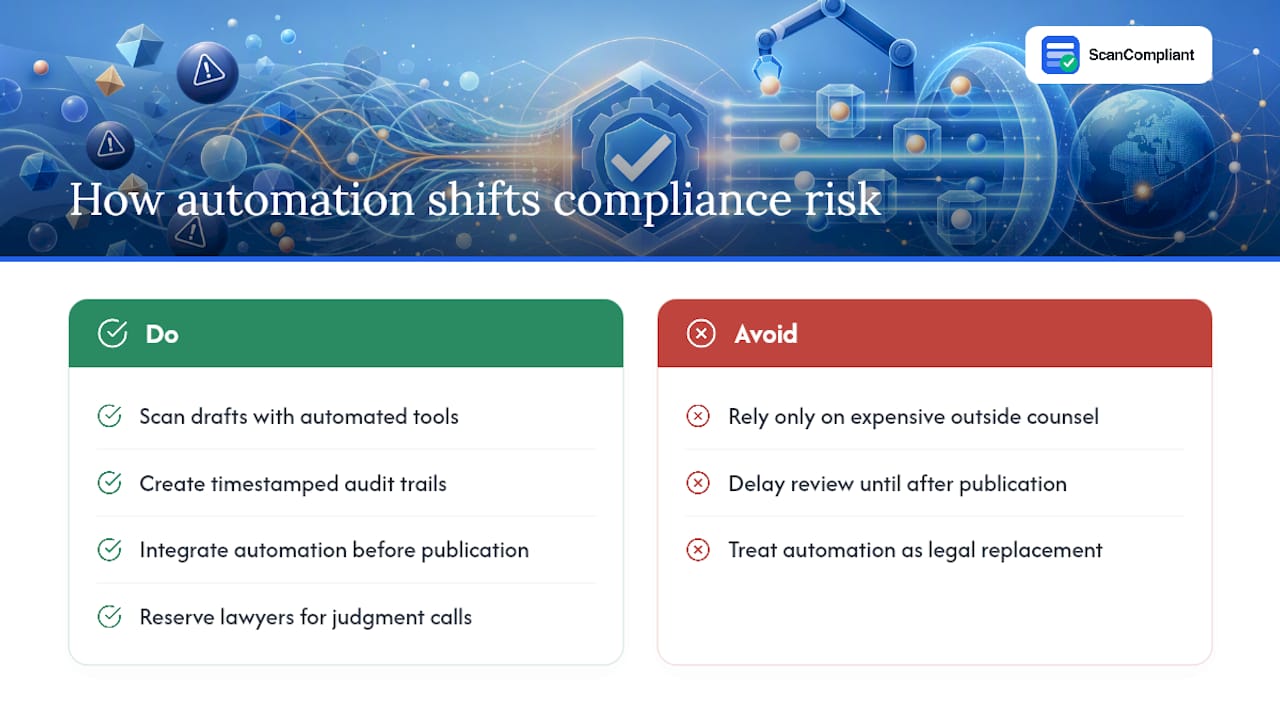
The conventional wisdom in DTC health compliance is that you need more lawyers. That framing misses the actual problem: most enforcement-triggering language is not a legal judgment call. It is a pattern-matching problem. “Cures,” “clinically proven,” implied sameness with an FDA-approved drug — these are detectable before a lawyer ever reads the copy. The question is whether your process catches them at draft stage or after publication.
Automated scanning catches implied claims that human reviewers miss under deadline pressure. It also creates a timestamped audit trail that is genuinely useful when a regulator asks what your review process looked like. The brands that fare best in enforcement inquiries are not the ones with the most expensive outside counsel. They are the ones with the most defensible documentation.
The other thing teams consistently underestimate: the cost of the emergency takedown. Pulling a campaign mid-flight, rewriting creative under pressure, and re-routing through legal review costs far more in lost media spend and team time than a systematic pre-publish process. Automation does not replace legal judgment. It makes legal judgment faster and more focused on the decisions that actually require it.
Scancompliant fits directly into this workflow
Catching a single high-risk claim before it reaches a regulator is worth more than months of reactive legal work. Scancompliant is built for exactly that moment: the pre-publish scan step that sits between creative completion and legal review.
The platform scans websites, social media content, product listings, and documents for FDA and FTC risk language, detects both explicit and implied claims, and returns prioritized findings in minutes with plain-English explanations and compliant rewrite suggestions. Every scan generates a documented compliance trail, so your legal team has a timestamped record of what was reviewed and when. With 1,000+ risk terms in its database and 200+ brands already protected, Scancompliant compresses the triage step that currently bottlenecks most DTC health content pipelines.
Start with a free trial at scancompliant.com and run your highest-risk product page through the scanner today.
Useful sources for your compliance team
- FTC: Endorsements & Testimonials: What People Are Asking (in plain language)
- FTC: Health Products Compliance Guidance
- FDA: Direct-to-Consumer Prescription Drug Advertisements: Presentation of the Major Statement in a Clear, Conspicuous, and Neutral Manner — Questions & Answers
- Federal Register: Direct-to-Consumer Prescription Drug Advertisements: Presentation of the Major Statement — Final rule
- HHS/FDA: Drug ad transparency fact sheet
- FTC: Endorsement Guides — 2023 revisions
- Federal Register Notice: Presenting Quantitative Efficacy and Risk Information in DTC Promotional Labeling and Advertisements — Guidance availability