
Before you publish any health marketing asset, run this fixed sequence: intake → triage → claim mapping & risk scan → medical review → legal/regulatory review → channel QA → final sign-off & audit trail → post-publish monitoring. These content review steps before health publishing are not optional for U.S. telehealth and DTC health brands. The FDA and FTC both hold brands accountable for every claim that reaches a consumer, and a missing substantiation document or an undisclosed material connection can trigger a warning letter or enforcement action.
TL;DR — do these in the next 15 minutes:
- Create a submission pack with asset name, channel, audience, claims inventory, and references attached.
- Map every explicit and implied claim to a primary source (NCT number, DOI, or FDA label section).
- Assign a named reviewer for Medical, Legal/Regulatory, and Marketing with a clear decision scope and deadline.
Table of Contents
- What does a complete intake and triage process look like?
- How should Medical, Legal, Regulatory, and Marketing each review content?
- How do you map claims and run a risk scan before reviewers see the asset?
- What does a thorough medical review actually check?
- How do FTC and FDA rules apply during legal and regulatory review?
- Does the destination channel change what you need to check?
- What goes into the final sign-off and audit trail?
- How do you monitor and remediate issues after publishing?
- Copy-and-use pre-publication checklist
- Key Takeaways
- The process design is the compliance strategy
- Scancompliant cuts pre-publication scan time from hours to minutes
- Useful sources and additional reading
What does a complete intake and triage process look like?
Incomplete submission packs are the single biggest cause of review delays. Treating every submission as a formal legal record from the start prevents the back-and-forth that kills launch timelines.
Required fields for every submission pack:
- Asset name, version ID, and owner
- Product or indication and target audience
- Destination channel (web, paid search, social, email, app store)
- Rendered mockup or final draft
- Claims inventory with a source reference for each claim
- Requested review deadline and escalation contact
Once the pack is complete, triage it into one of three risk tiers. Tiering content by risk reduces unnecessary full reviews and keeps high-volume queues manageable.
| Tier | Content type | Reviewer set | Target SLA |
|---|---|---|---|
| Low | General health education, no product mention | Editor + Compliance | 2 business days |
| Medium | Service or treatment mentions, testimonials | Editor + Medical + Legal | 3–4 business days |
| High | Product claims, GLP-1 or Rx mentions, comparative efficacy | Full MLR (Medical + Legal + Regulatory) | 5 business days |
Pro Tip: Build a pre-submission QC gate into your intake form. Block submission until all required fields are populated. This alone eliminates the most common rejection reason and cuts average cycle time.
How should Medical, Legal, Regulatory, and Marketing each review content?
The fastest review teams are not the ones with the most reviewers. They are the ones where each discipline has a defined decision lens and stays inside it.
- Medical: Evidence accuracy, study population alignment, endpoint language, safety statement completeness.
- Legal: Claims boundary, endorsement compliance, risk exposure, usage restrictions.
- Regulatory: Promotional classification, required disclaimers, channel fit, 21 CFR applicability.
- Marketing: Brand voice, audience appropriateness, CTA behavior, readability.
When scopes overlap, you get contradictory edits and extra rounds. A RACI model fixes this: Medical is responsible for clinical accuracy decisions; Legal is accountable for risk sign-off; Regulatory is consulted on channel-specific rules; Marketing is informed of final constraints. For most medium-tier assets, parallel review with a single shared comment record is safe and cuts handoff delays significantly. Sequential review is reserved for high-risk assets where a Medical decision must precede the Legal assessment.
Pro Tip: Use one shared comment document per asset. Assign every comment to an owner and a resolution status. Unowned comments are the primary source of conflicting edits.
For a deeper look at governance and RACI models, Scancompliant’s workflow guide covers role definitions in detail.
How do you map claims and run a risk scan before reviewers see the asset?
Every asset contains explicit claims (direct outcome statements) and implied claims (images, graphs, testimonials, or framing that suggests a benefit). Both are regulated. Build a claims inventory before the asset enters formal review.
For each claim, document: the exact language used, whether it is explicit or implied, the claim type (efficacy, safety, comparative, testimonial), and the primary source reference. Require a specific source identifier — an NCT number, DOI, or package insert section — and block review entry until references are attached and accessible.
High-risk claim triggers to flag immediately:
- Disease, diagnosis, treatment, or cure language
- Comparative efficacy claims without head-to-head data
- “Clinically proven” or “scientifically proven” without a cited study
- Before/after testimonials implying guaranteed results
- GLP-1 or prescription drug claims without fair balance
| Claim type | Regulatory trigger | Required substantiation |
|---|---|---|
| Efficacy claim | FTC substantiation standard | Competent and reliable scientific evidence |
| Disease/treatment claim | FDA drug/device promotion rules | Approved labeling or clinical data |
| Testimonial/endorsement | FTC Endorsement Guides | Disclosure of material connections; typical results |
| Comparative claim | FTC and FDA | Head-to-head data or qualified comparative basis |
| Safety claim | FDA labeling requirements | Label-consistent language; fair balance |
An automated risk-term scanner catches common triggers before reviewers open the file. Pre-approved content libraries with modular claim blocks let marketing reuse previously cleared language, which removes entire claim categories from the review queue.
Pro Tip: Every claim cell in your submission pack must carry a primary source link or an approved content-module ID. No source, no review entry. This rule alone prevents the most common substantiation gaps.

For guidance on integrating automated checks into your content pipeline, Scancompliant’s operational guide walks through gating rules and CMS setup.
What does a thorough medical review actually check?
Medical review is not a general read-through. It is a structured evidence audit. Reviewers should work from a checklist, not intuition.
Medical reviewer checklist:
- Does each efficacy claim match the cited study’s primary endpoint?
- Is the study population consistent with the target audience described in the asset?
- Are benefit statements limited to what the data actually shows (no extrapolation)?
- Are secondary sources (meta-analyses, reviews) backed by original study references when the claim is specific?
- Do benefit mentions include appropriate safety language or fair balance?
- Are preprints flagged and held pending peer review?
Document every Medical decision with a rationale. The record should state the claim reviewed, the source consulted, the decision (approved/modified/rejected), and the reviewer’s name and date.
Medical review standard: Before any content containing clinical information is published, one or more clinicians must confirm it is accurate, clinically safe, and reflects relevant evidence. Publication dates and review dates should both be displayed so readers and regulators can assess currency.
For rewrite guidance when claims need adjustment, Scancompliant’s editing guide for compliance covers common medical language corrections.
How do FTC and FDA rules apply during legal and regulatory review?
Legal and regulatory review runs on two parallel tracks: FTC advertising standards and FDA promotional guidance. Both apply to most telehealth and DTC health marketing.
Core legal checks (FTC):
- Every express and implied claim must be substantiated by competent and reliable scientific evidence before publication.
- Endorsements and testimonials must disclose material connections and reflect typical consumer experience.
- Pricing, savings, and comparison claims must be truthful and non-misleading.
Core regulatory checks (FDA):
- Classify the asset as promotional or non-promotional. Promotional materials for prescription drugs or devices trigger 21 CFR obligations including fair balance and, in some cases, FDA submission requirements.
- Confirm the asset does not make off-label claims for approved products.
- Verify platform-specific restrictions (e.g., character limits that prevent required disclosures from appearing in paid search).
Red flags requiring escalation to senior counsel:
- Any comparative efficacy claim against a named competitor
- Off-label use suggestions for Rx products
- Missing or truncated safety information in a promotional piece
- New drug or device promotion without confirmed regulatory status
Capture the legal rationale in the approval record and cite the governing guidance. A regulatory review checklist mapped to FDA and FTC standards keeps this step consistent across reviewers.
The FTC’s substantiation standard applies broadly. Building a compliance program with documented review procedures strengthens your defense if a claim is ever challenged.
Does the destination channel change what you need to check?
Yes, significantly. The same core claim may be compliant on a long-form web page and non-compliant in a paid search ad where character limits prevent required disclosures from appearing.
Channel-specific considerations:
- Website/landing pages: Full fair balance and disclosures can appear; check that required safety language is not buried below the fold.
- Paid search: Character limits often prevent full disclosure; avoid claims that require substantiation text the ad unit cannot display.
- Social media: Platform policies layer on top of FDA/FTC rules; PHI screening and clinical accuracy checks are required for user-generated or frontline content.
- App stores: Description copy is promotional material; disease claims in app store listings have triggered FDA scrutiny.
- Email: CAN-SPAM compliance plus any required health disclosures; unsubscribe mechanism must function.
Check accessibility at this stage. Alt text on images, readable font sizes, and logical heading structure are ADA considerations that also affect SEO and user trust.
| Channel | Top policy risk | Required mitigation |
|---|---|---|
| Paid search | Disclosure truncation | Limit claims to what fits with disclosure |
| Social (organic) | Platform health ad policies | Pre-screen against platform guidelines |
| App store | Disease/diagnosis claims | Remove or reclassify before submission |
| Missing unsubscribe + health disclosures | Template audit before send | |
| Web/landing page | Fair balance below fold | Place safety info above key CTA |
What goes into the final sign-off and audit trail?
The approved package is a legal record. If a regulator or plaintiff asks what was approved, when, and by whom, your answer lives here.
Final approved package must contain:
- Rendered final asset (PDF or screenshot with timestamp)
- Source files and version ID
- Claims inventory with references
- Approver names, roles, and approval dates
- Permitted channels and any audience constraints
- Expiration date or scheduled review date
Retain pre-approval drafts and all comment records. Scheduled review cycles and documented rationale for every approval decision are what make audit responses fast and credible.
Audit trail standard: The approval record should capture not just who approved the asset, but why specific language was permitted or changed. A record that shows only a name and date is insufficient for a regulatory inquiry — the rationale is the evidence.
For a deeper look at what auditors typically request, Scancompliant’s audit guide covers retention requirements and common documentation gaps.
How do you monitor and remediate issues after publishing?
Publishing is not the end of the review cycle. Monitoring is an ongoing obligation.
Monitoring plan:
- Social listening for consumer complaints or adverse event mentions
- Paid search query reviews for derivative or affiliate ads using your brand claims
- Web crawls to detect unauthorized republication of approved assets
- Complaint channel monitoring with a documented intake process
Immediate remediation steps when a regulator contacts you:
- Isolate the asset (take it offline or pause the campaign within one business day).
- Collect all evidence: the approved package, version history, and comment records.
- Notify Legal and Regulatory leads within 24 hours.
- Draft a preliminary response timeline and assign a response owner.
- Link all remediation actions back to the original approval record.
Retain post-publish event records with the same rigor as pre-publication approvals. Compliant content release practices include SLAs for remediation response that regulators expect to see documented.
Copy-and-use pre-publication checklist
Paste this into your submission form or workflow tool. Block submission until every item is checked.
Intake and triage:
- [ ] Asset name, version ID, and owner completed
- [ ] Channel and audience documented
- [ ] Risk tier assigned (Low / Medium / High)
- [ ] Rendered mockup or final draft attached
Claim mapping:
- [ ] Claims inventory completed (explicit and implied)
- [ ] Primary source reference attached for every claim (NCT, DOI, label section)
- [ ] Automated risk-term scan completed; findings reviewed
- [ ] Pre-approved content modules used where available
Reviewer assignments:
- [ ] Medical reviewer named and SLA confirmed
- [ ] Legal/Regulatory reviewer named and SLA confirmed
- [ ] Marketing reviewer named and SLA confirmed
Channel QA:
- [ ] Channel-specific disclosure requirements verified
- [ ] Accessibility checks completed (alt text, font size, heading structure)
- [ ] Platform policy review completed
Final sign-off:
- [ ] All reviewer approvals documented with names, roles, and dates
- [ ] Version ID and permitted channels recorded
- [ ] Audit package archived
Common risky phrases and compliant rewrites:
| Risky phrase | Compliant rewrite |
|---|---|
| “Cures [condition]” | “May help manage symptoms of [condition] — see full prescribing information” |
| “Clinically proven to work” | “Studied in a clinical trial — [cite study]” |
| “Guaranteed results” | “Results may vary — based on [study population]” |
| “Safe for everyone” | “Consult your healthcare provider to determine if this is right for you” |
Embed this checklist in your CMS or project management tool with required fields and automated routing rules. Automating the routing step based on risk tier eliminates manual assignment errors and keeps SLAs visible.
Key Takeaways
A complete, sourced submission pack is the single most effective intervention for shortening health content review cycles and reducing regulatory risk.
| Point | Details |
|---|---|
| Start with a complete submission pack | Incomplete packs cause most review delays; treat every submission as a formal legal record. |
| Assign defined decision lenses | Give Medical, Legal, Regulatory, and Marketing distinct scopes to prevent duplicate or conflicting feedback. |
| Map claims before review begins | Every explicit and implied claim needs a primary source reference attached before the asset enters formal review. |
| Run parallel review with one comment record | Parallel review with a single shared document cuts handoff delays without losing ownership or escalation paths. |
| Use Scancompliant for pre-submission scanning | Scancompliant’s AI scanner flags risk terms and suggests compliant rewrites before reviewers see the asset, protecting many brands. |
The process design is the compliance strategy
Most compliance teams focus on what to review. The teams that actually move fast focus on how the review is structured. Role clarity is not a bureaucratic nicety. When a Medical reviewer comments on brand voice or a Legal reviewer rewrites a clinical endpoint, you get extra rounds, conflicting edits, and a frustrated launch team. The defined decision lens model solves this at the structural level, not the personnel level.
The other underrated lever is the submission gate. Requiring a complete pack before review begins feels like friction. It is actually the opposite. A submission that bounces back for missing references costs two to three days. A submission that enters review complete moves straight through. Common manual review errors almost always trace back to an incomplete intake, not a difficult claim.
The “speed vs. compliance” framing is a false choice. Early Legal and Medical involvement, clear process design, and pre-approved claim modules accelerate reviews. The teams that treat compliance as a late-stage gate are the ones with unpredictable timelines and last-minute legal holds.
Scancompliant cuts pre-publication scan time from hours to minutes
Regulatory and marketing teams running the checklist above still face one bottleneck: manually scanning every asset for risk terms before it reaches reviewers. Scancompliant removes that bottleneck. The platform scans websites, social media, documents, and product listings against a database of over 1,000 risk terms, detects both explicit and implied claims, and delivers a prioritized risk queue with plain-English explanations and suggested rewrites in minutes.
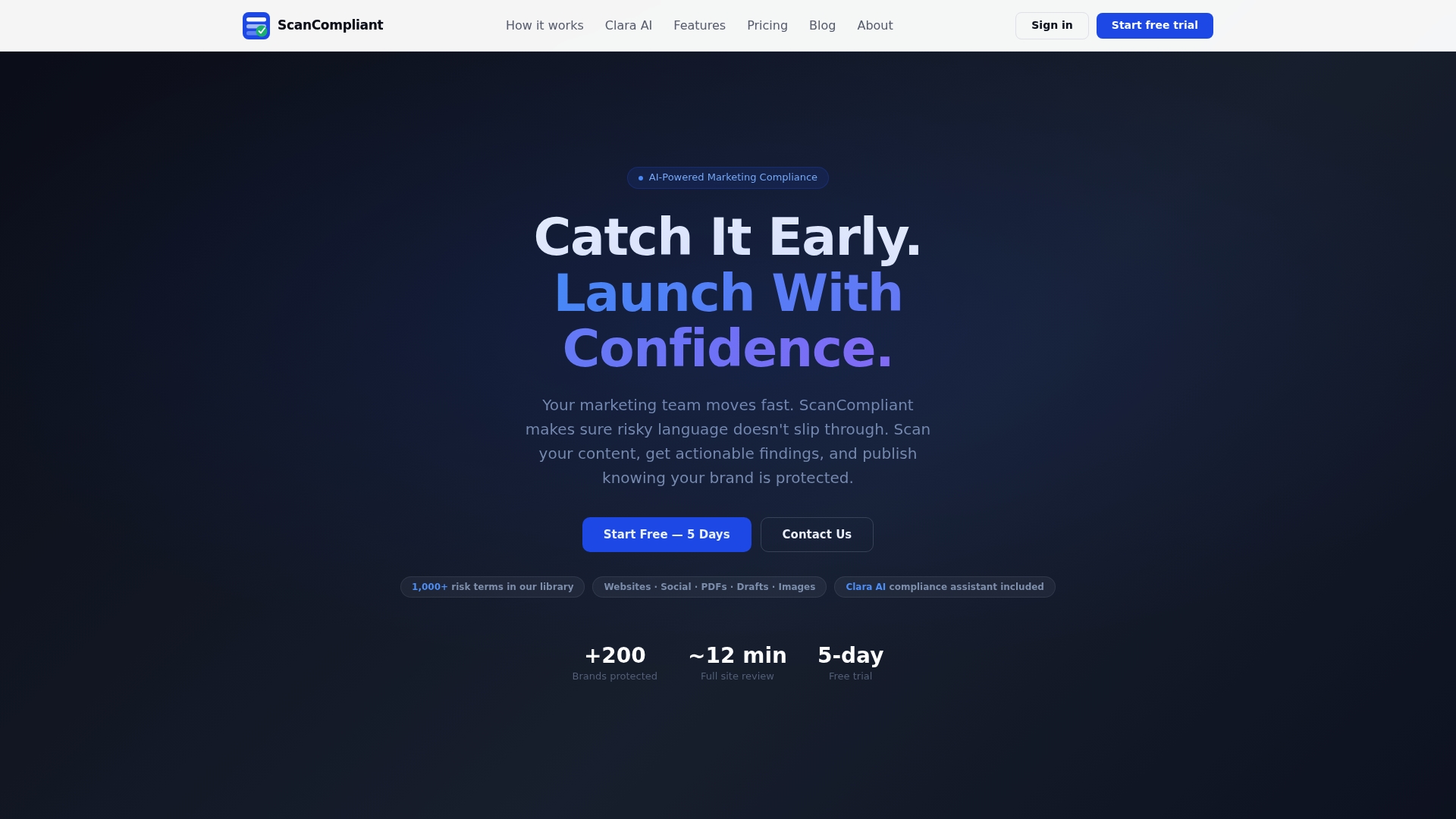
The workflow fit is direct: run a Scancompliant scan at the pre-submission stage, attach the findings report to the submission pack, and let reviewers focus on judgment calls rather than term hunting. The platform also exports a documented compliance trail that satisfies audit and regulatory inquiry requirements. Teams protecting GLP-1 or other high-risk product categories can use the GLP-1 compliance scanner for category-specific risk detection. See pricing and plan options to find the right tier for your team size.
Useful sources and additional reading
Primary U.S. regulatory references:
- FDA Promotional Labeling and Advertising — governing rules for prescription drug and device promotion
- FTC Advertising Substantiation Guidance — substantiation standards for health and efficacy claims
- FTC Endorsement Guides — disclosure requirements for testimonials and endorsements
Operational workflow resources:
- MLR Review Process: Reducing Bottlenecks — pre-submission QC and parallel review guidance
- Healthcare Content Approval Workflow — tier-based review model and shift-left practices
- MLR Review Process Guide — modular content libraries and reference validation
- Frontline Social Media Content Review — PHI screening and tiered SLAs for high-volume content
- Mayo Clinic Health Information Policy — scheduled review cycles and medical editor oversight
When to bring in external counsel: Escalate to outside regulatory or legal counsel when an asset involves a new drug or device claim, an off-label use question, a comparative efficacy claim against a named competitor, or direct regulator contact. Internal reviewers handle routine promotional review; novel legal questions require qualified external expertise. For cross-jurisdictional digital health regulation, digital health regulatory frameworks provides a useful comparative reference.
This article is general information for compliance and marketing practitioners, not legal or regulatory advice. Confirm current FDA and FTC requirements with a qualified regulatory attorney or your primary regulatory contacts for your specific products and channels.
3 Comments