
AI-powered pre-publication content review protects creators by catching FDA violations, FTC substantiation failures, platform policy breaches, and reputational risks before a single word goes live. For telehealth and DTC health brands, that protection is the difference between a compliant launch and a warning letter.
Here is what systematic pre-publication scanning delivers:
- Enforcement prevention: Flags disease claims, off-label language, and implied FDA approval before regulators see them.
- Rework reduction: Prioritized findings let marketing and legal teams fix the right things first, cutting revision cycles.
- Creator protection: Regulatory and marketing staff avoid disciplinary exposure when a documented sign-off trail shows due diligence.
- Audit defensibility: A timestamped compliance record for every asset gives counsel something concrete to hand regulators.
Pro Tip: Run a pre-publish scan on your highest-risk channels first: paid social ads and influencer briefs carry the most enforcement exposure and are the fastest wins.
Key Takeaways
Pre-publication AI content review is the most direct protection telehealth and DTC health brands have against FDA enforcement, FTC substantiation failures, and platform policy violations.
| Point | Details |
|---|---|
| FDA and FTC both apply | The FDA-FTC Liaison Agreement means one piece of copy can draw scrutiny from either agency simultaneously. |
| Risk-term database size matters | A database of more than 1,000 terms is the baseline for catching explicit and implied violations across claim types. |
| Audit trail is your legal defense | Timestamped reviewer sign-offs for every asset give counsel a defensible record when regulators inquire. |
| Role matrix prevents gaps | Assign explicit ownership: drafter, regulatory reviewer, medical reviewer, legal counsel, and final approver. |
| Scancompliant delivers findings in minutes | Prioritized results let teams fix the highest-severity claims first, cutting rework cycles and time to publish. |
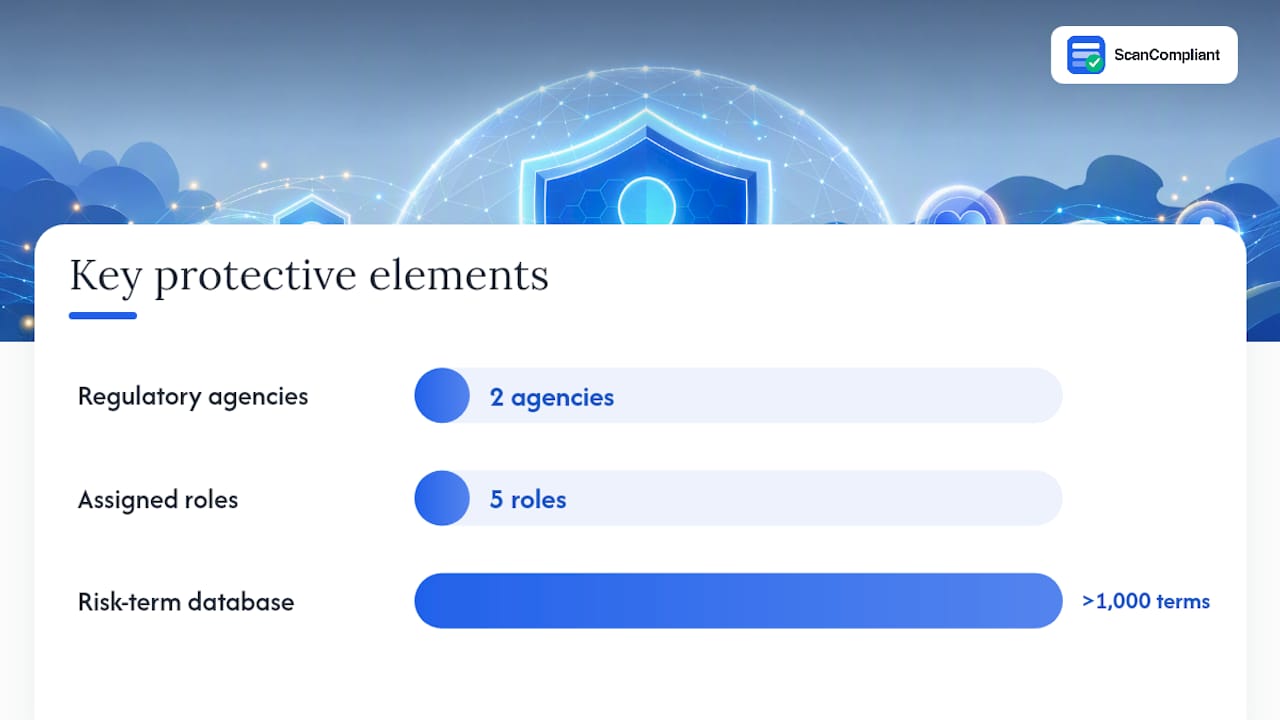
Table of Contents
- What risks does pre-publication content review actually protect you from?
- How AI-powered scanning detects risks before publication
- Where scanning fits in your publishing workflow
- Concrete outcomes you can measure after implementing content review
- Scancompliant in practice: what the platform does for your team
- How to evaluate a content-review solution: a vendor-grade checklist
- Red-flag language and safe rewrites you can apply right now
- Why pre-publication review matters more right now than it did two years ago
- Scancompliant gives your team a faster path to defensible compliance
- Sources
What risks does pre-publication content review actually protect you from?
The regulatory exposure for telehealth and DTC health brands comes from three directions at once, and most teams underestimate at least one of them.
Regulatory risks split between FDA and FTC jurisdiction. The FDA holds primary authority over labeling and point-of-sale materials; the FTC enforces advertising claims across every channel under a “competent and reliable scientific evidence” standard. Both agencies coordinate under a formal FDA-FTC Liaison Agreement, so a single piece of copy can draw scrutiny from either direction.
Risky claim types that trigger enforcement include:
- Disease claims that position a product as treating or curing a condition (a drug claim requiring FDA approval)
- Structure/function claims that cross into drug-claim territory through implication or context
- Unqualified efficacy statements lacking clinical substantiation
- Off-label promotion of prescription or compounded products
- Language or imagery that implies equivalence to an FDA-approved drug
Platform risks add a second layer. Meta and Google both enforce health advertising policies independently of regulators. Influencer posts that omit material connection disclosures violate FTC endorsement guides and can expose the brand, not just the creator. Suppressed or manipulated reviews carry their own advertiser liability under the revised FTC Guides.
Operational and reputational risks are where brands feel the pain longest. FDA warning letters trigger required corrective actions and can lead to consent decrees mandating pre-approval of future marketing. Lost ad account access on Meta or Google can halt an entire campaign overnight. Media coverage of an enforcement action compounds the damage well beyond the legal cost.
The enforcement signal is clear: in March 2026, the FDA issued 30 warning letters to telehealth companies for misleading marketing of compounded GLP-1 products, citing misbranding, implied FDA approval, and brand-adjacent terminology. Telehealth DTC marketing is a priority enforcement target right now.
How AI-powered scanning detects risks before publication
The mechanism is automated detection plus risk scoring plus human-in-the-loop review plus a documented audit trail. Each layer catches what the previous one cannot.
Detection works across three layers:
- Risk-term matching: A database of more than 1,000 terms flags explicit disease claims, drug-claim language, and prohibited phrases the moment they appear in copy.
- Pattern and context detection: Implied claims, comparative language (“works like Ozempic”), and imagery that suggests FDA approval are caught through contextual pattern analysis, not just keyword hits. The FTC’s guidance is explicit that regulators evaluate the full communication, including images and juxtaposition, not just text.
- Substantiation checks: Claims flagged as requiring clinical backing are surfaced with a note on what evidence standard applies, so reviewers know whether a randomized controlled trial is needed or whether a lower-evidence tier is defensible.
Findings arrive prioritized by risk level within minutes, not days. A reviewer opening the report sees the highest-severity items first: a disease claim in a headline ranks above a missing disclaimer in body copy. That ordering matters when a team has two hours before a campaign goes live.
Regulatory alignment is built into the scoring. Findings map to FDA categories (labeling, structure/function, off-label) and FTC concerns (substantiation, endorsement disclosure, review moderation). Reviewers see not just what is flagged but why it is flagged and which agency cares about it.
Pro Tip: When the scanner flags a claim, ask one question before escalating: does fixing it require a clinical judgment (escalate to a medical or regulatory SME) or a copy edit (marketing can handle it)? That single triage step cuts unnecessary legal review cycles.
Where scanning fits in your publishing workflow
Run scans pre-publication at the last edit gate and any time copy changes materially. A version that passed review last week may not pass today if a headline was rewritten.
Integration points to cover in your pipeline, following pre-publication review best practices:
- CMS pre-publish hook: Trigger a scan before any content moves from draft to scheduled.
- Social scheduler integration: Scan copy and creative assets before they enter the scheduling queue.
- PR distribution checkpoint: Press releases and media kits carry the same claim liability as ads; scan before distribution.
- Paid ad creative endpoint: Every ad variant, including image-text overlays, goes through a scan before trafficking.
The role matrix for sign-off should be explicit:
- Marketing drafter: Submits copy for scanning, remediates flagged copy-level issues.
- Regulatory reviewer: Reviews high-severity flags, confirms claim categorization.
- Medical reviewer: Signs off on any claim requiring clinical judgment.
- Legal counsel: Reviews findings with enforcement or consent-decree implications.
- Final approver: Documents sign-off in the audit trail before publication.
SLAs keep the process from becoming a bottleneck. Standard content (blog posts, organic social) typically clears in 15–24 hours. High-risk content (therapeutic claims, paid ads, influencer briefs) warrants a 48–72-hour window. Every version and every reviewer action should be timestamped in the audit log. For a detailed role and SLA framework, the compliance training guide for teams is worth reviewing before you build your matrix.
Pro Tip: Treat any material copy change as a new submission. “We already scanned this” is not a defense if the headline changed after sign-off.
Concrete outcomes you can measure after implementing content review
Pre-publication scanning produces measurable results across speed, risk, and cost. The content review workflow best practices from teams that have embedded scanning show faster cycles and fewer escalations as the clearest early wins.

Scancompliant delivers prioritized findings in minutes, giving teams a concrete baseline to measure against. Brands that have run a pre-publication audit baseline before deploying scanning consistently find more risky language in live content than they expected, which sets a clear before/after comparison.
To instrument measurement: run a baseline audit of currently live content, tag each finding by severity and claim type, then track the same metrics monthly after scanning is live. Link the audit trail to any incident (a platform takedown, a regulator inquiry) so you can demonstrate the review process was followed.
Scancompliant in practice: what the platform does for your team
Scancompliant has protected more than 200 brands by catching risky language before it reaches regulators, platforms, or the press. The typical outcome is fewer risky claims reaching live channels, faster sign-off cycles, and a documented compliance record that holds up when questions arise.
The platform’s core capabilities:
- AI risk-term database covering more than 1,000 terms, updated as enforcement priorities shift
- Prioritized findings delivered in minutes, with plain-English explanations of why each item is flagged
- Suggested compliant rewrites so marketing teams can remediate without waiting for legal
- A documented compliance audit trail for every asset, exportable for regulatory review or internal governance
The audit trail is the most underused feature in most compliance programs. When an FDA investigator or FTC staff attorney asks what your review process looked like for a specific piece of content, a timestamped log of who reviewed it, what was flagged, and what was changed is the difference between a defensible answer and a credibility problem.
Pro Tip: Use the audit trail proactively. Before a product launch, export the compliance log for your highest-risk assets and share it with legal counsel. It signals program maturity and gives counsel a head start if questions arise later.
How to evaluate a content-review solution: a vendor-grade checklist
Prioritize regulatory alignment, evidence-mapping, explainability, audit trails, and integrations. A tool that flags terms without explaining which regulation applies or what evidence would fix the gap is not a compliance tool; it is a spell-checker with extra steps.
Functional must-haves:
- Risk-term database of at least 1,000 terms with a documented curation and update process
- Implied and visual claim detection, not just keyword matching
- Claim-to-evidence mapping (flags which claims need RCT-level substantiation per FTC guidance)
- Prioritized findings so reviewers act on severity, not alphabetical order
- Plain-English explanations and suggested rewrites for each finding
- Customizable rules for brand-specific risk categories
Technical requirements:
- CMS, social scheduler, and digital asset management integrations
- API and webhook support for pipeline automation
- SSO and role-based access control
- Data retention and exportable audit logs
- Security and data handling documentation (review Scancompliant’s security policy as a benchmark)
Legal and operational requirements:
- Exportable audit reports with timestamps and reviewer actions
- Human-review workflow with documented sign-off steps
- Scanning latency SLA (minutes, not hours, for standard content)
- Regulatory update cadence (how often the risk-term database is refreshed)
- Reviewer training resources and onboarding support
For a full feature-level comparison framework, the marketing compliance software features guide covers the technical criteria in detail.
Red-flag language and safe rewrites you can apply right now
Examples are ordered by enforcement frequency. Disease claims and implied FDA approval appear most often in warning letters; unqualified efficacy statements are the most common FTC substantiation target.
- Red flag: “Treats type 2 diabetes” / Compliant rewrite: “Supports healthy blood sugar levels already within normal range” — the original is a disease claim requiring drug approval; the rewrite is a structure/function claim that requires substantiation but not drug approval.
- Red flag: “FDA-approved formula” (for a compounded product) / Compliant rewrite: “Compounded by a licensed pharmacy” — implying FDA approval for a compounded drug is a documented enforcement priority.
- Red flag: “Clinically proven to cause rapid weight loss” / Compliant rewrite: “In a 12-week study, participants lost an average of X lbs” — “clinically proven” is unqualified and unverifiable; a specific cited study is substantiable.
- Red flag: “Thousands of customers say this cured their condition” (testimonial) / Compliant rewrite: “Customers report feeling better” with a disclaimer that results vary — the original implies general effectiveness and may violate FTC endorsement rules.
- Red flag: Before-and-after imagery showing dramatic transformation without a results disclaimer / Compliant rewrite: Same imagery with “Results not typical. Individual results may vary” clearly visible.
Pro Tip: For short-form social copy where character limits make full fair-balance impossible, apply this three-question test: Does the claim name a disease? Does it imply FDA approval? Does it promise a specific outcome? A “yes” to any one means the post needs a rewrite before it goes live.
Why pre-publication review matters more right now than it did two years ago
The enforcement environment has shifted in a way that makes pre-publication scanning less optional and more foundational. The FDA’s March 2026 wave of 30 warning letters to telehealth companies over GLP-1 marketing is not an anomaly. It is a signal that regulators have built the infrastructure to monitor DTC health marketing at scale and act on it quickly.
The FTC has simultaneously updated its endorsement guides and sharpened its substantiation expectations, making it harder to rely on a DSHEA disclaimer or a single small study to defend a health claim. Brands that treat compliance as a post-publication cleanup problem are operating on a timeline that no longer exists.
The Compliant Team’s view: the brands that will avoid enforcement in the next 24 months are the ones building review into the workflow now, not scrambling to retrofit it after a warning letter arrives. That means a documented process, trained reviewers, and a tool that maps findings to the specific regulatory standard that applies. The cultural shift is from “legal will catch it” to “we catch it before legal ever sees it.”
Scancompliant gives your team a faster path to defensible compliance
Regulatory and marketing teams publishing health content face a straightforward problem: the gap between what sounds compelling and what is legally defensible is narrower than most copy writers realize, and the cost of getting it wrong has never been higher.
Scancompliant closes that gap before publication. The platform scans websites, social copy, ad creative, and product listings against a database of more than 1,000 risk terms, returns prioritized findings in minutes, and generates a documented audit trail for every asset reviewed. More than 200 brands have used it to catch the claims that human reviewers miss under deadline pressure.
For teams managing GLP-1 programs or other high-risk therapeutic categories, the GLP-1 compliance scanner is the fastest way to assess current exposure. For a full platform trial or demo, visit Scancompliant and start with your highest-risk channel.
Sources
These are the primary regulatory and industry documents that underpin the guidance in this article. Use them for legal substantiation, enforcement signals, and operational checklists.
- Health Products Compliance Guidance | Federal Trade Commission
- Revised Guides Concerning the Use of Endorsements and Testimonials in Advertising (Federal Register)
- GLP‑1 Compliance: FDA targets telehealth marketing in 30 new warning letters | Foley & Lardner LLP
This article is general information, not a substitute for advice from a qualified doctor. Consult a qualified healthcare professional about your own circumstances before acting on anything here.
Recommended
- Regulatory Review Checklist for Healthcare Marketing – scancompliant.com
- Telehealth Email Marketing Compliance Tips for 2026 – scancompliant.com
- Content Review Workflow Best Practices for Healthcare Teams – scancompliant.com
- Pre-Publication Health Content Review Steps for Compliance Teams – scancompliant.com