
Misleading health claims are marketing statements, express or implied, that falsely or inadequately substantiate prevention, treatment, or cure messaging and create legal risk under FTC and FDA rules. If your brand publishes health-related advertising in the United States, the FTC Health Products Compliance Guidance and FDA labeling standards apply to you. Three actions to take right now:
- Pause any claim that asserts disease prevention, treatment, or cure without documented RCT-level evidence.
- Preserve all evidence supporting current claims, including study reports, approval emails, and creative archives.
- Run a substantiation check using a structured review process or a tool like Scancompliant before the next publish cycle.
Key Takeaways
Misleading health claims create enforcement risk under both FTC and FDA authority, and the most effective protection is a gated claim-review workflow with documented substantiation at every step.
| Point | Details |
|---|---|
| FTC substantiation standard | High-quality RCTs are typically required for disease-prevention or treatment claims under the Health Products Compliance Guidance. |
| Net impression governs | The FTC evaluates the overall consumer impression, not just literal claim text, so imagery and context count. |
| Document everything | Maintain a claim file with study links, reviewer sign-offs, and decision rationale, including negative findings. |
| Remediation sequence | When contacted by regulators, preserve records first, pause the claim second, then notify counsel before any other action. |
| Scancompliant | Automated pre-publish scanning flags risky language and generates audit trails, reducing review cycle time for teams managing high claim volume. |
Table of Contents
- Why misleading health claims put telehealth and DTC brands at serious risk
- What the FTC and FDA actually require from your marketing team
- Common red flags: claim types and language patterns that draw scrutiny
- How to evaluate a health claim before it publishes
- What counts as adequate evidence: study design basics for marketers
- How channel and format change your compliance risk
- What to do when the FTC or FDA contacts you
- How to embed claim review into your content workflow
- The compliance failure most teams don’t see coming
- Scancompliant reduces enforcement risk before content goes live
- Sources
Why misleading health claims put telehealth and DTC brands at serious risk
Regulatory enforcement is not theoretical. The FTC can seek injunctions, corrective advertising orders, and financial remedies. The FDA can issue warning letters, demand label changes, and refer cases for criminal prosecution. Reputational damage from a public enforcement action often outlasts the legal resolution.
Three enforcement cases illustrate what typically goes wrong:
Dannon/Activia. The FTC complaint against Dannon alleged that Activia and DanActive advertising implied the products reduced the likelihood of colds and flu and relieved irregularity, without adequate substantiation. Dannon’s studies had non-significant results that were not disclosed to consumers.
POM Wonderful. The Commission’s POM Wonderful decision found that implied disease-treatment claims in beverage advertising were unsupported, and that the company misrepresented the strength of its clinical evidence. The Commission required clinical substantiation before future disease claims could run.
Garcinia Cambogia. FTC complaints against weight-loss supplement advertisers alleged unsubstantiated efficacy claims and fabricated reviews, citing violations of Sections 5(a) and 12 of the FTC Act.
Common business consequences: mandatory stop-sell orders, corrective advertising campaigns, disgorgement of revenue, and multi-year compliance monitoring.
What the FTC and FDA actually require from your marketing team
The FTC requires “competent and reliable scientific evidence” for health-related advertising claims; the FDA controls product labeling and DTC prescription drug promotion under separate statutory authority. Both agencies apply independently, and satisfying one does not satisfy the other.
For the FTC, “competent and reliable scientific evidence” means well-designed studies conducted by qualified researchers. For disease-prevention or treatment claims, the FTC Health Products Compliance Guidance makes clear that high-quality randomized, controlled human clinical trials are generally expected. The FDA’s benchmark of “significant scientific agreement” is treated as a useful reference point: claims that fall short of that standard are likely deceptive unless limitations are clearly and conspicuously disclosed.
| Claim type | Governing authority | Evidence standard |
|---|---|---|
| Advertising (all health products) | FTC | Competent and reliable scientific evidence; RCTs typically required for disease claims |
| Product labeling | FDA | Significant scientific agreement for health claims; structure/function claims must be truthful and not misleading |
| DTC prescription drug promotion | FDA (with FTC overlap) | Fair balance; quantitative efficacy and risk presentation per FDA DTC guidance |
Note that structure/function claims on a label do not automatically pass FTC scrutiny in advertising. The FTC applies its own substantiation test, which can be stricter.
Pro Tip: Have legal and clinical reviewers agree in writing on the minimum evidence threshold for each claim category before content is drafted. Retroactive threshold-setting after a claim is already live is one of the most common compliance failures.
The FDA DTC quantitative guidance recommends presenting control-group outcomes alongside treatment outcomes, using absolute frequencies or percentages, and avoiding formatting that obscures risk information.
Common red flags: claim types and language patterns that draw scrutiny
The most common enforcement triggers are disease claims, “clinically proven” language, risk-reduction statements, before/after imagery, and testimonials that imply generalizable results. Any of these, expressed or implied, can constitute a misleading health claim.
Red-flag patterns to audit in every asset:
- Express disease claims: “Treats,” “cures,” “prevents,” or “reduces the risk of” any named condition. Example: “Our supplement prevents diabetes.”
- Implied disease claims: Imagery of a person recovering from illness paired with product branding, even without explicit text.
- “Clinically proven” or “clinically tested”: High-bar language that will draw scrutiny if the underlying study lacks between-group statistical significance or if data were selectively reported.
- Misuse of FDA terms: Calling a supplement “FDA-approved” when only the facility is registered, or using “GRAS” in a way that implies broader safety endorsement than the designation covers.
- Testimonials implying typical results: A customer saying “I lost 30 pounds in 30 days” without a clear, conspicuous disclosure that results are not typical.
- Before/after imagery: Visual comparisons that imply a treatment outcome without adequate substantiation of the depicted result.
- Fake or undisclosed paid reviews: Fabricated reviews and undisclosed material connections between endorsers and brands are deceptive under FTC rules and have been cited in enforcement complaints.
How to evaluate a health claim before it publishes
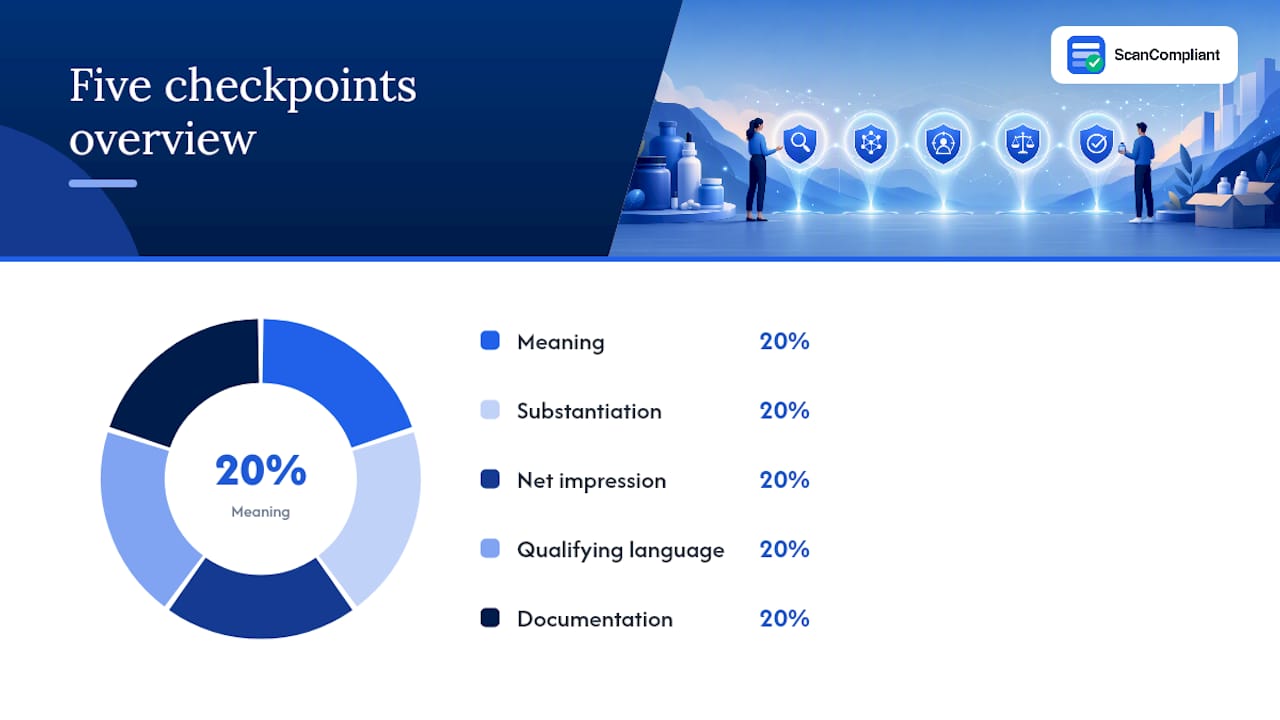
Every health-related claim should clear five checkpoints: meaning, substantiation, net consumer impression, qualifying language, and documentation.
- Identify the express and implied meaning. Write out every reasonable interpretation a consumer could take from the claim, including from imagery, headlines, and surrounding copy.
- Map to product-specific evidence. Match each interpretation to a specific study conducted on the actual product (not a similar ingredient in a different formulation).
- Assess study quality. Does the study have a randomized control group, pre-specified endpoints, and statistically significant between-group results? Is the effect clinically meaningful?
- Decide: publish, qualify, or withdraw. If evidence is strong, publish with appropriate qualifiers. If evidence is suggestive but limited, add clear disclosures. If evidence is absent or weak, withdraw the claim.
- Document the decision. Record the claim text, supporting studies, reviewer names, and the rationale, including why any borderline claim was approved or rejected.
A regulatory review checklist can standardize this process across your team.
Pro Tip: Document negative findings. If a study showed no significant effect and you chose not to use it, record that decision. Regulators routinely ask whether advertisers were aware of contradicting evidence.
What counts as adequate evidence: study design basics for marketers
The FTC expects high-quality RCTs for disease-prevention and treatment claims. Understanding what that means in practice keeps marketing teams from accepting weak evidence as sufficient.
Minimum study design elements to verify before accepting a study as substantiation:
- Randomization: Participants assigned to treatment and control groups by chance, not self-selection.
- Control group: A placebo or active comparator group run concurrently.
- Pre-specified endpoints: The primary outcome defined before data collection, not chosen after results are in.
- Statistical significance between groups: The treatment group must outperform the control group at a recognized significance threshold, not just show within-group improvement.
- Clinical meaningfulness: A statistically significant result that is too small to matter to patients does not support a strong efficacy claim.
- Adequate sample size: Underpowered studies that happen to reach significance are a known enforcement trigger.
Two additional cautions: p-hacking (testing multiple endpoints and reporting only the significant ones) and selective reporting of favorable trial arms have both appeared in FTC enforcement records. Animal or preclinical data alone cannot substantiate consumer-facing efficacy claims.
How channel and format change your compliance risk
Format and context shape the “net impression” a consumer takes from an ad, and the FTC evaluates the net impression, not just the literal text. A landing page that pairs a before/after photo with a headline like “Feel like yourself again” can imply a disease-treatment claim even if no explicit claim appears.
Channel-specific risks to manage:
- Search ads and meta descriptions: Short character limits make qualifying language nearly impossible. A snippet that reads “Reverses insulin resistance” is a disease claim regardless of what the landing page says.
- Social carousels and Reels: Sequential frames can build an implied claim across slides. Each frame must be evaluated as part of the whole sequence.
- Influencer posts: The FTC requires clear, conspicuous disclosure of material connections. “#ad” buried in a hashtag string does not meet the standard.
- Review platforms: Soliciting or incentivizing reviews without disclosure, or suppressing negative reviews, is deceptive under FTC rules.
The FDA DTC guidance recommends absolute frequencies and control-group data when presenting quantitative efficacy information. For telehealth brands running email campaigns, channel-specific compliance controls reduce the risk of implied claims slipping through in subject lines or preview text.
Pro Tip: Archive every version of a creative asset, including the approval metadata (who approved it, when, and against which substantiation file). Net-impression analyses during an inquiry depend on what the ad actually looked like at the time it ran.
What to do when the FTC or FDA contacts you
Preserve evidence, pause the challenged claim, notify counsel, and prepare a remediation plan. That sequence matters because destroying or altering records after an inquiry begins creates separate legal exposure.
- Preserve all records related to the challenged claim: studies, approval emails, creative files, media placements, and any internal communications about the claim’s substantiation.
- Stop distribution of the challenged claim across all channels immediately.
- Assemble clinical and legal review of the full claim file to assess the strength of existing substantiation.
- Prepare corrective language if the claim cannot be substantiated, including any required disclosures or retractions.
- Document every remediation step with timestamps and reviewer sign-offs.
- Implement follow-up monitoring to confirm the claim is removed from all active placements, including third-party retailer pages and cached search results.
The Dannon and POM Wonderful cases both resulted in corrective advertising requirements and ongoing compliance monitoring. Early, documented remediation typically produces better outcomes than delayed response.
How to embed claim review into your content workflow
The single most effective operational control is a gated claim-review process with defined approval thresholds and an indexed audit trail for every published claim.
| Role | Gate responsibility | Threshold |
|---|---|---|
| Content owner | Drafts claim; flags health-related language | All health-related language flagged before review |
| Clinical reviewer | Assesses study quality and claim-evidence match | Required for any efficacy or disease-adjacent claim |
| Legal reviewer | Evaluates FTC/FDA compliance and net impression | Required before any external publication |
| Compliance owner | Maintains claim file; tracks remediation | Signs off on final claim file and archive |
| Executive sign-off | Required for disease claims or novel claim categories | Any claim referencing prevention, treatment, or cure |
Automated scanning tools fit at the content-owner gate, surfacing risky language before clinical and legal reviewers spend time on it. Scancompliant’s database of over 1,000 risk terms flags explicit and implied claims, prioritizes findings by risk level, and generates a documented review record. Teams running GLP-1 marketing programs have used this triage approach to focus scarce clinical review time on the highest-risk language first.

Pro Tip: Set SLAs for each review gate (e.g., 48 hours for clinical, 24 hours for legal on standard claims). Undefined review timelines are the most common reason marketing teams bypass compliance gates under deadline pressure.
The compliance failure most teams don’t see coming
The most common failure mode is not a reckless disease claim. It’s a vague study reference that sounds substantiated but isn’t. But if the only study is a small, uncontrolled pilot with no between-group comparison, that qualifier does nothing to reduce enforcement risk.
Three patterns that show up repeatedly in enforcement records: over-reliance on study language that doesn’t survive scrutiny, under-documentation of the review decision, and review cycles so slow that marketing teams route around them. The fix for the first is a mandatory study-quality checklist at the clinical gate. The fix for the second is a standardized claim file. The fix for the third is automated pre-screening that catches obvious red flags before the asset reaches clinical review.
Teams that have adopted pre-publish scanning report shorter review cycles because reviewers spend less time on low-risk language and more time on the claims that actually need judgment. Executive dashboards showing claim-file completion rates create accountability without adding headcount. Brief quarterly training on new enforcement examples keeps the team calibrated to current FTC and FDA expectations.
Scancompliant reduces enforcement risk before content goes live
Catching a risky claim after publication costs far more than catching it before. Scancompliant scans websites, social posts, product listings, and documents for explicit and implied health claims, then delivers prioritized findings in minutes with plain-English explanations and suggested rewrites.
The platform flags over 1,000 risk terms, distinguishes high-risk from low-risk language so clinical and legal reviewers focus where it matters, and generates a timestamped audit trail that satisfies the contemporaneous-record standard regulators request during inquiries. More than 200 brands have used it to reduce review cycle time and document compliance decisions at scale.
Evaluate Scancompliant against your current workflow: check pricing and plan options and Scancompliant to see how pre-publish scanning fits your team’s approval gates.
Sources
Start with these official FTC and FDA documents and the cited enforcement complaints.
- Health Products Compliance Guidance | Federal Trade Commission
- Presenting Quantitative Efficacy and Risk Information in Direct-to-Consumer Promotional Labeling and Advertisements; Guidance for Industry
4 Comments