
Remove or clearly qualify any language that implies FDA approval, guarantees clinical outcomes, or misstates pricing before you do anything else. That single action stops the bleeding. Then run a documented remediation workflow to replace, qualify, or remove every flagged claim across your full content surface.
Three immediate triage steps:
- Take down or hide the live copy. Unpublish the page, set it to noindex, or replace it with a placeholder while edits are in review. Live non-compliant copy accumulates risk every hour it stays up.
- Flag for expedited legal and scientific review. Do not let marketing self-approve the fix. Route the flagged content to regulatory counsel and a qualified scientist before republishing.
- Document the action in your audit trail. Record what was live, when you took it down, who flagged it, and what the next step is. This record matters if the FDA or FTC asks what you did and when.
Pro Tip: The FTC’s Health Products Compliance Guidance treats express and implied claims identically. A product page that never says “FDA-approved” can still imply it through imagery, layout, or proximity to drug names. Flag both.
Key Takeaways
Correcting non-compliant product descriptions requires immediate triage, a documented remediation workflow, and governance controls that prevent the same violations from republishing.
| Point | Details |
|---|---|
| Triage first | Take down live non-compliant copy, flag for legal/science review, and document the action before anything else. |
| Risk-score your inventory | Assign critical, high, or standard priority to every flagged item so the most dangerous claims get fixed within 24–72 hours. |
| Match evidence to claim type | FTC’s 2022 guidance requires randomized controlled human clinical trials for many efficacy claims; testimonials do not substitute. |
| Govern before you publish | SOPs with scientific, legal, and marketing sign-off, plus a pre-publish automated scan, stop violations before they go live. |
| Scancompliant automates the audit trail | The platform scans for over 1,000 risk terms, prioritizes findings, and logs every correction for agency-ready documentation. |
Table of Contents
- What edits reduce enforcement risk right now?
- How to run a full remediation workflow
- How do you evaluate express vs. implied claims?
- Before/after rewrite examples for common violations
- Auditing influencer content, testimonials, and third-party pages
- How to respond to FDA warning letters and FTC investigative demands
- Prevention: governance and controls that stop problems before they publish
- How Scancompliant speeds up corrections and preserves your audit trail
- The compliance mindset most teams get wrong
- Scancompliant catches what manual review misses
- Sources
What edits reduce enforcement risk right now?
Start with the highest-signal violations. These edits take minutes and materially lower your exposure:
- Remove FDA-approval language. Phrases like “FDA-approved formula,” “approved by the FDA,” or any claim that a compounded product is equivalent to an approved drug must go. In March 2026, the FDA sent warning letters to roughly 30 telehealth companies specifically for GLP-1 marketing that implied equivalence to approved drugs.
- Strip disease and treatment claims. “Treats insulin resistance,” “reverses metabolic syndrome,” and similar phrases are drug claims under the FDCA. Replace with structure/function language: “supports healthy blood sugar levels already in the normal range.”
- Remove guaranteed outcomes. “Lose 30 pounds guaranteed” or “clinically proven to work for everyone” cannot be substantiated for an entire population. Cut the guarantee; qualify the claim.
- Fix pricing and inclusion misrepresentations. Hidden fees, undisclosed membership requirements, and “free consultation” language that buries costs are FTC enforcement triggers. The FTC complaint against NextMed illustrates exactly this pattern.
For any qualifier you keep, proximity and prominence matter. The qualifier must appear immediately adjacent to the claim, in the same font size and contrast as the claim itself, not buried in a footnote or a separate page.
Pro Tip: Run a find-and-replace for “proven,” “guaranteed,” “FDA-approved,” “cure,” “treat,” and “eliminate” across every product page before your next publish cycle. These terms are the fastest path to a warning letter.
How to run a full remediation workflow
A repeatable workflow prevents the same violations from resurfacing after the initial fix.
- Build a content inventory. Scope every surface: product pages, landing pages, FAQs, social posts, influencer content, packaging images, and labels. Map each URL or asset to the claim it contains and the regulatory venue it falls under (FDA-governed labeling vs. FTC-governed advertising). These are not the same standard, and compliance in one does not automatically satisfy the other.
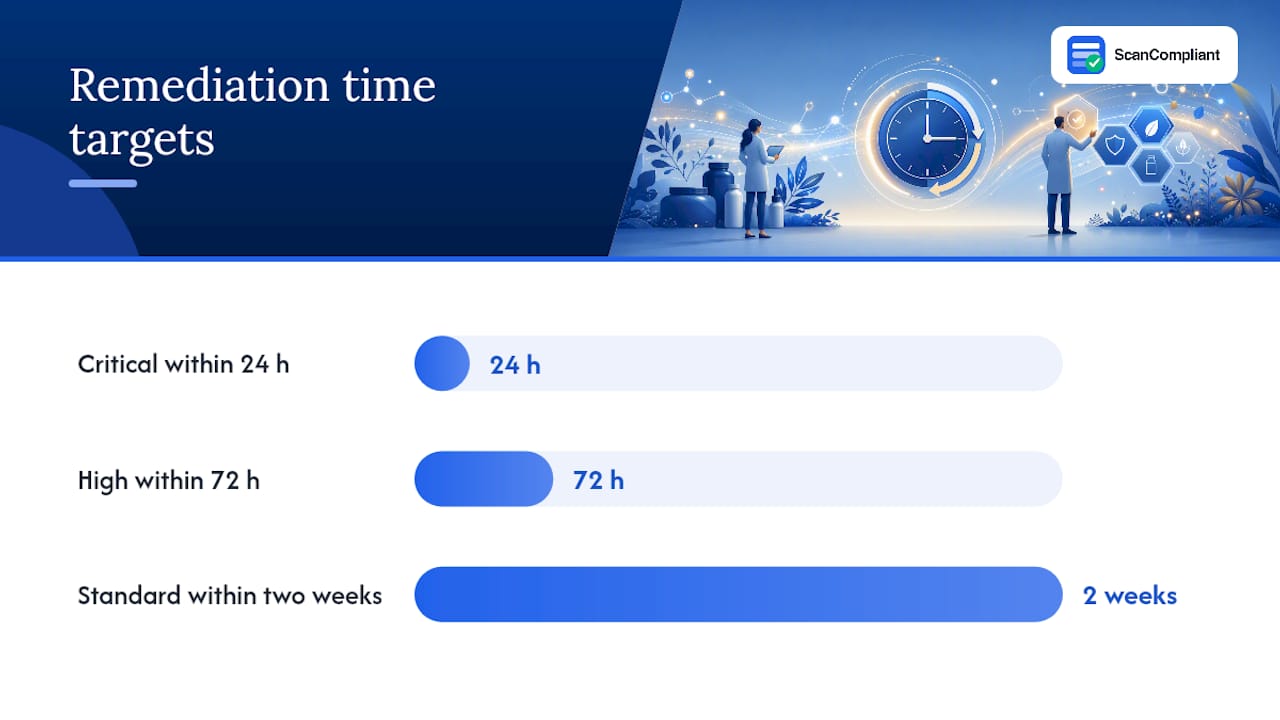
- Risk-score each item. Assign a score based on claim severity (disease claim = critical; vague efficacy = moderate), audience reach (homepage vs. archived blog), and enforcement precedent. A DTC brand compliance audit process typically uses three bands: critical (fix within 24 hours), high (fix within 72 hours), and standard (fix within two weeks).
- Prioritize and assign. Critical items go to regulatory counsel immediately. High items go to the legal/science review queue. Standard items enter the normal content revision cycle.
- Edit, review, and approve. Every corrective edit requires scientific sign-off confirming the revised claim is substantiated, legal sign-off confirming it meets FTC and FDA standards, and a documented approval record.
- Document the change. Record the original text, the revised text, who approved it, and the date. This change log is your evidence of good-faith remediation.
- Monitor for recurrence. Schedule recurring scans of the same content surfaces at least quarterly.
For urgent remediations, the 24-to-72-hour window is realistic for critical items if you have pre-assigned roles. Assign one person to inventory, one to risk scoring, and one to coordinate legal review. Do not let the workflow stall waiting for a single approver.
How do you evaluate express vs. implied claims?
The FTC evaluates claims from the perspective of a reasonable consumer and looks at the net impression, not just the literal words. A page that never says “cures diabetes” can still imply it through before/after photos, testimonials, and clinical-sounding language stacked together.
The substantiation standard the FTC applies depends on claim type:
| Claim type | Required evidence |
|---|---|
| General structure/function | Competent and reliable scientific evidence (can include well-designed observational studies) |
| Specific efficacy percentage | At least one well-designed human clinical trial supporting that figure |
| Disease treatment or prevention | Significant scientific agreement; typically multiple RCTs |
| Emerging-science claim | Clear qualifier explaining the preliminary nature; single study rarely sufficient |
The FTC’s 2022 guidance update raised the bar explicitly: for many health claims, randomized controlled human clinical trials are expected. Testimonials and vague qualifiers do not substitute for that evidence.
For emerging-science claims you want to keep, the qualifier must:
- Appear immediately adjacent to the claim, not at the bottom of the page
- Use plain language that explains the limitation (“Early research suggests; larger studies are needed”)
- Be in sufficient contrast and size to be noticed
Pro Tip: Ask this question before publishing any claim: “If a reasonable consumer read only this sentence, what would they believe the product does?” If the answer is something you cannot substantiate, the claim needs a qualifier or a cut. The regulatory review checklist from Scancompliant walks through this test claim by claim.
Vague qualifiers like “promising” or “preliminary” do not adequately qualify an emerging-science claim on their own. Regulators expect the qualifier to explain the limitation, not just signal uncertainty.
Before/after rewrite examples for common violations
These patterns cover the most frequently flagged claim types.
Implied FDA approval
- Before: “Our GLP-1 compound uses the same active ingredient as Ozempic.”
- After: “Our compounded formulation contains semaglutide. Compounded drugs are not FDA-approved.”
Unqualified efficacy percentage
- Before: “Clinically proven to reduce weight by 15%.”
- After: “In a single 12-week study, participants lost an average of 15% of body weight. Individual results vary; larger studies are needed.”
“Clinically proven” and “works fast” style claims
- Before: “Clinically proven formula. Results in 48 hours.”
- After: “Formulated based on published research. Some users report noticing changes within days; results vary by individual.”
Pricing and membership misrepresentation
- Before: “Start for $49/month.”
- After: “Plans start at $49/month. A $199 enrollment fee applies. See full pricing details.”
For qualifier placement: the qualifier must appear in the same visual field as the claim, before the consumer takes any action (clicks, scrolls, or purchases). A hyperlinked “see details” does not satisfy clear-and-conspicuous requirements when the claim itself is unqualified.
Acceptable short disclaimer template: “These statements have not been evaluated by the Food and Drug Administration. This product is not intended to diagnose, treat, cure, or prevent any disease.” This must appear proximate to any structure/function claim, not only in a site-wide footer.
Auditing influencer content, testimonials, and third-party pages
Third-party content is your liability if it is reachable from your site. The two-clicks rule is the practical test: if a deceptive claim is reachable within two clicks of your ad or landing page, you are likely responsible for it.
Audit checklist for third-party content:
- Map every influencer, affiliate, and review partner linked from your product pages
- Pull the last 90 days of posts and check for disease claims, FDA-approval implications, and undisclosed compensation
- Confirm every paid partnership includes a clear, conspicuous disclosure (“Paid partnership” or “#ad” at the start of the post, not buried in hashtags)
- Review user-generated testimonials for implied disease claims or outcome guarantees; remove or add a qualifier
When a third-party partner refuses to correct non-compliant content:
- Send a written take-down notice citing the specific claim and the applicable FTC or FDA standard
- Suspend affiliate commissions pending correction
- Remove the link from your site immediately
- Report the content to the platform (Instagram, TikTok, YouTube) under its health-misinformation policy
- Document every step of the escalation in your audit trail
How to respond to FDA warning letters and FTC investigative demands
Speed and documentation are the two variables you control. For FDA warning letters, the agency typically expects a response within 15 working days. For FTC Civil Investigative Demands (CIDs), the deadline is set in the demand itself and is not negotiable without a formal extension request.
Preserve everything before you change anything. Litigation holds apply the moment you receive a warning letter or CID. Deleting or modifying marketing materials, emails, or study files after receipt can constitute spoliation. Freeze the record first; then begin corrective action.
Response steps:
- Notify outside regulatory counsel within 24 hours of receipt
- Issue a litigation hold covering all marketing materials, substantiation files, and internal communications related to the flagged claims
- Draft a factual correction plan: identify each cited claim, state whether you will remove or qualify it, and give a timeline
- Assemble all available substantiation for claims you intend to keep; acknowledge gaps honestly
- Propose corrective actions in writing, including revised copy and a monitoring plan
- Submit the response on time; request an extension in writing if you need one
Per Venable LLP’s enforcement guidance, agencies respond better to responses that acknowledge weaknesses and propose concrete corrective steps than to responses that dispute every finding. Suspend paid advertising for flagged claims immediately; do not wait for the response to be accepted.
Prevention: governance and controls that stop problems before they publish
The fastest way to reduce remediation costs is to stop non-compliant copy from going live in the first place. A content pipeline with built-in compliance checks can catch violations before they reach a live URL.
SOP checklist for claim development:
- Scientific review: a qualified scientist confirms the claim is supported by the evidence cited
- Legal review: regulatory counsel confirms the claim meets FTC and FDA standards for the venue
- Marketing sign-off: confirms the approved language is used verbatim in the final asset
Content gating rules:
- No product page, ad, or social post publishes without a documented approval from all three roles above
- Override authority is limited to the Chief Compliance Officer or General Counsel, and every override is logged
- Staging environments run an automated pre-publish scan before any content moves to production
For training, a healthcare marketing compliance training program should run at onboarding and at least annually, with a focused refresher any time the FDA or FTC issues new guidance. The 2022 FTC guidance update is a good example of a trigger event that warranted an immediate refresher for every content-producing team.
Pro Tip: Build a “claim bank”: a shared document of pre-approved claims, qualifiers, and disclaimers that marketing can pull from without triggering a new review cycle. Every approved claim goes in; every rejected claim goes in with the reason. This cuts review time and prevents the same rejected language from resurfacing.
How Scancompliant speeds up corrections and preserves your audit trail
Manual review misses implied claims. A human reviewer reading a product page linearly will catch “FDA-approved” but often miss the cumulative impression created by a clinical-looking layout, a before/after photo, and a testimonial stacked together. Scancompliant’s platform scans for over 1,000 risk terms and detects both explicit and implied claims across websites, social media, documents, and product listings.
The workflow in practice:
- Paste or connect the content surface; the scanner returns a prioritized list of flagged terms and phrases within minutes
- Each finding includes a plain-English explanation of why the language is risky and a suggested compliant rewrite
- The integrated AI assistant answers follow-up questions about specific claims without requiring a separate legal query
- Every scan, finding, and edit is logged with a timestamp and user ID, creating an audit trail that holds up in an agency response
Scancompliant has protected more than 200 brands by catching the subtle implied claims that human reviewers routinely miss, and by generating the documented change log that agencies expect to see when they ask what corrective action was taken.
For teams running a large-scale remediation, the platform’s prioritization output maps directly onto the risk-scoring matrix in the workflow above. Critical items surface first; the audit log documents every correction automatically.
The compliance mindset most teams get wrong
Most teams treat compliance as a legal filter at the end of the content process. That framing guarantees you will always be correcting non-compliant product descriptions reactively, under pressure, with a warning letter already in hand.
The teams that avoid enforcement cycles have internalized a different principle: the marketing brief is where compliance starts, not where it ends. When a copywriter writes “clinically proven” in a first draft, the structural problem is that no one told them what evidence existed before they started writing. The fix is not a better editing pass; it is a claim bank, a pre-approved qualifier library, and a scientific review that happens before the brief goes out.
The “fix-first, document-second” instinct is also worth resisting. Fix and document simultaneously. The audit trail is not paperwork; it is your primary defense if an agency asks why a claim was live and when you removed it. Teams that treat documentation as a post-remediation chore often find they cannot reconstruct the timeline when it matters most.
Scancompliant catches what manual review misses
Correcting non-compliant product descriptions at scale requires more than a careful editor. Scancompliant gives regulatory and marketing teams a compliance scanner that flags risky language across every content surface, suggests rewrite options, and generates an audit-ready log, all without a lengthy manual review cycle.
- Speed: Prioritized findings in minutes, not days, so critical items get fixed before they accumulate enforcement risk
- Coverage: Scans websites, social media, documents, and product listings for both explicit claims and implied impressions
- Audit trail: Every scan and edit is timestamped and logged, giving you the documentation agencies expect
- Rewrite support: Plain-English explanations and suggested compliant alternatives reduce back-and-forth with legal
More than 200 brands have used Scancompliant to protect their content from FDA and FTC exposure. Start a free trial or review pricing plans to see which tier fits your team’s review volume.
Sources
These are the primary documents your compliance team should have on file and cite in internal remediation plans and agency responses:
- Health Products Compliance Guidance (PDF) | Federal Trade Commission
- GLP-1 compliance: FDA targets telehealth marketing in 30 new warning letters | Foley
- FTC complaint: NextMed (representative enforcement filing)
- Consumer products in focus: FTC and FDA guidances (Ropes & Gray)
This article provides general compliance information and does not constitute legal advice. Confirm current FDA and FTC requirements with qualified regulatory counsel before making compliance decisions.
This article is general information, not a substitute for advice from a qualified doctor. Consult a qualified healthcare professional about your own circumstances before acting on anything here.
Recommended
- Responding to Regulatory Scrutiny: Your Health Brand Guide – scancompliant.com
- GLP-1 Marketing Compliance in 2026: What the FDA Warning Letter Wave Means for Your Brand — ScanCompliant
- Editing Health Content for Regulatory Compliance – scancompliant.com
- The 7 Most Common FDA Warning Letter Triggers in Supplement Marketing — ScanCompliant Blog