
Health content liability is the legal and regulatory exposure telehealth and DTC health brands face when their marketing content makes false, unsubstantiated, or misleading health claims under FDA and FTC rules. Get it wrong, and you are looking at warning letters, platform takedowns, and corrective advertising orders. On March 3, 2026, FDA sent 30 warning letters to telehealth companies marketing compounded GLP-1 products, citing misbranding and implied approval concerns. That single enforcement wave made clear that liability in health content is not a theoretical risk for this industry. It is an operational one.
Table of Contents
- What marketing content actually creates health content liability?
- Which U.S. regulators set the rules for health marketing claims?
- What are the real consequences, and how fast do they happen?
- How do you prevent health content liability before publication?
- What should you do when a complaint or regulator contact arrives?
- How does Scancompliant reduce health content liability in practice?
- Key Takeaways
- The compliance gap most teams are not closing
- Scancompliant cuts the time between draft and defensible approval
- Useful sources and further reading
What marketing content actually creates health content liability?
The triggers are more varied than most teams expect. The obvious ones are false efficacy claims (“lose 30 pounds in 30 days”) and unsubstantiated safety statements. But the 2026 GLP-1 enforcement wave revealed that regulators are just as focused on implied claims and brand-adjacent language.
The most common liability triggers in telehealth and DTC marketing:
- Unsubstantiated effectiveness claims: Any claim about a product’s effect on the body that lacks adequate scientific support.
- Implied FDA approval or equivalence: Phrases like “contains the active pharmaceutical ingredient in Wegovy” or “generic Zepbound” suggest an FDA-approved equivalence that does not exist for compounded products. FDA specifically called out this type of brand-adjacent wording as misbranding.
- Off-label promotion: Marketing a prescription product for uses not covered by its approved labeling.
- Hyperbolic superlatives: “The most effective,” “the only,” “guaranteed results” — all require substantiation most brands cannot provide.
- Misleading testimonials: Before/after photos and patient stories that imply typical results when they are not.
- Visual and non-textual triggers: FDA enforcement letters from the GLP-1 sweep flagged fast scene changes, attention-grabbing visuals, and implied age ranges alongside copy violations.
- Platform policy violations: Social platforms and ad networks remove content for implied drug claims even when the copy technically avoids a direct statement.
Pro Tip: Audit your imagery alongside your copy. A photo of a syringe next to a weight-loss headline can imply a drug claim even when the text does not make one explicitly.

Which U.S. regulators set the rules for health marketing claims?
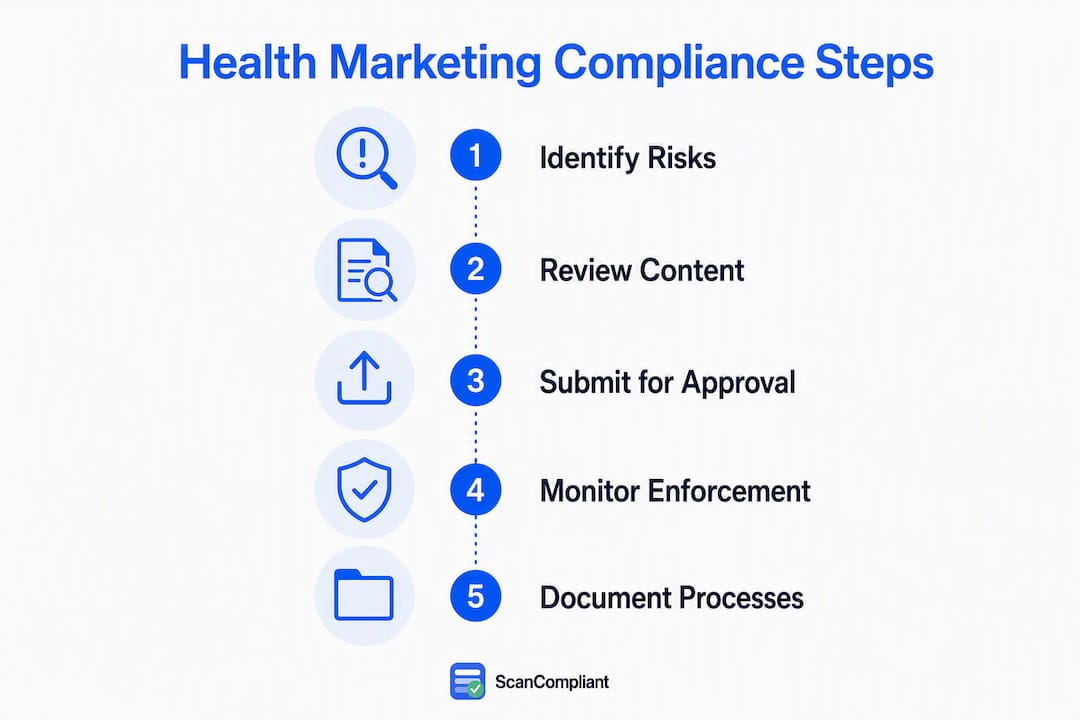
Two federal agencies drive the vast majority of enforcement, and they coordinate closely.
FDA governs misbranding and new drug claims under the Federal Food, Drug, and Cosmetic Act. For DTC prescription advertising, FDA requires fair balance, adequate risk disclosure, and accurate representation of approved indications. HHS and FDA signaled increased enforcement of DTC prescription advertising in 2025, including planned rulemaking to tighten risk disclosure requirements.
FTC governs deceptive advertising and substantiation under Section 5 of the FTC Act. Its updated Health Products Compliance Guidance consolidates principles for evaluating express and implied claims, drawing on more than 200 enforcement cases since 1998.
“FTC staff gives significant deference to FDA determinations. A claim that meets FDA’s ‘significant scientific agreement’ standard will generally be presumed substantiated under FTC law — but a claim that falls short of that standard faces scrutiny from both agencies simultaneously.”
Source: FTC Health Products Compliance Guidance
Because FDA and FTC coordinate under a formal liaison agreement, a single problematic ad can trigger parallel inquiries. State attorneys general add a third layer, particularly for consumer protection claims, and platform enforcement (Meta, Google, TikTok) operates independently of federal action. A brand can receive a platform takedown and a federal warning letter for the same piece of content.
What are the real consequences, and how fast do they happen?
The enforcement pathway typically starts faster than most teams anticipate.
Platform takedowns can happen within days of a complaint or algorithmic flag. FDA and FTC warning letters usually follow weeks to months after a complaint or surveillance sweep. Warning letters are not final agency actions and cannot typically be challenged in court, but they function as enforcement roadmaps and signal that escalation is on the table.
If a brand does not respond adequately, the pathway can escalate to injunctions, consent decrees, civil monetary penalties, or product seizure. In cases involving prescription drugs, criminal exposure is possible. The 30 GLP-1 warning letters issued in March 2026 came with a short response window, requiring affected companies to pull content and respond in writing.
Cost categories to plan for:
- Corrective advertising: — In some FTC resolutions, brands must run corrective messaging.
The legal compliance obligations for telehealth extend beyond marketing copy into how services are described, priced, and positioned, which means the cost of a single enforcement action often spreads across multiple business functions.
How do you prevent health content liability before publication?
Prevention is cheaper than remediation by a wide margin. The practical controls that work in the field combine automated scanning with structured human review.
Pre-publish controls to implement:
- Run every asset through an automated scan that flags risk terms, implied-approval language, and off-label phrasing before it reaches legal review.
- Maintain a claims matrix that ties each marketing claim to a specific study citation or substantiation source.
- Require medical/legal/regulatory (MLR) sign-off with time-stamped approvals before any health claim goes live.
- Build platform-specific playbooks for Meta, Google, and TikTok, since each has distinct policies on drug claims and before/after imagery.
- Archive all original drafts, reviewer comments, and approval records for regulator inquiries.
Health content liability protection checklist — must-have artifacts:
- Source studies or clinical references for every efficacy claim
- Qualification language (“in clinical studies,” “results may vary”) where required
- Disclosures for testimonials and endorsements per FTC guidelines
- Risk information meeting FDA’s adequate provision standard for prescription ads
- Documented reviewer sign-offs with timestamps
Pro Tip: Prioritize your highest-traffic conversion pages and active ad campaigns first. A landing page driving 10,000 visits a month carries more enforcement exposure than a blog post from two years ago.
A content review workflow that separates the automated scan from the human MLR gate catches two different categories of risk: the scan catches volume and pattern, the human gate catches context and nuance.
What should you do when a complaint or regulator contact arrives?
Speed and documentation are the two variables that most affect outcome.
Immediate steps (within 24 hours):
- Preserve copies and timestamps of all flagged content before pulling it.
- Pull the content from all live channels.
- Assign a single response owner with authority to coordinate legal, marketing, and regulatory.
- Notify in-house legal and, if the contact is a formal FDA or FTC letter, outside counsel.
Short-run actions (within the response window):
- Evaluate the flagged claims against your substantiation library. If support exists, document it. If it does not, prepare corrective language.
- Coordinate with the relevant platform or ad network for appeals or amended content submissions.
- Draft the regulatory response letter with outside counsel, addressing each cited violation specifically.
Retain all original materials, reviewer notes, and approval records. Do not overwrite or delete drafts. The content compliance audit process should produce a defensible paper trail that shows good-faith review, even when a claim ultimately needed correction.
How does Scancompliant reduce health content liability in practice?
Scancompliant is an AI-powered content scanning platform built specifically for telehealth and DTC health brands. It scans websites, social media, documents, and product listings for FDA, FTC, and platform policy risks, detecting both explicit claims and implied language that human reviewers often miss.
The platform’s core capabilities map directly to the prevention controls above:
| Capability | What it does for your team |
|---|---|
| 1,000+ risk term database | Flags regulated language, brand-adjacent phrasing, and off-label triggers automatically |
| Implied-claim detection | Catches visual and structural signals, not just keyword matches |
| Substantiation linking | Connects flagged claims to your library of supporting studies |
| Pre-publish gating | Blocks high-risk content from going live before MLR sign-off |
| Audit log | Time-stamps every scan, flag, and reviewer action for regulator inquiries |
Scancompliant has protected more than 200 brands with faster review cycles and a documented compliance trail. For teams operating in the GLP-1 space, the platform includes a dedicated GLP-1 compliance scanner built around the specific phrasing and implied-approval patterns that triggered the March 2026 warning letters.
The practical advantage over a manual review process is speed and consistency. Automated scanning runs in minutes across an entire content library, while a human reviewer working alone might miss a brand-adjacent phrase buried in ad copy variation 47 of 60.
Key Takeaways
Health content liability is an active enforcement risk for U.S. telehealth and DTC brands, requiring automated pre-publish scanning, a substantiation-linked claims matrix, time-stamped MLR sign-offs, and a documented incident response plan to manage FDA and FTC exposure.
| Point | Details |
|---|---|
| Liability triggers go beyond copy | FDA enforcement flags visuals, implied claims, and brand-adjacent phrasing, not just explicit false statements. |
| Two agencies, coordinated scrutiny | FDA and FTC coordinate enforcement; a single ad can trigger parallel inquiries from both. |
| 30 GLP-1 warning letters in 2026 | FDA’s March 2026 sweep targeted telehealth companies for misbranding and implied approval in GLP-1 marketing. |
| Prevention requires four controls | Claims matrix, automated scan, MLR sign-off with timestamps, and an archived audit trail are the minimum viable workflow. |
| Scancompliant | The platform scans for 1,000+ risk terms, detects implied claims, and has protected more than 200 brands with documented audit trails. |
The compliance gap most teams are not closing
The conventional wisdom in health marketing compliance is that legal review is the safety net. Get legal to sign off, and you are covered. That framing misses the actual failure mode.
Most enforcement actions do not happen because a brand skipped legal review. They happen because legal reviewed the wrong version, or reviewed it once and never caught the variation that went live in ad set 12, or because the implied claim was in the image, not the headline, and nobody thought to flag it.
The 2026 GLP-1 sweep is instructive here. The brands that received warning letters were not fly-by-night operations. They were telehealth companies with legal teams. The problem was systematic: brand-adjacent language had become normalized in the category, and nobody had built a process to catch it at scale across every asset.
What actually works is treating compliance as a content operations problem, not a legal review problem. That means automated scanning runs before human review, not after. It means the claims matrix is a living document that marketing updates when new studies come in, not a PDF that legal made in 2023. It means the audit log is generated automatically, not assembled retroactively when a letter arrives.
The teams that come through enforcement actions cleanly are the ones who can show a regulator exactly what their process looked like, who approved what, and when. That documentation does not exist unless you built the workflow to create it.
Scancompliant cuts the time between draft and defensible approval
Every hour a piece of health content sits in manual review is an hour it could be live, or an hour it could be live with a claim that should have been caught. Scancompliant gives regulatory and marketing teams a faster path to both.
The platform scans your content against 1,000+ risk terms, flags implied claims your reviewers might miss, and generates a time-stamped audit log that holds up to regulator scrutiny. Teams using Scancompliant move from draft to compliant faster, with a documented trail that covers them if enforcement comes knocking.
- Pre-publish scanning catches FDA and FTC risk language before it goes live
- Implied-claim detection covers visuals, structure, and brand-adjacent phrasing
- Audit logs create the defensible paper trail regulators ask for
Start a trial or review pricing to see how Scancompliant fits your team’s review workflow.
Useful sources and further reading
“Companies must have appropriate substantiation to back up claims for health-related products. Through more than 50 examples, FTC’s Health Products Compliance Guidance explains the how-tos of making sure you have scientific support.”
Primary regulatory sources:
- FTC Health Products Compliance Guidance — The authoritative FTC staff guidance on substantiation standards for health claims.
- FTC Health Products Compliance Guidance (PDF) — Full document with 50+ annotated examples of compliant and non-compliant claims.
- FDA DTC Prescription Drug Advertising Final Rule — FDA’s final rule on clear, conspicuous, and neutral presentation of major statements in DTC ads.
Enforcement context:
- GLP-1 Compliance: FDA Targets Telehealth Marketing in 30 New Warning Letters — Foley & Lardner’s analysis of the March 2026 enforcement wave.
- FDA Takes Aim at Drug Ads: What It Means for Compounding Pharmacies, Medspas and Telehealth Companies — Mondaq overview of enforcement implications.
Scancompliant resources:
- GLP-1 Marketing Compliance in 2026 — What the FDA warning letter wave means for your brand, with specific compliance actions.
- GLP-1 Marketing Compliance Scanner — Scan your GLP-1 content for the specific risk language FDA flagged in 2026.
- How Content Compliance Audits Work for Healthcare Teams — Practical implementation guide for pre-publish audits and audit-log practices.
This article provides general information about U.S. regulatory requirements for health marketing content. It is not legal advice. Confirm current rules with the FDA, FTC, or a qualified attorney before making compliance decisions.
1 Comment