
Health marketing copy creates legal risk because regulators treat not just explicit statements but the entire “net impression” of an advertisement — imagery, layout, claims, and placement — as potentially deceptive under the Federal Food, Drug, and Cosmetic Act (FDCA) and FTC standards. Three facts demand immediate attention:
- The FTC gives significant deference to FDA determinations about scientific support, so a claim that fails FDA’s “significant scientific agreement” test is also an FTC problem.
- On March 3, 2026, FDA sent 30 warning letters to telehealth companies marketing compounded GLP-1 products, confirming telehealth is not exempt from traditional FDA rules.
- Express claims carry strict liability for accuracy and substantiation — one unsupported percentage can trigger enforcement.
Two actions to take now: pause any messaging that makes outcome claims without mapped evidence, and run a claim-to-evidence audit for every express or implied claim currently live.
Table of Contents
- Why health writing carries legal risk: the core doctrines
- High-risk claim categories your copy team must flag
- What counts as competent and reliable scientific evidence
- Pre-publication checklist and approval workflow
- Who owns what: roles and documentation
- Red-flag phrases and safe rewrites
- Enforcement actions and your response playbook
- How Scancompliant fits into this workflow
- Key Takeaways
- The compliance team’s honest take on making this work internally
- Scancompliant: reduce legal risk before you publish
- Useful sources and enforcement references
Why health writing carries legal risk: the core doctrines
Four legal frameworks govern how regulators read your copy.
Net Impression. The FTC and FDA apply the Net Impression doctrine to assess whether advertising is deceptive. A technically accurate headline can still be misleading when the surrounding imagery, product name, or page layout implies something the text never states. A photo of a clinician in a white coat next to a compounded product, for example, can imply FDA approval that does not exist.
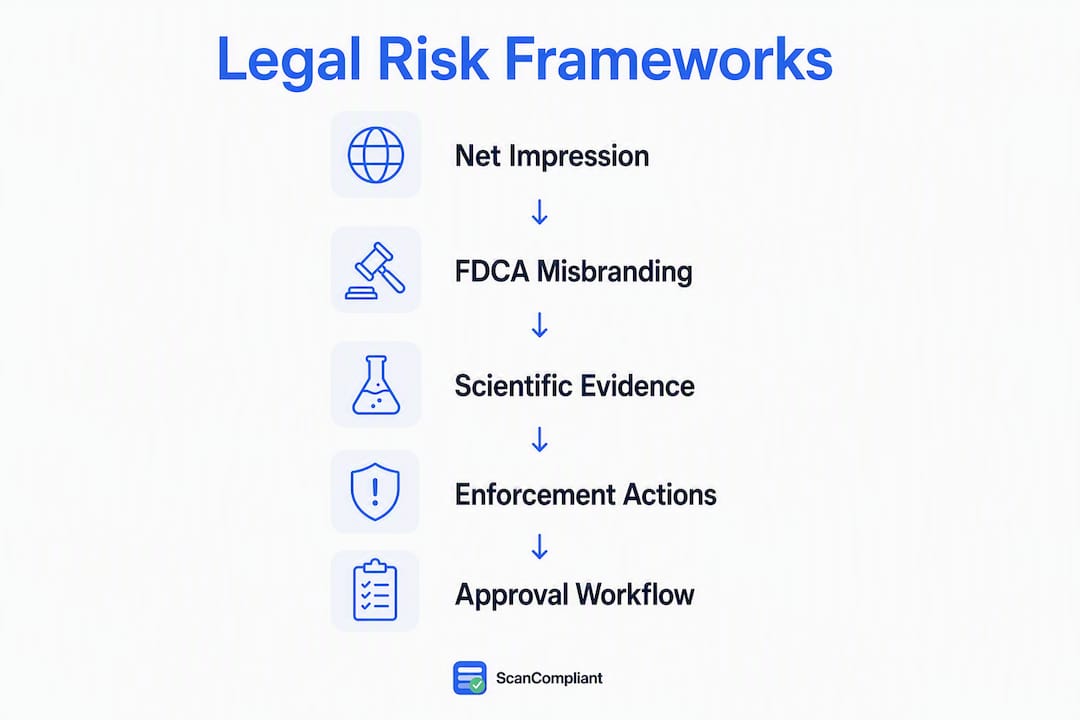
FDCA misbranding. Under the FDCA, a product is misbranded when its labeling or promotional materials are false or misleading in any particular. FDA treats websites and social posts as promotional labeling. Legal experts warn that marketing suggesting a compounded product is equivalent to an approved drug can trigger misbranding allegations even when individual phrases are technically true.
FTC substantiation standard. Health claims require “competent and reliable scientific evidence.” The agency’s Health Products Compliance Guidance (2022) makes clear that vague qualifiers rarely cure a deceptive claim unless the disclosure is clear and conspicuous.
Interagency coordination. A GAO report confirmed that FDA and FTC have overlapping oversight roles and coordinate enforcement. A warning letter from one agency often signals scrutiny from the other.
“A deceptive ad is one that contains a material misrepresentation or omission that is likely to mislead consumers acting reasonably under the circumstances.” — FTC Health Products Compliance Guidance
High-risk claim categories your copy team must flag
These are the categories that generate the most enforcement activity for telehealth and DTC brands.
- Express efficacy claims with numbers. “Lose 15% of body weight” or “reduces cholesterol by 30%” require randomized, controlled human trial data. Without it, the claim is unsubstantiated.
- Implied clinical endorsement. Actors in lab coats, clinical imagery, or brand names that echo approved drugs (e.g., “Ozempic-like”) imply regulatory status the product does not have.
- Compounded-product equivalence framing. Describing a compounded GLP-1 as a “generic” or using the branded drug’s name in proximity to your product is a direct misbranding trigger. FDA’s mid-June 2026 warning letter wave focused specifically on this.
- Before/after photos without typical-result disclosures. FTC guidance requires evidence of typical outcomes — a “results not typical” footnote alone does not satisfy the standard.
- Hidden pricing and billing terms. The FTC’s action against NextMed shows that deceptive pricing and hidden fees are part of the net impression regulators evaluate alongside health claims.
What counts as competent and reliable scientific evidence
The FTC’s substantiation standard is not a suggestion. Here is what it requires in practice.
- Qualifiers do not substitute for evidence — FTC guidance explicitly warns that “may,” “promising,” or “preliminary” typically do not cure a deceptive emerging-science claim unless the disclosure is clear and conspicuous.
For compliant content release, every efficacy claim needs a mapped citation before the asset leaves the drafting stage.
Pre-publication checklist and approval workflow
Run every creative asset through this sequence before it goes live.
Checklist — verify for each asset:
- Identify every express claim and list the implied claims a reasonable consumer would draw.
- Map each claim to a specific citation, approved label language, or clinical study.
- Confirm disclosures are clear, conspicuous, and unavoidable — not buried in fine print.
- Review imagery, layout, and product naming for net-impression risk independent of the text.
- Validate that testimonials reflect typical outcomes and carry appropriate disclosures.
- Confirm pricing, subscription terms, and cancellation policies are accurately represented.
Approval workflow:
Content creator → Medical reviewer → Legal/regulatory sign-off → Marketing QA → Final approver

For standard ads and email campaigns, budget 3–5 business days. Landing pages with novel efficacy claims need 7–10 days to allow legal review and evidence mapping. High-risk claims — disease treatment, specific outcome percentages, compounded drug equivalence — escalate directly to legal before any creative work is finalized.
Audit trail: store versioned copy, evidence links, reviewer notes, timestamps, and the final sign-off record. Retain for a minimum of five years, or longer if your counsel advises based on state law. For telehealth email campaigns, version control is especially important because subject lines and body copy often diverge across A/B tests.
Who owns what: roles and documentation
Clear ownership prevents gaps that regulators exploit.
- Legal/regulatory reviewer: — applies FDCA, FTC, and state consumer protection standards; signs off on high-risk claims.
Escalation criteria: any claim involving a specific percentage outcome, disease diagnosis or treatment, or compounded drug equivalence goes to legal before creative development begins — not after.
A compliance audit trail must include versioned copy at each review stage, the evidence or label language cited for each claim, reviewer notes, and timestamped sign-offs. Coordinate with your privacy and security teams when storing reviewer notes that reference patient data or medical information.
Red-flag phrases and safe rewrites
| Red-flag phrase | Why it’s risky | Compliant rewrite |
|---|---|---|
| “FDA-approved” (for a compounded product) | Compounded drugs are not FDA-approved; implies regulatory status that doesn’t exist | “Prescribed by licensed clinicians” |
| “Clinically proven to reduce weight by 15%” | Requires RCT data mapped to that exact figure | “Supported by clinical research — ask your provider about expected outcomes” |
| “Generic semaglutide” | Implies equivalence to an approved branded drug; misbranding risk | “Compounded semaglutide, prescribed by a licensed provider” |
| “Ozempic alternative” | Implies therapeutic equivalence and may imply FDA approval | “A compounded weight-management option — discuss with your clinician” |
| “Clinically proven” (no citation) | Express efficacy claim requiring substantiation | “Formulated based on published research” with citation |
| “Results guaranteed” | Absolute outcome claim; no substantiation standard can support a guarantee | “Individual results vary; speak with your provider” |
Pro Tip: Maintain a claim matrix that links every marketing statement to a single source or approved labeling language. When creative teams iterate on messaging, the matrix prevents “regulatory drift” — the gradual strengthening of claims across versions until the final copy bears no resemblance to what the evidence supports.
Enforcement actions and your response playbook
Regulators have a wide toolkit. Warning letters are the most common first step, but the sequence can escalate to demands for corrective advertising, injunctions, civil penalties, product seizures, platform takedowns, and state attorney general actions. The FTC’s July 2025 action against NextMed included both misleading health claims and deceptive pricing — a reminder that joint scrutiny of advertising and business practices is now standard.
When a warning letter or platform notice arrives:
- Preserve all records immediately — do not delete or modify any version of the flagged content.
- Suspend the disputed messaging across all channels within 24 hours.
- Gather the evidence file: sign-offs, evidence citations, version history, and reviewer notes.
- Notify outside counsel before responding to the agency.
- Prepare a corrective communications plan for affected consumers if required.
- Coordinate with operations to address any product or fulfillment issues the letter identifies.
Quick, well-documented remedial steps consistently reduce penalties. For a detailed operational guide, see responding to regulatory scrutiny. For GLP-1-specific enforcement context, Scancompliant’s GLP-1 marketing compliance analysis covers the warning letter wave in detail.
How Scancompliant fits into this workflow
Automated scanning catches what human reviewers miss under deadline pressure. Scancompliant’s platform scans websites, social media, documents, and product listings for FDA, FTC, and platform policy risks, flagging both explicit and implied claims with prioritized risk scores and plain-English explanations.
- Detects explicit and implied claims across all content types
- Flags over 1,000 risk terms drawn from FDA and FTC enforcement patterns
- Suggests compliant rewrites within the platform
- Exports an audit trail with timestamps and risk findings for documentation
Scancompliant has protected more than 200 brands by catching risky language before publication — reducing review cycles and building a defensible compliance record.
Automated compliance screening shortens review cycles by surfacing the highest-risk items first, so legal reviewers spend time on genuine judgment calls rather than scanning for obvious red flags.
Key Takeaways
Health marketing copy exposes telehealth and DTC brands to FDA and FTC enforcement because regulators evaluate the net impression of every asset — not just the literal text.
| Point | Details |
|---|---|
| Net Impression governs everything | Review imagery, layout, and claims together — context can make accurate text misleading. |
| Implied claims need substantiation | The FTC requires the same evidence for implied claims as for express claims. |
| Qualifiers rarely cure weak evidence | “May” and “promising” do not satisfy the substantiation standard without clear, conspicuous disclosures. |
| Document every sign-off | Retain versioned copy, evidence links, and timestamped approvals for a minimum of five years. |
| Scancompliant automates the safety net | With 1,000+ risk terms and protection for 200+ brands, it flags risky language before publication. |
The compliance team’s honest take on making this work internally
The hardest part of operationalizing these controls is not the legal framework — it is the internal negotiation between speed and caution. Marketing teams face launch deadlines; legal reviewers face liability. That tension is real, and pretending a checklist resolves it misses the point.
What actually moves the needle is embedding legal and regulatory reviewers in the creative sprint from the start, not as a final gate. When a medical reviewer sits in on the brief, the team writes differently from the first draft. Claims that would have required three revision cycles get written correctly the first time. That is not a compliance win — it is a speed win.
Framing policy changes for marketing partners works best when you lead with templates, not restrictions. Give the team a claim matrix, a list of pre-approved phrasings, and a clear escalation path. The message becomes “here is how to move fast safely” rather than “here is what you cannot do.”
One cultural shift worth making: stop treating the approval workflow as a compliance tax and start treating it as the evidence file you will need if a warning letter arrives. Teams that build the audit trail as a byproduct of normal work are far better positioned than those scrambling to reconstruct it under regulatory pressure.
Scancompliant: reduce legal risk before you publish
Every checklist in this article requires someone to catch risky language before it goes live. That is where most teams have a gap — not in policy, but in execution under deadline pressure.
Scancompliant gives regulatory, legal, and marketing teams an automated first pass that flags implied claims, maps risk to FDA and FTC standards, and suggests compliant rewrites in minutes. The platform has protected more than 200 brands using a database of over 1,000 risk terms, and every scan produces an exportable audit trail your team can use as documentation. It is the difference between discovering a problem in a warning letter and catching it in draft.
Start a free trial or review pricing and plan options to see which tier fits your team’s review volume.
This article provides general information about U.S. regulatory standards for health marketing. It is not legal advice. Confirm current rules with FDA, FTC primary sources, or qualified legal counsel before publishing health-related marketing content.
Useful sources and enforcement references
Primary guidance and enforcement materials to bookmark for your compliance playbook:
- FTC Health Products Compliance Guidance (2022) — the core substantiation and net-impression standard for health advertising
- FTC Enforcement Policy Statement on Food Advertising — precedent and principles for food and supplement claims
- GAO Report GAO-23-106197: Medical Advertising — Federal Oversight of Devices — interagency coordination between FDA and FTC
- FTC action against NextMed (2025) — deceptive pricing and fake testimonials in telehealth
- FDA GLP-1 warning letter wave analysis — Foley & Lardner — 30 warning letters issued March 3, 2026
- Digital Health Products Advertising and Promotion Requirements — FDLI — device promotion requirements and misbranding standards
- Informed consent to telehealth services — Legacy Meds — practical resource on consent and patient-facing disclosures in telehealth