
Cross-functional compliance is defined as the coordinated collaboration of multiple organizational departments working together to achieve cohesive regulatory adherence and shared risk management. For telehealth and direct-to-consumer (DTC) health brands, this model is not optional. FDA and FTC regulations touch every function, from marketing copy to data infrastructure, and a siloed approach leaves dangerous gaps. Understanding how cross-functional compliance works means understanding how legal, IT, HR, operations, and executive teams share ownership of regulatory obligations rather than passing them off as someone else’s problem.
How cross-functional compliance works: core structure and team roles
Cross-functional compliance operates through a defined structure where every department holds a specific compliance role, not just the legal team. The most widely applied framework is the three lines of defense model. Executives define strategy and set risk tolerance at the first line. Cross-functional teams handle execution and day-to-day monitoring at the second. Specialized departments, such as internal audit and risk management, provide independent oversight at the third.
In healthcare and telehealth specifically, this structure maps onto real regulatory pressure. Legal reviews marketing claims for FDA and FTC alignment. IT manages data security under HIPAA. HR trains staff on updated protocols. Operations embeds compliance checkpoints into product and service workflows. Each function owns a slice of the regulatory picture, and the compliance officer holds the whole map.

Clear ownership is the mechanism that makes this work. Auditors consistently flag gaps between departments rather than failures within a single control. The fix is explicit documentation: who decides, who performs, and who verifies each control. Without that documentation, accountability dissolves at every handoff.
Pro Tip: Assign ownership in three tiers, strategy, execution, and oversight, and document each tier in a shared register. When an auditor asks who owns a control, you need a name, not a department.
Regular communication locks the structure in place. Cross-functional teams managing high-risk domains, including AI-driven telehealth tools, should meet bi-weekly to review open issues, monitor systems, and assess incoming regulatory changes. That cadence keeps compliance current rather than reactive.
- Legal: Reviews all external communications and marketing claims against FDA and FTC standards
- IT: Manages HIPAA-compliant data handling, security protocols, and platform audits
- HR: Delivers compliance training and tracks staff certifications
- Operations: Integrates compliance checkpoints into product development and service delivery
- Executive leadership: Sets risk appetite, approves compliance budgets, and sponsors cross-functional initiatives
What tools and frameworks embed compliance into daily operations?
Shared platforms are the infrastructure of cross-functional compliance. When IT, legal, and operations all update the same compliance dashboard, real-time visibility replaces the email chains and spreadsheet versions that create information loss. A single source of truth means every team sees the same compliance status, the same open findings, and the same deadlines.
The stage-gate framework takes this further by building compliance directly into project timelines. Each project phase, from concept through design, build, test, and launch, carries mandatory compliance checkpoints as exit criteria. A telehealth product cannot move from design to build until legal has signed off on data consent flows. A DTC health campaign cannot launch until marketing claims have cleared regulatory review. This prevents the costly rework that happens when compliance is treated as a final step.
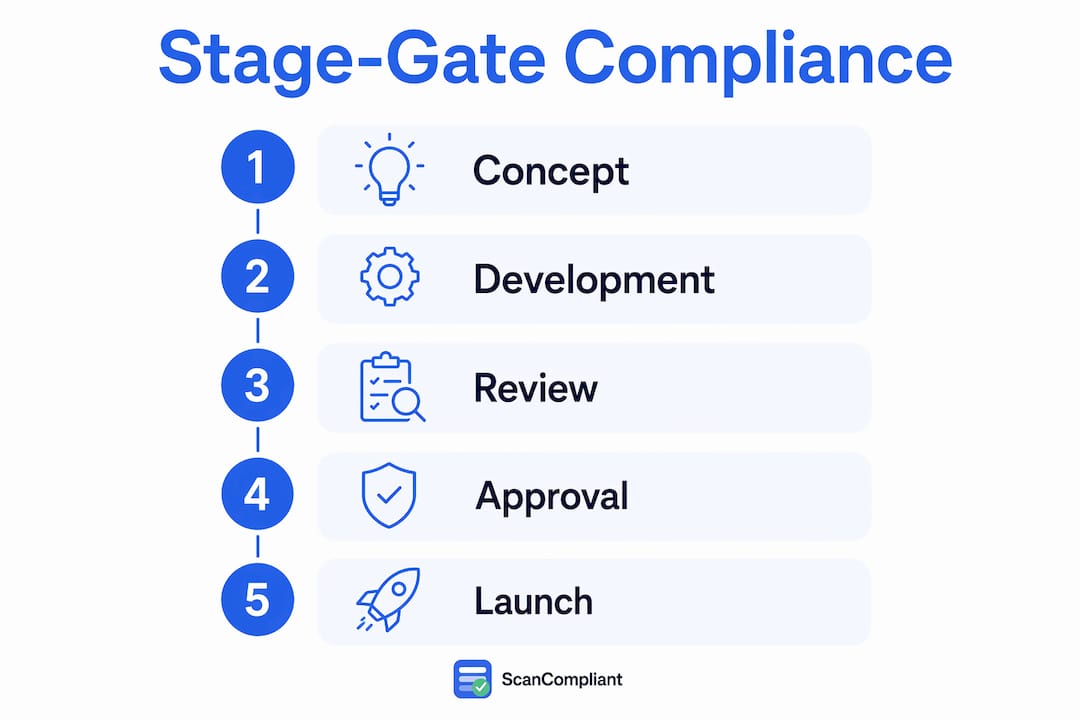
Pro Tip: Treat each stage-gate checkpoint as a formal sign-off event, not a checklist item. Require a named approver from legal or compliance at every gate. That paper trail becomes your audit defense.
The contrast between embedded and reactive compliance is significant. Reactive compliance audits what already happened. Embedded compliance shapes what is being built. For telehealth brands operating under active FDA scrutiny, the difference between those two approaches shows up in enforcement letters and warning actions.
The table below shows how these two approaches compare across key operational dimensions.
| Dimension | Reactive compliance | Embedded compliance |
|---|---|---|
| Timing | After product or content launch | During each project phase |
| Ownership | Compliance team alone | Shared across all departments |
| Audit readiness | Requires retroactive documentation | Documentation built in real time |
| Cost of failure | High: rework, fines, delays | Low: issues caught early |
| Regulatory response speed | Slow: gaps discovered late | Fast: changes integrated at each gate |
Embedding compliance into daily healthcare operations through shared tools also builds a stronger compliance culture over time. Teams stop viewing compliance as an external checkpoint and start treating it as part of how work gets done.
What challenges do organizations face in cross-functional compliance?
Blurred accountability is the most common failure point. When no single person owns a control, every person assumes someone else is handling it. Compliance officers must assert authority as risk leaders rather than advisors, requiring formal sign-offs at every process handoff. That shift from advisory to authoritative is cultural, and it takes deliberate effort to establish.
Departmental silos create a related problem. When departments operate independently, information gets lost or misread at the boundaries. A marketing team that does not know what legal flagged last quarter will repeat the same risky claims. An IT team that does not know what operations changed in a patient intake workflow cannot update security controls in time. Independent department operation leads directly to compliance failures that no single team could have predicted or prevented alone.
The following challenges appear most frequently in cross-functional compliance programs across telehealth and DTC health organizations:
- Undefined ownership: Controls exist on paper but no individual is named as responsible, creating gaps that auditors find immediately
- Inconsistent documentation: Each department maintains its own records in different formats, making audit preparation slow and error-prone
- Delayed regulatory updates: New FDA or FTC guidance reaches legal but does not reach marketing or operations for weeks
- Meeting fatigue without structure: Cross-functional meetings happen but produce no decisions, no owners, and no deadlines
- Technology fragmentation: Teams use different platforms that do not share data, so compliance status is never visible across the organization
Proactive governance closes most of these gaps. Formal sign-off processes, documented ownership registers, and shared compliance risk reporting tools give compliance officers the visibility they need to catch problems before they become enforcement actions.
How does cross-functional compliance create strategic advantages?
Cross-functional compliance is a business enabler, not just a risk filter. When compliance is embedded across departments, cross-functional visibility identifies bottlenecks early and accelerates the organization’s response to regulatory changes. A telehealth brand that catches a labeling issue in the design phase moves faster than one that catches it after launch.
The data on compliance system maturity makes the gap concrete. Only 6% of businesses operate with leading-edge, real-time cross-functional predictive compliance capabilities. Meanwhile, 42% rely on functional but non-integrated systems. That 36-point gap represents organizations that know compliance matters but have not yet connected their departments into a unified picture. The 6% at the top use predictive analytics to foresee regulatory risks before they materialize.
For DTC health brands, this strategic edge shows up in product launch speed. When legal, marketing, and operations share a compliance workflow, a new product campaign does not stall waiting for sequential reviews. All three teams work in parallel against the same compliance criteria. The result is faster time to market with lower regulatory risk, which is a genuine competitive advantage in a crowded telehealth market.
Cross-functional compliance also supports ongoing innovation. Teams that understand the regulatory boundaries early in a product lifecycle can design around them rather than retrofitting compliance after the fact. The role of technology in enabling this kind of proactive design is growing rapidly, particularly as AI-powered tools give compliance officers real-time signals about content risk before publication.
Key Takeaways
Effective cross-functional compliance requires defined ownership, shared tools, and embedded checkpoints across legal, IT, HR, and operations to prevent regulatory gaps in telehealth and DTC health organizations.
| Point | Details |
|---|---|
| Three lines of defense | Assign strategy to executives, execution to cross-functional teams, and oversight to specialized audit functions. |
| Document ownership explicitly | Name a responsible individual for every control to close the gaps auditors consistently find between departments. |
| Use stage-gate frameworks | Build mandatory compliance checkpoints into each project phase so issues surface early, not at launch. |
| Embed compliance in shared tools | A single compliance platform gives IT, legal, and operations real-time visibility and eliminates information silos. |
| Shift from reactive to predictive | Only 6% of organizations use real-time predictive compliance; moving toward that model accelerates response and reduces enforcement risk. |
Why compliance officers need to stop waiting for a seat at the table
The compliance officer role has been miscast for years. Too many organizations treat compliance as a legal function that gets consulted after decisions are made. That model fails in telehealth and DTC health, where a single marketing claim can trigger an FTC warning letter or an FDA enforcement action before the legal team even sees the content.
What I have observed working with regulated health brands is that the organizations with the fewest compliance incidents are not the ones with the largest legal teams. They are the ones where compliance officers sit in product meetings, review campaign briefs before creative begins, and have a named seat in every stage-gate review. The authority is structural, not just cultural.
Technology is accelerating this shift. AI-powered content scanning tools now give compliance officers real-time signals about risky language in marketing materials, catching subtle claims that human reviewers miss under deadline pressure. That capability changes the conversation from “legal will review it later” to “compliance is already embedded in the workflow.” The compliance officer becomes a design partner, not a gatekeeper.
The future of cross-functional compliance in telehealth is predictive, not reactive. Organizations that invest now in shared platforms, defined ownership, and embedded review processes will not just avoid enforcement actions. They will move faster, launch cleaner, and build the kind of regulatory trust that becomes a brand asset.
— Compliant Team
Scancompliant: built for cross-functional compliance in healthcare
Healthcare and telehealth teams face a specific problem: marketing content moves fast, and regulatory risk hides in language that looks fine to a non-specialist. Scancompliant’s AI-powered platform scans content against a database of over 1,000 risk terms, flagging FDA and FTC compliance issues in minutes rather than days.
More than 200 brands have used Scancompliant to build a documented compliance trail that holds up under audit scrutiny. The platform gives legal, marketing, and operations teams a shared view of content risk, so cross-functional review happens in one place rather than across disconnected email threads. For teams building a marketing compliance workflow that keeps pace with regulatory change, Scancompliant delivers the speed and specificity that manual review cannot match.
FAQ
What is cross-functional compliance?
Cross-functional compliance is the coordinated effort of multiple departments, including legal, IT, HR, and operations, to share ownership of regulatory obligations and risk management across an organization.
Why do compliance silos cause failures in telehealth?
When departments operate independently, regulatory information gets lost at handoffs. A marketing team unaware of a legal flag will repeat risky claims, and an IT team unaware of operational changes cannot update security controls in time.
How often should cross-functional compliance teams meet?
Teams managing high-risk domains should meet bi-weekly to review open issues, monitor systems, and assess new regulatory developments, according to compliance governance best practices.
What is the stage-gate compliance framework?
The stage-gate framework places mandatory compliance checkpoints at each project phase, from concept through launch, so issues are caught and resolved before they advance to the next stage.
How does Scancompliant support cross-functional compliance?
Scancompliant scans marketing content against over 1,000 FDA and FTC risk terms, delivering prioritized findings in minutes and creating a shared compliance record that legal, marketing, and operations teams can all access.
Recommended
- How Compliance Audits Work for Healthcare Teams – scancompliant.com
- How Content Compliance Audits Work for Healthcare Teams – scancompliant.com
- Compliance Risk Reporting for Healthcare Teams: 2026 Guide – scancompliant.com
- The Role of Compliance Documentation Systems in Healthcare – scancompliant.com