
Before any mental health ad runs, substantiate every express and implied claim, and audit your tag manager and pixels to confirm no treatment information leaks to ad vendors. That combination satisfies the two agencies that matter most, the FTC and, when drug-related language appears, the FDA, plus a growing list of state statutes. The next move is mechanical: run a risk-term scan, pull a tag-manager inventory, and route both to legal before publish.
TL;DR:
- Claims about mental health benefits must be backed by randomized controlled studies, especially for efficacy or symptom relief, before ads go live.
- Pixel and data flows must be audited regularly to prevent sharing treatment-related information with vendors, which can breach privacy promises and trigger FTC action.
- Influencer disclosures must be clear, placed at the start, and backed by evidence, as platform formats limit space and increase risk of misleading omission.
- AI features should be labeled plainly, with human oversight maintained to prevent language suggesting licensed clinical judgment.
- Building a detailed claim log, routine audits, and automated risk scans helps ensure compliance and speeds response to regulatory inquiries.
Table of Contents
- Pre-Publish Checklist For Mental Health Advertising Copy And Claims
- What The FTC And FDA Actually Require For Health Claims
- Pixel And Intake-Data Risks Telehealth Advertisers Keep Repeating
- Social Platforms And Influencer Rules For Mental Health Campaigns
- AI Features In Mental Health Advertising: Where Disclosure Breaks Down
- Turning The Checklist Into A Repeatable Compliance Workflow
- State-Level Rules That Complicate National Mental Health Campaigns
- Mental Health Claims Versus General Wellness Claims: Where The Line Sits
- Stigma, Discrimination, And Sensitive Content Risks In Mental Health Ads
- Disclaimers And Risk Disclosures Done Right For Mental Health Ads
- Managing Compliance Across Social Media And Connected Health Apps
- Compliant Team Perspective: The Same Five Mistakes, Every Time
- A Faster Way To Run The Pre-Publish Gate
- Sources
Pre-Publish Checklist For Mental Health Advertising Copy And Claims
Every ad, landing page, and intake flow should clear the same gate before it goes live. The order matters. Claims get vetted first because they drive everything downstream, including the disclosures and disclaimers that come later.
- List every express and implied claim in the copy, then log what evidence backs each one.
- Flag any language suggesting FDA approval or “sameness” with an approved drug whenever a prescription or drug-adjacent term appears.
- Audit pixels, hashed identifiers, and vendor data flows against whatever your privacy policy actually promises.
- Confirm influencer and testimonial disclosures are visible without a click, not buried behind a “see more.”
- Check purchase and subscription flows for dark patterns, especially auto-renewal defaults and hard-to-find cancellation paths.
- Sweep creative for hidden-source cues such as generic pharmacy labels or stock product photos that imply your brand manufactures a drug it doesn’t.
- Review vendor and influencer contracts for clauses that actually assign compliance responsibility, not just payment terms.
Pro Tip: Run the claims audit and the pixel audit as two separate passes with two separate owners. Teams that combine them tend to rubber-stamp the technical review once the copy looks clean, and that’s exactly where privacy violations slip through.
What The FTC And FDA Actually Require For Health Claims
The FTC’s substantiation standard is the backbone of mental health advertising compliance, and it’s stricter than most marketing teams assume. Objective claims about outcomes, symptom relief, or clinical effectiveness need “competent and reliable scientific evidence” before the ad runs, not after a complaint arrives. For efficacy claims specifically, that often means randomized, controlled human clinical testing, not a testimonial or an internal survey.
Implied claims carry the same weight as express ones. A headline that never says “cures depression” can still trigger liability if the visual, headline, and context add up to that message in a reasonable consumer’s mind.
Watch for phrases that read as harmless but function as clinical claims:
- “Clinically proven” without a citation to the actual study
- “Works just like [named prescription drug]”
- “Doctor-recommended” without disclosing who paid for the recommendation
- “Guaranteed results” for any behavioral health outcome
When your marketing touches prescription or compounded products, 21 C.F.R. § 202.1 adds fair-balance and brief-summary obligations on top of the FTC standard. The FDA’s early 2026 warning letters to 30 telehealth companies over compounded GLP-1 marketing show exactly what happens when “sameness” language slips through unreviewed.
Build a claim log for every campaign: the exact wording, the evidence citation, who reviewed it, and the date. That dossier is what you hand to counsel when an inquiry lands, not a scramble through old email threads.
Pixel And Intake-Data Risks Telehealth Advertisers Keep Repeating
The FTC’s BetterHelp settlement is the case every mental health brand should study line by line. The agency alleged the platform shared hashed emails, IP addresses, and intake questionnaire answers with ad vendors, data that directly contradicted the privacy promises on the site. That’s “treatment information” in the FTC’s eyes: anything tied to a person’s mental health status, symptoms, or care history, even when it’s hashed or pseudonymized.
The exposure points are rarely in the ad copy. They’re in the tag manager.
- Inventory every pixel and tag firing on intake forms, checkout pages, and appointment scheduling.
- Block any trigger that captures questionnaire responses or diagnosis-adjacent form fields.
- Require vendors to delete data on a defined schedule and cap retention contractually, not just in a privacy policy.
- Run a live test purchase through the funnel with a tag debugger and compare what actually fires against what your privacy policy claims.
Pro Tip: Most privacy failures aren’t intentional. They’re leftover tags from an old A/B test that nobody removed. Schedule a tag audit quarterly, not just when legal asks for one.
Social Platforms And Influencer Rules For Mental Health Campaigns
The FTC’s revised Endorsement Guides tightened what counts as an adequate disclosure online: clear, conspicuous, and in most cases unavoidable. A disclosure buried behind “see more” or dropped only in a video description doesn’t meet that bar anymore.
Endorsements and testimonials aren’t exempt from substantiation. If an influencer says a therapy service “changed my life” in a way that implies a specific clinical outcome, your brand needs evidence backing that outcome, the same as if you’d written the claim yourself.
Platform formats complicate this. A 15-second video or a character-capped caption leaves little room for risk disclosures, which pushes teams to compress language until it’s misleading by omission.
- Require disclosure language (“#ad” or “paid partnership”) placed in the first line, not the caption’s end.
- Pre-approve specific claim language before any influencer posts, not after.
- Require proof-of-posting screenshots within 24 hours of publication.
- Reserve audit rights in every influencer contract to pull deleted or edited posts.
AI Features In Mental Health Advertising: Where Disclosure Breaks Down
AI-driven chat features and ad copy generators introduce a new failure mode: implying a licensed clinician is behind the response. States are moving fast here, with California’s AB 489 and similar proposals restricting language that suggests AI output equals professional clinical judgment.
- Label AI-generated chat or triage responses plainly, in the interface, not in a footer disclaimer.
- Keep a human reviewer in the loop for anything resembling a diagnosis or treatment recommendation.
- Constrain prompts so AI tools can’t generate “clinically proven” or “diagnosis” language unsupervised.
Pro Tip: If your AI feature can answer a question a licensed therapist would answer, treat its output like clinical copy, not chatbot filler.
Turning The Checklist Into A Repeatable Compliance Workflow
A checklist only works if someone owns each line. Assign a role matrix before your next campaign, not during the crisis after one ships broken.
- Marketing drafts copy and creative, then submits it with the claim log attached.
- The substantiation owner (usually legal or a designated compliance lead) verifies evidence for every claim.
- A privacy engineer audits pixels and vendor data flows against policy language.
- A product owner signs off on intake flows and purchase funnels for dark patterns.
Automate what’s repetitive: risk-term scanning and pixel detection. Reserve human judgment for anything touching clinical outcomes or novel claim language, since automated tools flag candidates, but legal makes the final call.
If a warning letter or FTC inquiry arrives, timelines get short fast. Build a standing folder with your evidence dossier, claim logs, and privacy audits so you’re not assembling a response from scratch. Most FDA warning letters carry a 15-day response window; missing it escalates the matter quickly. Loop in outside counsel early, and have a public communications plan ready in case the response requires a corrective statement.
State-Level Rules That Complicate National Mental Health Campaigns
Federal standards set the floor, not the ceiling. States regulate mental health advertising through consumer protection statutes, licensing board rules, and health data privacy laws that vary widely and stack on top of FTC and FDA requirements.
A handful of patterns recur across states. Health data privacy statutes, often modeled on or exceeding HIPAA in scope, can classify mental health intake information as protected even when the FTC or FDA wouldn’t require the same handling. Advertising rules tied to professional licensing boards sometimes restrict how a therapy platform can describe outcomes or credentials, particularly if the ad implies a specific clinician-patient relationship. Attorney general offices have also grown more active in health advertising enforcement generally, treating deceptive claims as unfair trade practices under state law independent of any federal action.
The practical fix isn’t chasing fifty separate rulebooks for every campaign. Build your national compliance baseline to the strictest applicable standard, whichever state that happens to be for a given claim type, then flag exceptions where a specific state’s rule is genuinely more permissive. Maintain a simple internal reference noting which states have mental-health-specific advertising restrictions or heightened privacy statutes, and route any campaign targeting those states through an extra review pass. This costs a little more time upfront and saves considerably more when a campaign runs in a jurisdiction nobody checked first.
Mental Health Claims Versus General Wellness Claims: Where The Line Sits
Not every claim in a mental health ad carries the same regulatory weight, and treating them all identically wastes review time on low-risk copy while under-scrutinizing the claims that actually draw enforcement.
General wellness claims, things like “supports emotional balance” or “helps you feel your best,” generally face lower scrutiny because they don’t assert a specific clinical outcome or diagnosis-related result. Mental health claims tied to a recognized condition, “reduces symptoms of generalized anxiety disorder,” or a specific therapeutic outcome, “proven to treat clinical depression,” fall squarely into the FTC’s competent-and-reliable-evidence standard and, if drug-related, FDA’s prescription advertising rules.
The safest editorial practice is to ask what condition or diagnosis the copy implies treating. If the answer names a specific disorder from the DSM-5 or implies replacing a licensed intervention, treat it as a mental health claim requiring clinical substantiation. If the copy stays in the territory of mood, stress, or general well-being without naming a condition or promising a therapeutic outcome, it likely qualifies as a wellness claim, though it still needs some reasonable basis behind it.
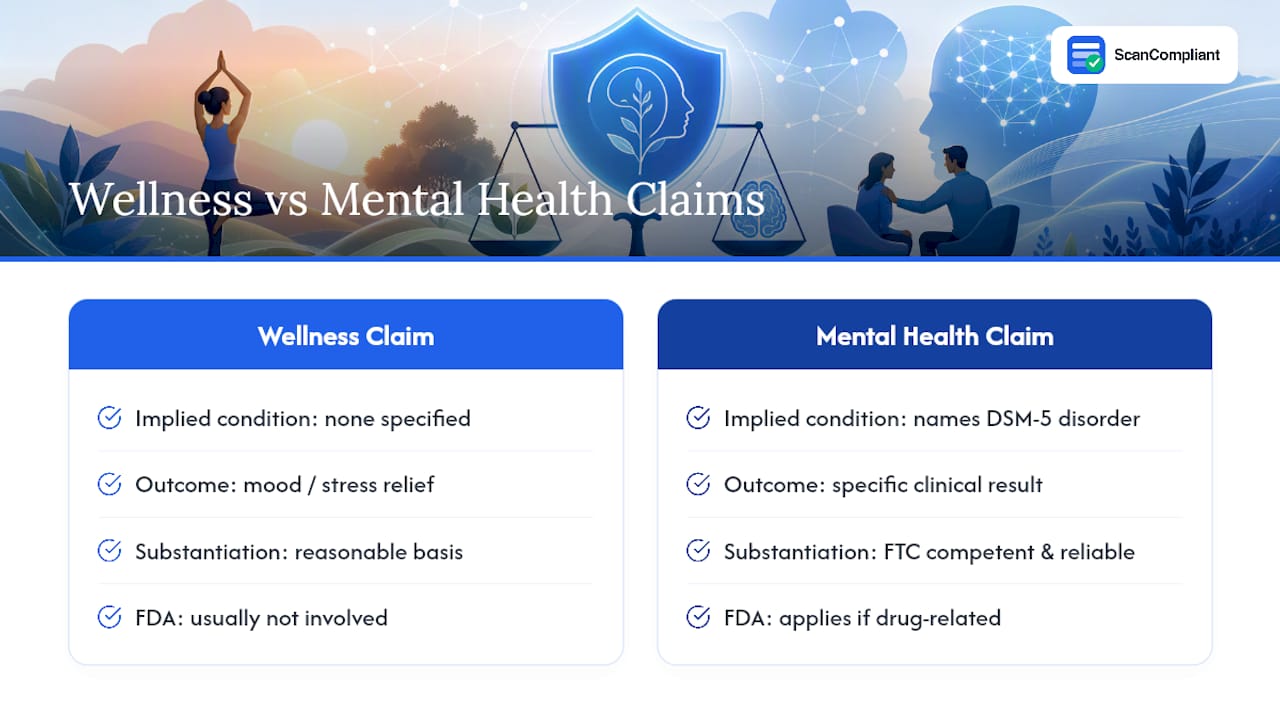
This distinction should live in your claim log as a tag, not just a note. A campaign mixing both claim types needs the stricter substantiation standard applied to the whole piece, since regulators read the ad as a unified message, not a sentence-by-sentence breakdown.
Stigma, Discrimination, And Sensitive Content Risks In Mental Health Ads
Mental health advertising carries a legal exposure that generic DTC health marketing doesn’t: content that stigmatizes a condition or targets a vulnerable population can create liability well beyond a false-advertising claim.
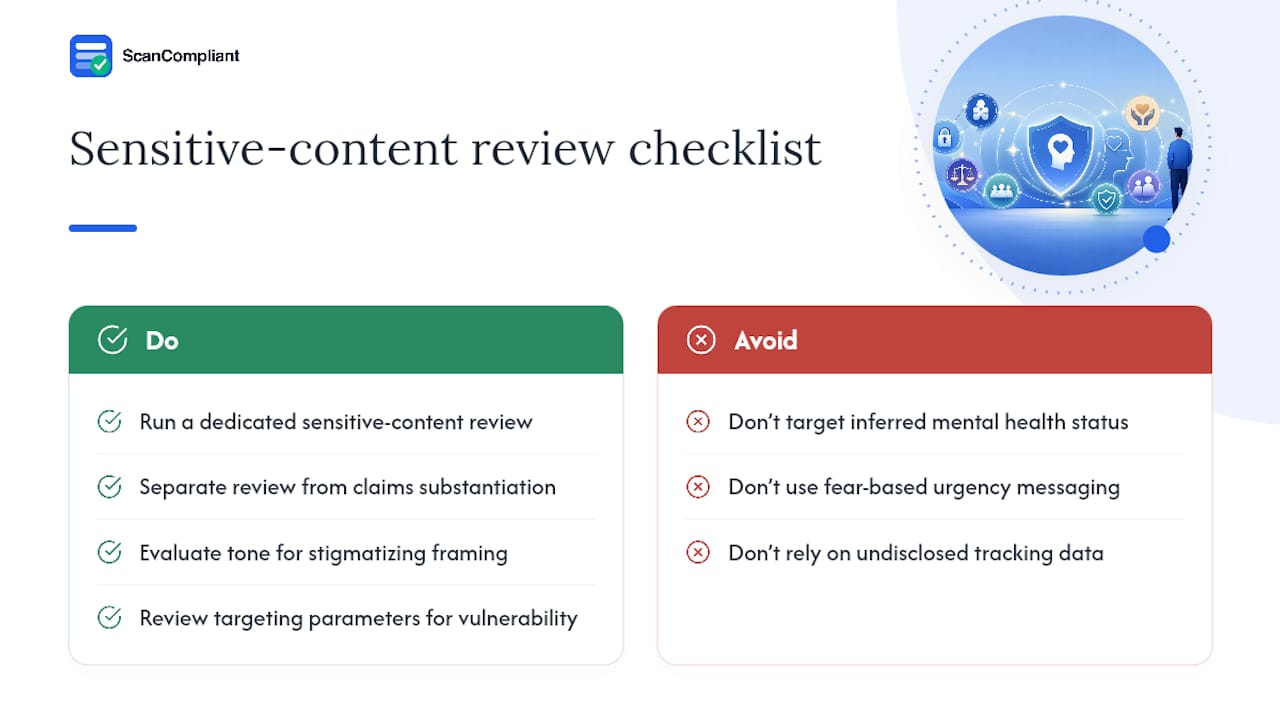
Ad targeting itself is a growing risk area. Using inferred mental health status, past search behavior, or app usage patterns to target ads at people presumed to be in crisis raises both privacy and discrimination concerns, particularly where that targeting data was gathered through means the platform’s own privacy policy doesn’t disclose. This overlaps directly with the pixel and intake-data risks covered earlier, since the same tracking infrastructure that leaks treatment data often powers the targeting that draws separate scrutiny.
Imagery and language choices matter more here than in most ad categories. Copy that frames mental illness as a personal failure, or that uses fear-based messaging to push urgency (“your anxiety is only getting worse without our app”), invites both regulatory attention and reputational damage that spreads faster than a warning letter. Sensitive content rules on ad platforms themselves also restrict certain depictions of self-harm, suicide, or crisis language, and violating platform policy can pull an entire campaign down regardless of whether the FTC ever gets involved.
The safer path treats sensitive content review as its own checklist line, separate from claims substantiation, with someone specifically evaluating tone, targeting parameters, and imagery for stigmatizing framing before the claims team even starts its pass.
Disclaimers And Risk Disclosures Done Right For Mental Health Ads
A disclaimer that technically exists but nobody reads doesn’t protect you. The FTC’s disclosure standard, clear and conspicuous, applies to risk disclosures the same way it applies to influencer disclosures: placement and visibility matter as much as wording.
For mental health treatment ads specifically, a few disclosure practices hold up better than the generic legal boilerplate most brands default to. State plainly that the service doesn’t replace emergency care, and place that disclaimer near any messaging that could be read as urgent or crisis-related, not buried in a footer. If the platform involves a licensed clinician, disclose the credential type clearly rather than using vague terms like “provider” or “specialist” that could imply a higher level of licensure than what’s actually offered. When a service involves medication management, the fair-balance requirements under 21 C.F.R. § 202.1 mean risk information needs roughly proportional visibility to the benefit claims, not a single line of side effects under a paragraph of promised outcomes.
Video and social formats make this harder, since a 15-second ad has little room for a full risk disclosure. The practical answer isn’t cramming a disclaimer into unreadable text at the bottom of the screen. It’s keeping the claim itself modest enough that it doesn’t require a disclosure the format can’t support.
Managing Compliance Across Social Media And Connected Health Apps
Every new channel adds a new place for an old mistake to reappear. Connected apps, wearables that feed mood data into an ad platform, and social features inside telehealth apps all create advertising touchpoints that didn’t exist when most compliance policies were written.
The core rule doesn’t change by channel: claims still need substantiation, disclosures still need to be unavoidable, and intake data still needs to stay out of ad vendor pipelines. What changes is the technical surface you’re auditing. In-app messaging that nudges a user toward an upsell based on mood-tracking data functions as an ad, even if it never appears on a public social feed, and it carries the same substantiation and privacy obligations as a banner ad would. Connected wearables and mood-tracking integrations that feed data back into marketing automation platforms need the same pixel-style audit described earlier, just applied to an API instead of a web tag.
Short-form video platforms compress your disclosure space, which means claim complexity needs to shrink to match, not the disclosure. Livestreams and ephemeral content (stories, disappearing posts) create documentation gaps, since the ad itself may not exist by the time a regulator asks to see it, making a screenshot-and-archive habit a basic requirement rather than a nice-to-have. Treat every new channel launch as a mini compliance review, not an extension of an already-approved campaign.
Compliant Team Perspective: The Same Five Mistakes, Every Time
The recurring failures aren’t exotic. Checkout dark patterns, pixel leaks, and language implying FDA approval show up across brands of every size, and they’re catchable before publish, not just after an inquiry. Automated risk-term scanning changes the review dynamic by surfacing the highest-risk items first, so legal spends its limited hours on judgment calls instead of hunting for them.
— Compliant Team
A Faster Way To Run The Pre-Publish Gate
Running the checklist above manually, campaign by campaign, is exactly the kind of repetitive, easy-to-miss work that eats a compliance team’s week and still lets a stray pixel or an implied-approval phrase slip through. Scancompliant is built for that specific gap: it scans your marketing copy, landing pages, and product listings against a database of 1,000-plus risk terms, flags express and implied claims a tired human reviewer might read past on the fifth pass of the day, and hands back prioritized findings in minutes rather than days.

It fits directly into the workflow described above: automated scan first, prioritized findings routed to the right reviewer, then a traceable audit log that documents exactly who reviewed what and when, the same record you’d want on hand if a warning letter ever showed up. Many brands run their content through such a platform before publishing. If your team is still relying on a shared spreadsheet and institutional memory to catch risky language, start a Scancompliant trial and run your next campaign through it before it goes live.
This article is general information, not a substitute for advice from a qualified lawyer. Consult a qualified legal professional about your own circumstances before acting on anything here.
Sources
- FDA press announcement: FDA warns 30 telehealth companies against illegal marketing of compounded GLP‑1s
- FTC Health Products Compliance Guidance
- 21 C.F.R. § 202.1 — Prescription-drug advertisements