
The most effective teams reduce compliance errors by combining three things: a proactive program with named ownership at every control, role-specific training that replaces dense policy documents with targeted micro-learning, and AI-assisted workflows that can reduce review handling time by 26% without removing human judgment from the final call. For regulatory and marketing teams at telehealth and DTC health brands, where a single FDA or FTC misstep can trigger enforcement action, getting this combination right is the difference between a manageable review cycle and a crisis.
The core strategies that consistently reduce errors:
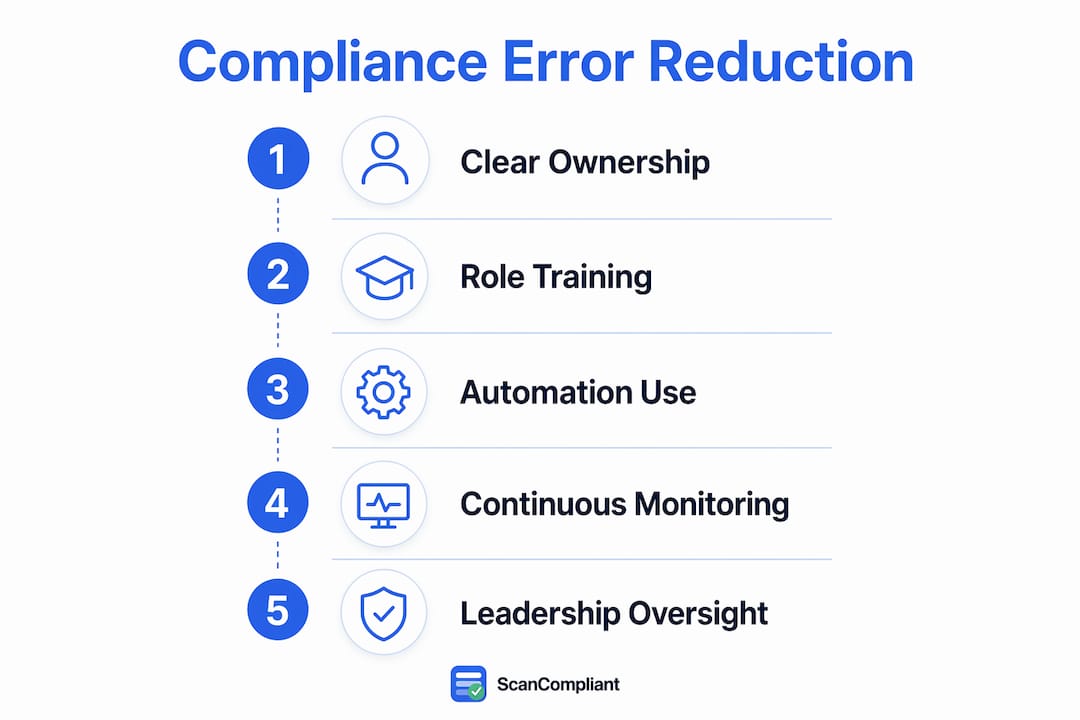
- Proactive program design anchored by board-level oversight and a written compliance officer mandate
- Named control ownership so every policy has one accountable person, not a department
- Role-specific micro-learning replacing annual slide decks that employees forget by lunch
- AI-assisted evidence gathering that cuts the manual workload on the most time-intensive tasks
- Continuous monitoring replacing point-in-time audits that only catch problems after the fact
- Cross-functional communication keeping regulatory, marketing, and legal teams aligned before content goes live
How do you build a proactive compliance program with clear ownership?
Effective compliance programs start at the board level. When leadership treats compliance as a business function rather than a legal formality, the tone carries through every layer of the organization. That board-level commitment translates into a written compliance program, a designated compliance officer with real authority, and a risk-based framework that maps controls to actual regulatory obligations.
The ownership piece is where most programs quietly fail. Generic team-level assignments diffuse accountability. Every control needs a single named owner responsible for execution, evidence collection, and remediation. When controls map to regulatory policies rather than the other way around, the program stays auditable and avoids the technical debt that accumulates when teams reverse-engineer policies to fit existing workflows.
Compliance dashboards give leadership real-time visibility into control status, error trends, and open remediation items. Without that visibility, problems surface only when an auditor finds them.
Pro Tip: Build your control library by starting with your FDA and FTC obligations, then mapping controls to those requirements. Never write a policy to justify a control that already exists.
Why role-specific training reduces errors better than annual compliance sessions
Compliance failures trace most often to employee confusion, not bad intent. A marketing writer who has never read the FTC’s endorsement guidelines will make claims that feel natural but trigger enforcement risk. Generic annual training does not fix that because it covers everything and therefore prepares people for nothing specific to their daily work.
Role-specific micro-learning modules solve this by targeting the exact risks each employee actually encounters. A content writer needs to understand structure/function claim limits. A paid media manager needs to know what FTC requires in influencer disclosures. Neither needs a 90-minute overview of HIPAA administrative safeguards. Shorter, focused modules tied to real job tasks produce measurably better comprehension and retention.

Training also needs to connect directly to compliance controls. Completion records become audit evidence. Verification steps confirm understanding, not just attendance. And when regulatory requirements shift, training updates should follow within weeks, not at the next annual cycle.
Clear communication channels between regulatory, marketing, and legal teams matter just as much as formal training. A Slack channel or weekly sync where marketing can ask “is this claim okay?” before content goes live prevents far more errors than any post-publication review.
Using automation and AI without losing human judgment
Evidence collection consumes more compliance hours than many other tasks, with 53% of organizations assigning a full-time employee equivalent solely to manual evidence gathering. That is the right place to start with automation, not the judgment-intensive work of interpreting a new FDA guidance document or responding to a regulator.
The efficiency gains are real. Manual SOC 2 evidence collection can consume 200–400 hours annually; automation typically reduces that to 20–40 hours of ongoing maintenance. Organizations using automated evidence collection report a 40–60% reduction in audit preparation time. Stripe’s production AI agent system, built on AWS, achieved a 26% reduction in review handling time while maintaining over 96% helpfulness ratings from human reviewers who retained final decision authority.
What that Stripe result actually shows: AI did not replace reviewers. It pre-fetched research so reviewers spent their time on judgment, not documentation hunting. The human stayed in the driver’s seat.
Automation does not replace human judgment in regulatory interpretation, vendor qualification, incident response, or audit interviews. Those require context no system has. The practical rule: automate high-frequency, repeatable tasks like access reviews and evidence pulls, and keep humans accountable for every decision that carries regulatory consequence.
Continuous monitoring replaces point-in-time testing that only tells you whether a control was working when you last looked. Real-time audit trails catch drift between reviews, which is exactly where auditors find problems. For telehealth and DTC brands publishing content daily, that cadence matters.
How Scancompliant helps teams cut content compliance errors
Scancompliant is built specifically for the gap that generic compliance platforms miss: the marketing content layer where FDA and FTC risk actually lives. Its AI scans content against a database of over 1,000 risk terms, surfacing subtle claim issues that human reviewers under time pressure routinely overlook. The platform has protected more than 200 brands and delivers prioritized findings in minutes rather than days.
| Capability | What it does for your team |
|---|---|
| AI content scanning | Flags risky language before publication using 1,000+ risk terms |
| Prioritized findings | Ranks issues by severity so reviewers focus on what matters most |
| Documented audit trail | Creates a timestamped compliance record for every piece of reviewed content |
| Role-based access | Keeps regulatory, marketing, and legal teams in the same workflow |
| Review cycle speed | Cuts the time from draft to approved content by up to 26% without cutting corners |
The platform keeps human authority central. Scancompliant surfaces the risk; your regulatory team makes the call. That structure satisfies the FDA and FTC expectation that a qualified person, not software, owns the compliance decision. For teams managing healthcare marketing compliance across multiple channels and product lines, the combination of speed and documented accountability is where the real value shows up.
Healthcare compliance teams operating under HIPAA alongside FDA and FTC obligations can also benefit from reviewing HIPAA compliance frameworks that emphasize the same principles: named ownership, continuous monitoring, and audit-ready documentation.
Scancompliant cuts your content review time without the compliance risk
Telehealth and DTC health brands publish fast. The compliance review process often can’t keep up, and that gap is where FDA warning letters and FTC actions originate.
Scancompliant closes that gap. The platform scans your marketing content against more than 1,000 FDA and FTC risk terms, returns prioritized findings in minutes, and builds a documented compliance trail your team can show regulators. Over 200 brands already use it to catch the subtle claims that slip past manual review. Your regulatory team keeps final authority. Scancompliant handles the scan. Start your first content review and see what your current process is missing.
Key Takeaways
Reducing compliance errors in healthcare marketing requires proactive program design, clear ownership, targeted training, and AI assistance that keeps humans in control of every final decision.
| Point | Details |
|---|---|
| Named ownership prevents drift | Every control needs one accountable person, not a team, to ensure execution and evidence collection. |
| Role-specific training outperforms annual sessions | Micro-learning tied to daily job risks reduces errors caused by employee confusion with dense policy language. |
| Automation targets evidence first | Organizations using automated evidence collection report a 40–60% reduction in audit preparation time. |
| Continuous monitoring beats point-in-time audits | Real-time audit trails catch control drift before regulators do, replacing snapshot evidence that creates audit theater. |
| Scancompliant accelerates content review | The platform scans content against 1,000+ risk terms and delivers prioritized findings in minutes, protecting over 200 brands. |
Recommended
- The Role of Technology in Compliance Teams: 2026 Guide – scancompliant.com
- Compliance Risk Reporting for Healthcare Teams: 2026 Guide – scancompliant.com
- Top 4 Loopholes.com Alternatives for Compliance 2026 – scancompliant.com
- Operational Compliance Risk in Healthcare: 2026 Guide – scancompliant.com