
What is continuous compliance monitoring?
Continuous compliance monitoring is the automated, ongoing process of verifying that your security controls and regulatory requirements stay satisfied in near real-time, rather than waiting for a quarterly or annual audit to find out something broke. NIST Special Publication 800-137 defines the practice as “maintaining ongoing awareness of information security, vulnerabilities, and threats to support organizational risk management decisions.” That framing matters: the goal is risk-aware decision support, not checkbox verification.
The term appears under several labels. Continuous controls monitoring (CCM), continuous compliance automation, and continuous compliance all describe the same operational pattern: automated, always-on verification of controls against framework requirements, with alerting when something drifts and a timestamped evidence trail ready for auditors at any moment.
Traditional audits confirm a control existed at a single point in time. Continuous monitoring proves it was consistently performing, every hour of every day. That distinction is often the difference between a minor audit finding and a major regulatory penalty.
Core elements of a continuous compliance monitoring program:
- Real-time telemetry: Automated data collection from systems, applications, and infrastructure as changes occur
- Automated policy checks: Machine-readable rules that evaluate controls against defined frameworks without human intervention
- Timestamped evidence capture: A permanent, auditable record of each control’s status over time
- Immediate alerting: Notifications fired the moment a control drifts out of compliance
- Remediation workflows: Predefined response procedures that move from detection to resolution with minimal delay
Why continuous compliance matters for your organization
The business case for ongoing compliance monitoring goes well beyond avoiding fines. Organizations that embed continuous verification into their operations gain faster incident detection, cleaner audits, and stronger stakeholder trust, all at the same time.
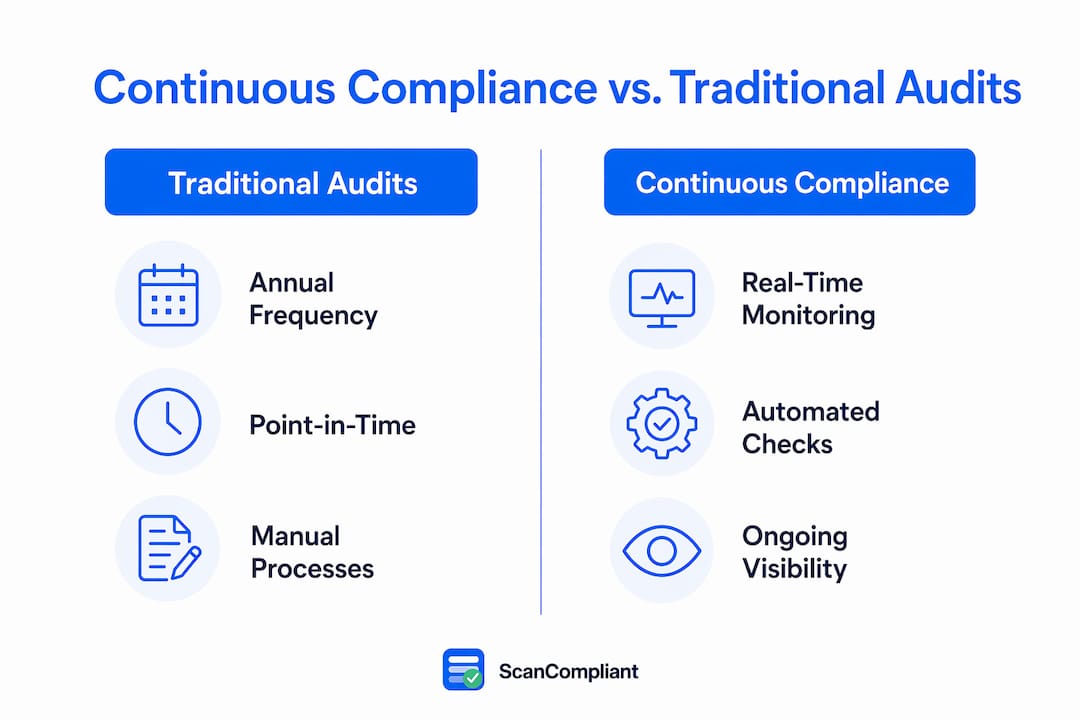
The core risk problem with periodic audits is the gap they leave open. Historical audit cycles left windows where controls could fail without anyone knowing. A misconfigured access policy, a lapsed encryption setting, a disabled branch protection rule: any of these can sit undetected for months under an annual audit model. Continuous monitoring closes that window by treating compliance as an operational state rather than an audit event.
The benefits extend to the bottom line as well. One global organization cut $18 million and 2,000 person-hours in the first year after integrating continuous compliance automation into its DevSecOps pipelines. That kind of efficiency gain comes from eliminating the manual evidence-gathering sprint that typically consumes weeks before every audit.
Key reasons organizations prioritize continuous monitoring:
- Reduces the window of undetected control failure from months to minutes
- Produces audit-ready evidence year-round, eliminating pre-audit scrambles
- Enables faster, more confident decisions by leadership with real-time compliance data
- Builds demonstrable trust with regulators, investors, and customers
- Supports faster software delivery by catching compliance issues before deployment
How continuous compliance differs from traditional audits
Traditional compliance audits are point-in-time assessments. An auditor arrives, reviews evidence from a defined period, and issues an opinion. The process works, but it has a structural blind spot: a control can fail on day one of the audit period and be remediated on day 364, and the audit may still pass. The auditor never sees the gap.
Continuous monitoring operates on an entirely different model. Controls are verified on a schedule measured in minutes or hours, not months, and every check produces a timestamped record. When a control changes state, an alert fires immediately. There are no surprises at audit time because the evidence trail is already built.
| Dimension | Traditional periodic audit | Continuous compliance monitoring |
|---|---|---|
| Frequency | Annual or quarterly | Every few minutes to hours |
| Evidence collection | Manual, pre-audit sprint | Automated, ongoing |
| Gap detection | After the fact, often months later | Immediate, upon control drift |
| Audit readiness | Requires preparation period | Always ready |
| Risk exposure window | months | Minutes to hours |
| Response to failures | Discovered at audit time | Alerts fire in real time |
One important clarification: continuous monitoring complements formal audits; it does not replace them. SOC 2 certification, for example, still requires a licensed CPA firm to examine your controls and issue an opinion. What continuous monitoring does is make that audit faster, less stressful, and far less expensive by maintaining the evidence infrastructure year-round.
Key components of an effective continuous compliance program
Effective continuous compliance monitoring rests on three foundational pillars: compliance automation, real-time visibility, and actionable insights. Each one is necessary; none is sufficient alone.

Policy as Code is where most mature programs start. Instead of documenting compliance requirements in a PDF that nobody reads before deployment, you encode them as machine-readable rules evaluated automatically in your CI/CD pipeline. Puppet’s integration with Center for Internet Security (CIS) benchmarks and U.S. Federal Frameworks, for example, translates those standards into self-enforcing policy that prevents non-compliant code from reaching production. The policy becomes a shared language between security and engineering teams, and it doubles as auditor-grade evidence.
The evidence pipeline is the operational core. Modern compliance monitoring tools connect to existing systems like GitHub, AWS, and Okta, pull current state data on every change, compute a hash of that state, and compare it against the last known-good baseline. Only real changes trigger AI analysis, which keeps alert volume manageable and processing costs low. The output is a structured verdict: not just “something changed” but “this specific change breaks control CC8.1 for this repository, and here is the before-and-after evidence.”
Alerting and remediation workflows close the loop. Detection without response is just noise. When a control fails, the system should automatically create a ticket, notify the control owner, and, where possible, trigger an automated fix such as reverting a misconfigured setting. The goal is to minimize the window between detection and resolution.
Core components at a glance:
- Automated policy enforcement (Policy as Code): Encodes compliance requirements as executable rules evaluated before and after deployment
- Real-time telemetry: Continuous data collection from cloud infrastructure, identity systems, and application environments
- Timestamped audit trail: Every control check produces a permanent, reviewable record
- Proactive alerting: Notifications tied to specific control owners with defined escalation paths
- Remediation integration: Alerts connect directly to incident response and ticketing workflows
- Shared responsibility awareness: In cloud environments, monitoring covers only customer-managed controls; provider-managed infrastructure requires separate vendor assurance
Pro Tip: In cloud environments, the AWS shared responsibility model draws a clear boundary between what you own and what your cloud provider manages. Your continuous monitoring program only validates controls on your side of that line. Map that boundary explicitly before you configure your first automated check, or you will have blind spots you do not know exist.
Common challenges when implementing continuous compliance monitoring
The biggest failure in continuous compliance programs is not technical. Alert handling and remediation ownership are the most frequent breakdown points: teams deploy monitoring tools, alerts fire, and nobody acts because it is unclear who owns the response or how urgent it is.
A close second is what practitioners call “automating the mess.” Organizations that take a broken manual process and automate it without redesigning it end up with a faster version of the same problem. Continuous monitoring requires intentional design, not just tooling. If your policy documentation is ambiguous, encoding it as Policy as Code will produce ambiguous automated checks.
Common implementation pitfalls:
- Alert fatigue: Too many low-priority alerts trained teams to ignore notifications, including critical ones
- Unclear ownership: No defined control owner means alerts sit unacknowledged until the next audit
- Automating bad processes: Encoding poorly designed manual workflows produces faster, more consistent failures
- Cultural resistance: Teams accustomed to annual compliance events resist the shift to continuous accountability
- Cloud boundary confusion: Assuming the monitoring tool covers provider-managed infrastructure when it only covers customer-managed controls
- Lack of escalation paths: Alerts with no defined escalation policy stall at the first responder
Pro Tip: Before deploying any monitoring tool, define three things in writing: who owns each control, what the response procedure is when that control fails, and what the escalation path looks like if the first owner does not respond within a defined window. Teams that skip this step spend the first six months watching alerts pile up with no action taken.
Best practices for running a continuous compliance program that actually works
The difference between a compliance program that passes audits and one that genuinely reduces risk comes down to how deeply the controls are embedded in your actual workflows. Running scans is not enough. The controls need to live inside your software delivery process, not alongside it.

Embedding Policy as Code into your CI/CD pipeline means compliance checks run automatically on every build, every deployment, and every infrastructure change. A developer pushing code that violates a PCI DSS configuration requirement gets immediate feedback, not a finding six months later. The role of technology in modern compliance teams is precisely this: shifting detection left so problems are caught before they reach production.
For healthcare and regulated industries specifically, automating marketing compliance review follows the same logic. Content that makes unsubstantiated claims or uses prohibited language should be flagged before publication, not after an FDA warning letter arrives.
Best practices for effective continuous compliance monitoring:
- Embed controls in CI/CD pipelines: Policy checks run on every code change, not just at audit time
- Use enforceable Policy as Code: Machine-readable rules prevent non-compliant configurations from deploying
- Maintain continuous audit-ready evidence: Every control check produces a timestamped record stored and accessible at any time
- Define control ownership explicitly: Every automated alert has a named owner and a documented response procedure
- Integrate with incident response: Compliance alerts trigger the same workflows as security incidents, not a separate manual process
- Review the program periodically: Regulations change, threat landscapes shift, and your monitoring rules need to keep pace
- Distinguish validation from effectiveness: Confirming a control exists is not the same as confirming it works; test both
What happens when continuous compliance breaks down
The consequences of compliance gaps are not hypothetical. Organizations relying solely on annual audits expose themselves to silent compliance failures lasting months, increasing both breach likelihood and regulatory penalties. A control that drifts out of compliance on January 15 and is not discovered until the october audit has been failing for nine months. Regulators and plaintiffs both notice that timeline.
Auditing confirms a control existed at a point in time. Continuous monitoring proves it was consistently performed. That distinction is often the key difference between a minor finding and a major penalty.
Business consequences of compliance failure:
- Regulatory penalties: HIPAA, PCI DSS, GDPR, and FTC enforcement actions carry fines that scale with the duration and severity of the gap
- Financial loss: Breach costs, remediation expenses, and legal fees compound quickly when a gap goes undetected for months
- Reputational damage: Public disclosure of a compliance failure erodes customer and investor trust in ways that outlast the fine itself
- Audit failures: Point-in-time audits can fail when evidence of consistent control performance is missing, even if the control is currently functioning
- Operational disruption: Emergency remediation after a discovered gap pulls engineering and compliance teams off planned work
- Loss of certifications: SOC 2, ISO 27001, and FedRAMP authorizations can be suspended or revoked when control failures are material
A permanent, timestamped audit trail does more than satisfy auditors. It removes the anxiety of not knowing your compliance status and gives leadership a defensible position if a regulator ever asks what you knew and when.
Continuous compliance as a strategic advantage, not just a requirement
The organizations that get the most value from continuous compliance monitoring are the ones that stopped treating it as a legal obligation and started treating it as operational infrastructure. That shift changes how leadership makes decisions, how engineering teams ship code, and how compliance teams spend their time.
The cultural evolution is real. Transitioning to continuous monitoring moves compliance from a sporadic, stressful event to an ongoing operational state. Compliance officers stop spending six weeks before every audit gathering evidence and start spending their time on actual risk management. Engineering teams stop getting compliance findings as surprises and start catching them in the development pipeline. Leadership gets a real-time view of organizational risk posture instead of a quarterly report that is already outdated.
Consider a mid-size healthcare technology company that previously spent eight weeks preparing for its annual SOC 2 audit, pulling engineers off product work to gather screenshots and access logs. After embedding continuous monitoring into its CI/CD pipeline and connecting it to its identity and cloud infrastructure, the same audit preparation dropped to under a week. The evidence was already there. The auditors reviewed a live, timestamped trail rather than a manually assembled package. The company passed with fewer findings than any prior year.
For telehealth and direct-to-consumer health brands, the compliance challenge extends beyond infrastructure controls into marketing content. Scancompliant addresses exactly this layer: its AI-powered platform scans marketing content against FDA and FTC requirements before publication, flagging risky language that human reviewers routinely miss. With over 1,000 risk terms in its database and more than 200 brands protected, Scancompliant provides the kind of documented compliance trail that turns a regulatory inquiry from a crisis into a manageable conversation. Healthcare compliance workflows that integrate content scanning alongside infrastructure monitoring give organizations a genuinely complete picture of their compliance posture.
The secure communication practices that healthcare providers rely on follow the same principle: continuous, automated verification of compliance controls produces better outcomes than periodic manual checks, whether the control is an email encryption setting or a marketing claim about a clinical outcome.
Compliance that runs continuously is compliance you can prove. That proof is what separates organizations that weather regulatory scrutiny from those that do not.
How to measure whether your compliance program is working
Continuous compliance monitoring generates data, but the program only improves if you track the right metrics. Raw alert volume tells you very little. Mean time to remediation tells you a great deal.
Key metrics and KPIs for continuous compliance monitoring:
- Mean time to detect (MTTD): How quickly the system identifies a control failure after it occurs
- Mean time to remediate (MTTR): How long it takes to resolve a detected compliance gap
- Control coverage rate: The percentage of required controls that are actively monitored versus manually checked
- Alert-to-action ratio: The proportion of alerts that result in a documented response, a low ratio signals alert fatigue
- Audit finding trend: Whether the number of findings per audit cycle is declining over time
- Evidence completeness: The percentage of controls with a continuous, unbroken evidence trail for the full audit period
- Policy drift frequency: How often controls drift out of compliance, a rising trend signals a process or configuration problem
Tracking MTTD and MTTR together reveals whether your alerting and remediation workflows are actually functioning. A program with fast detection and slow remediation has an ownership problem. A program with slow detection has a tooling or coverage problem. The metrics point you to the right fix.
Key Takeaways
Continuous compliance monitoring replaces periodic, point-in-time audits with automated, always-on verification that produces real-time evidence and closes the lengthy gaps where controls can silently fail.
| Point | Details |
|---|---|
| Closes the audit gap | Traditional audits leave windows where controls can fail without detection for months. |
| Three foundational pillars | Effective programs rest on compliance automation, real-time visibility, and actionable insights. |
| Ownership drives success | Alert handling and remediation ownership are the most frequent failure points, not technical capability. |
| Audit-ready evidence | A permanent, timestamped trail proves controls ran consistently, the key difference between minor findings and major penalties. |
| Strategic business value | Organizations that embed continuous monitoring cut audit preparation time, reduce costs, and gain real-time risk visibility for leadership. |
Scancompliant helps you close the compliance gap before it costs you
For telehealth and DTC health brands, the compliance risk that keeps regulatory teams up at night is not always a misconfigured server. It is a marketing claim that crossed a line, published before anyone caught it. Scancompliant scans your content against FDA and FTC requirements in minutes, flags risky language with prioritized findings, and builds the documented compliance trail your team needs when regulators ask questions.
More than 200 brands already use Scancompliant to catch what human reviewers miss. If your current review process relies on manual checks and institutional memory, see how Scancompliant works and find out what it would take to make your content compliance continuous.
Recommended
- The Role of Technology in Compliance Teams: 2026 Guide – scancompliant.com
- Operational Compliance Risk in Healthcare: 2026 Guide – scancompliant.com
- Marketing Compliance Software Features: 2026 Guide – scancompliant.com
- Compliance Review Stages: A Guide for Health and Marketing Teams – scancompliant.com