
Risk scoring assigns numeric or categorical values to potential compliance exposures, turning qualitative judgments into measurable, defensible data. At its core, the role of risk scoring in compliance is to give organizations a structured way to prioritize where attention and resources go, rather than treating every risk as equally urgent. Regulatory frameworks have formalized this expectation: FATF Recommendation 1 and the U.S. Bank Secrecy Act’s Customer Due Diligence Final Rule both require a risk-based approach, meaning risk scoring is not optional for most financial institutions and regulated entities.
Risk scoring serves four core functions in a compliance program:
- Prioritization: Identifies which risks demand immediate attention versus routine monitoring.
- Resource allocation: Directs compliance staff, budget, and controls toward the highest-exposure areas.
- Decision support: Provides documented, quantified rationale for compliance decisions and escalations.
- Regulatory adherence: Demonstrates to examiners that the organization applies proportionate controls based on assessed risk levels.
Without scores tied to these functions, compliance programs tend to default to checkbox exercises, reviewing everything with equal intensity and missing the exposures that actually matter.
Why risk scoring is critical for compliance in financial institutions
Financial institutions face a compliance environment where the volume of transactions, customers, and regulatory requirements makes manual, judgment-only oversight impractical. Risk scoring converts that complexity into something manageable. By assigning scores to customers, transactions, products, and business lines, compliance teams can focus enhanced due diligence where it belongs rather than spreading resources thin.
Anti-money laundering programs are the clearest example. A customer with a high-risk country of origin, a cash-intensive business type, and irregular transaction patterns will score materially higher than a salaried employee with predictable direct deposits. That score difference directly determines the level of monitoring applied, the documentation required, and whether a relationship requires senior approval. The BSA/AML framework makes this explicit: institutions must demonstrate that their controls are calibrated to risk, not applied uniformly.

Risk scoring also supports early detection. When a customer’s score rises because new transaction data reveals unusual behavior, the compliance team gets a signal before a suspicious activity report deadline forces their hand. That proactive posture is what separates effective compliance programs from reactive ones. Dynamic scoring that updates as business conditions and regulations change keeps the program current rather than anchored to last year’s risk profile.
What types of risks does compliance risk scoring actually cover?
Risk scoring in compliance programs typically spans five major categories, each requiring distinct data inputs and scoring logic:
- Regulatory risk: Exposure to penalties, enforcement actions, or license revocations from failing to meet applicable rules. Scored based on the number of applicable regulations, jurisdictional complexity, and recent examination findings.
- AML and financial crime risk: The probability that a customer, transaction, or product facilitates money laundering, terrorist financing, or sanctions evasion. Inputs include customer type, geography, transaction volume, and behavioral patterns.
- Fraud risk: Likelihood of internal or external fraud events. Scored using indicators like access controls, transaction anomalies, and historical incident rates.
- Operational risk: Risk from process failures, system outages, or human error that create compliance gaps. Scored by control coverage, testing results, and incident frequency.
- Reputational risk: Potential damage from public association with compliance failures, even when no legal violation occurs. Harder to quantify but often incorporated as a qualitative modifier on top of other scores.
Risk scoring covers both inherent risk (the exposure before any controls are applied) and residual risk (what remains after controls are factored in). A business line with high inherent AML risk but strong, tested controls may carry a moderate residual score. A business line with moderate inherent risk and weak controls can end up with a higher residual score than expected. That distinction drives the actual compliance response.
How risk scoring methodologies and models work
The most widely used calculation method is the likelihood-by-impact matrix, where a risk’s probability of occurring is multiplied by its potential severity to produce an inherent risk score. Control effectiveness then reduces that score to arrive at residual risk. Residual risk calculations typically apply control effectiveness tiers: Effective controls reduce inherent risk substantially, Partially Effective controls provide moderate reduction, and Ineffective controls offer little to no reduction.
Scoring scales vary by organization, but a common structure uses a 1–5 or 1–25 numeric range, sometimes mapped to color-coded categories for governance reporting. The table below illustrates a standard scoring framework:
| Risk Factor | Likelihood (1–5) | Impact (1–5) | Inherent Score | Control Effectiveness | Residual Score |
|---|---|---|---|---|---|
| AML customer risk | 4 | 5 | — | Partially Effective | High |
| Regulatory change exposure | 3 | 4 | — | Effective | Low-Medium |
| Fraud transaction anomaly | 3 | 5 | — | Ineffective | High |
| Operational process failure | 2 | 3 | 6 | Effective | Low |
| Sanctions screening gap | 5 | 5 | 25 | Partially Effective | High |
Model explainability matters as much as the math. Examiners and internal auditors need to understand why a customer received a particular score, not just what the number is. Models that produce scores without traceable logic create audit risk. The Federal Reserve’s guidance on compliance risk management programs emphasizes that scoring criteria must be documented in compliance standards so that assessments are consistent and defensible across business lines.
The step-by-step risk scoring process in compliance workflows
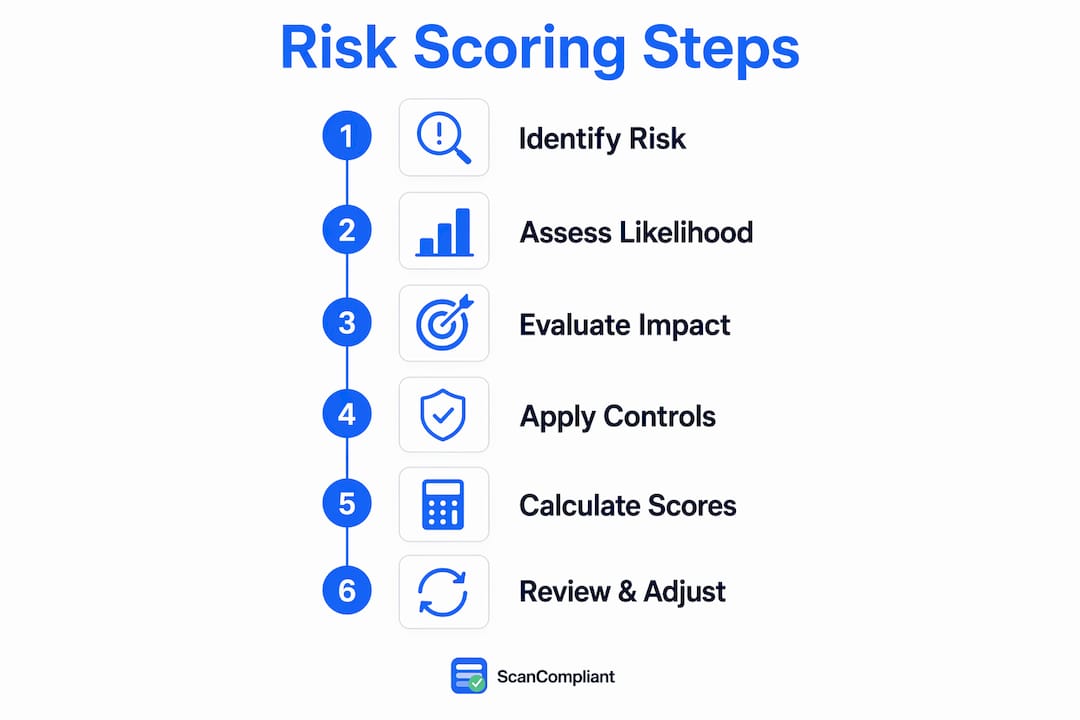
A well-run risk scoring process follows a defined sequence, not an ad hoc judgment call.
- Risk identification: Catalog the compliance risks relevant to each business activity, product, customer segment, and jurisdiction. Use regulatory inventories, prior examination findings, and business change logs as inputs.
- Data gathering: Collect the quantitative and qualitative data needed to score each risk. For AML, this includes customer due diligence data, transaction history, and geographic exposure. For regulatory risk, it includes applicable rule sets and recent regulatory changes.
- Inherent risk scoring: Apply the likelihood-impact matrix to each identified risk before considering controls. Document the rationale for each score, particularly where judgment is involved.
- Control assessment: Evaluate the effectiveness of existing controls using the Effective / Partially Effective / Ineffective framework. Testing results from compliance monitoring and internal audit feed directly into this step.
- Residual risk calculation: Combine inherent scores with control effectiveness ratings to produce residual risk scores. Flag any residual scores that exceed the organization’s risk appetite thresholds.
- Approval and escalation: Route high residual scores through the appropriate governance channel, whether that is a compliance committee, senior management, or the board, depending on severity.
- Workflow action assignment: Link each score to a specific compliance action. High scores trigger enhanced due diligence, increased monitoring frequency, or relationship review. Risk rating outputs should drive document requests, senior review requirements, and monitoring protocols, not sit as standalone numbers.
- Ongoing monitoring and reassessment: Monitor risk scores continuously and reassess formally at least every two years, or sooner when material business or regulatory changes occur.
Pro Tip: Document the rationale for every score adjustment, especially when an analyst overrides an automated calculation. That documentation is your first line of defense in an examination.
Common mistakes to avoid in compliance risk scoring
Most risk scoring failures trace back to a handful of recurring errors, not exotic edge cases.
- Static “set-and-forget” models: Building a risk scoring model and leaving it unchanged for years is one of the most common compliance failures. Regulations change, business lines evolve, and customer behavior shifts. A model that was accurate in 2022 may be dangerously outdated by 2026. Effective assessments require updates at least biennially, and more often when material changes occur.
- Averaging divergent risk factors: Combining a sanctions match (a critical indicator) with several low-risk factors into a single average score can dilute the alert into a moderate rating. Hard rules embedded in scoring models ensure that high-risk indicators like sanctions matches trigger immediate escalation rather than disappearing into an average.
- Ignoring qualitative nuance: Automated scores miss context. A customer flagged for cash transactions may be a legitimate retail business. Analyst override capability, backed by documented rationale, keeps the model grounded in reality. The best scoring systems treat automated outputs as a starting point, not a final verdict.
- Scores without linked actions: A risk score that sits in a spreadsheet without triggering a compliance response is not a control. It is a record. High-risk ratings require correspondingly enhanced due diligence and monitoring to demonstrate compliance effectiveness to regulators.
- Lack of audit trails: If you cannot show an examiner how a score was calculated, what data was used, and who approved it, the model provides no regulatory protection. Every scoring decision needs documentation.
How real-time transaction monitoring supports dynamic risk scoring
Transaction monitoring and risk scoring are most effective when they feed each other continuously rather than operating as separate functions. Real-time monitoring generates the behavioral signals that update customer and transaction risk scores as activity unfolds, rather than waiting for a scheduled reassessment.

When a customer’s transaction pattern shifts suddenly, such as a spike in wire transfers to high-risk jurisdictions or a series of structured cash deposits, monitoring systems flag those signals and feed them back into the risk scoring model. The customer’s score rises, triggering a review before the behavior escalates into a reportable event. Real-time integration supports rapid detection of suspicious behavior, fraud, and compliance risks that periodic reviews would miss entirely.
The operational benefit extends beyond detection. When monitoring and scoring are integrated, compliance teams spend less time manually reviewing low-risk accounts and more time on the cases that genuinely need attention. That efficiency is not just a resource management win. It also demonstrates to regulators that the compliance program is risk-calibrated, not uniformly applied. For healthcare compliance teams managing similar risk-based monitoring challenges, operational compliance risk frameworks offer a useful parallel for structuring continuous oversight.
How compliance risk scoring fits within enterprise risk management
Compliance does not own risk scoring in isolation. Within an enterprise risk management framework, the compliance function operates as part of the second line of defense, independently validating and testing the risk management work performed by the first line, which includes business units and risk managers.
That independence is what gives compliance risk scoring its credibility. When compliance validates the scores produced by risk managers, and internal audit then reviews compliance’s work, the organization has a genuine three-layer oversight structure. The Federal Reserve’s guidance reinforces this: compliance functions should perform monitoring continuously and testing more frequently than internal audit, which typically operates on an annual cycle.
Effective ERM integration also requires that risk scores feed governance reporting. Board-level risk committees need aggregated views of residual risk across business lines, not just transaction-level scores. Compliance functions that translate scores into meaningful firmwide metrics close the gap between operational risk data and strategic oversight.
How risk scoring integrates with regulatory frameworks and standards
Risk scoring is not a best practice that organizations adopt voluntarily. Regulatory frameworks in the United States mandate it explicitly. The Bank Secrecy Act’s Customer Due Diligence rule requires financial institutions to identify and verify beneficial owners and assess the nature and purpose of customer relationships, which is a scoring exercise by design. FinCEN’s guidance operationalizes this through customer risk rating requirements that directly inform AML program design.
The Basel Committee on Banking Supervision’s compliance principles require compliance functions to identify, document, and assess compliance risks associated with business activities, including new products and customer relationships. Performance indicators such as irregular trading or payments activity serve as inputs to those assessments, connecting transaction-level data to the broader risk scoring framework.
For healthcare and DTC health brands, the FDA and FTC regulatory environment creates its own risk scoring requirements. Marketing claims carry regulatory exposure that can be quantified and scored much like financial crime risk, with high-risk language triggering review workflows before content goes live. Risk-prioritized compliance approaches apply the same scoring logic to content risk that financial institutions apply to customer risk.
FATF Recommendation 1 sets the international standard: countries and institutions must identify, assess, and understand their money laundering and terrorist financing risks, then apply measures proportionate to those risks. That proportionality principle is the foundation of every risk-based scoring model in use today.
What effective risk scoring looks like in practice
A regional bank implementing a customer risk rating program under BSA/AML requirements illustrates how scoring translates into compliance outcomes. The bank segments its customer base by risk tier using inputs including customer type, geographic exposure, product usage, and transaction behavior. Customers scoring in the high tier receive enhanced due diligence at onboarding, annual relationship reviews, and real-time transaction monitoring with lower alert thresholds. Customers in the low tier receive standard due diligence and periodic reviews.
When the bank’s monitoring system flags a business customer for a sudden increase in international wire activity, the customer’s score updates automatically. The compliance team receives a prioritized alert, reviews the account, and either documents a satisfactory explanation or files a suspicious activity report. The score drove the workflow, the workflow drove the action, and the action is documented for examination.
Healthcare compliance teams face a structurally similar challenge. A DTC health brand scoring its marketing content for FDA and FTC risk uses the same logic: assign risk values to specific claim types, flag high-scoring content for legal review before publication, and document the review trail. Compliance risk reporting frameworks for healthcare teams apply these scoring principles to content rather than transactions, but the underlying methodology is identical.
Physician practice compliance programs also use risk scoring to prioritize audit focus. Audit methodologies in healthcare organizations apply risk-based scoring to billing, coding, and documentation risks, directing audit resources toward the highest-exposure areas rather than reviewing everything with equal intensity.
How risk scoring shapes decisions and resource allocation
Risk scoring changes how compliance departments spend their time and money. Without scores, teams tend to allocate resources based on volume or seniority of the business requesting review. With scores, allocation follows risk. High-residual-risk areas get more frequent testing, more senior review, and more documentation. Low-risk areas get proportionate, lighter-touch oversight.
The Federal Reserve’s compliance guidance makes this connection explicit: the scope and frequency of compliance monitoring and testing should be a direct function of the risk assessment results. Testing frequency should correspond to risk levels, with compliance functions performing more frequent tests in high-risk areas than internal audit alone would cover.
Resource allocation decisions also extend to technology investment. A compliance team that has scored its risks knows which processes carry the highest residual exposure and can make a defensible case for investing in monitoring tools, additional staff, or training in those specific areas. That specificity is what separates a risk-informed budget request from a general ask for more compliance resources.
Challenges and limitations of compliance risk scoring
Risk scoring is a powerful tool, but it has real constraints that compliance professionals need to account for. Compliance risk does not aggregate as cleanly as market or credit risk. A firm with operations across multiple jurisdictions and business lines faces compliance exposures that span different rule sets, different regulators, and different enforcement environments. Producing a single firmwide compliance risk score that is meaningful for governance reporting remains genuinely difficult.
Static siloed scores often lack utility for firmwide oversight without integration into broader performance metrics. A score that accurately reflects AML risk in one business line may not translate to a comparable score in a different line with different regulatory exposure. Calibration across business lines requires ongoing effort and governance commitment.
Model bias is another real limitation. Scoring models trained on historical data can perpetuate past blind spots. If certain customer segments were historically under-scrutinized, their scores may be artificially low not because they carry less risk, but because less data was collected on them. Compliance teams need to audit their models for these patterns, not just their outputs.
Finally, scores can create false confidence. A customer with a moderate score is not a low-risk customer. It is a customer whose known risk factors, measured by the current model, produce a moderate result. New information, a change in business activity, or a regulatory update can shift that picture quickly.
Emerging trends shaping risk scoring in 2026
Artificial intelligence and machine learning are changing what risk scoring models can do. Traditional models rely on static rule sets and periodic recalibration. AI-powered models can identify patterns across thousands of variables simultaneously, updating scores in near real time as new data arrives. AI applications in regulatory risk detection are moving from pilot programs to production deployments across financial services and healthcare compliance.
Network analysis is gaining traction for AML risk scoring specifically. Rather than scoring individual customers in isolation, network-based models map relationships between customers, accounts, and transactions to identify risk that only becomes visible at the network level. A customer who scores moderate individually may score high when the model accounts for connections to flagged entities.
Explainable AI is becoming a regulatory expectation, not just a technical preference. Examiners increasingly ask compliance teams to demonstrate that their automated scoring models produce traceable, auditable outputs. Black-box models that produce accurate scores but cannot explain their logic are creating examination friction at institutions that adopted them early.
Continuous monitoring is replacing the annual or biennial assessment cycle for high-risk areas. Iterative compliance review processes that update scores as new information arrives are becoming the standard for organizations that want to stay ahead of regulatory expectations rather than catch up to them.
Risk scoring sits at the center of every effective compliance program, connecting regulatory requirements to operational decisions and resource allocation.
Key Takeaways
| Point | Details |
|---|---|
| Risk scoring is regulatory-mandated | FATF Recommendation 1 and the BSA CDD rule require a risk-based approach, making scoring a compliance obligation. |
| Residual risk drives action | Inherent risk minus control effectiveness equals residual risk, and residual scores should trigger specific workflow responses. |
| Static models create audit risk | Scores must be updated at least biennially and more often when business or regulatory changes occur. |
| Hard rules prevent risk dilution | Sanctions matches and other critical indicators need escalation rules that override averaging logic. |
| Compliance acts as second-line validator | The compliance function independently tests risk management scoring, with internal audit reviewing compliance’s work as the third line. |
Recommended
- Risk-Prioritized Compliance for Healthcare Marketers: 2026 Guide – scancompliant.com
- Compliance Risk Reporting for Healthcare Teams: 2026 Guide – scancompliant.com
- AI in Regulatory Risk Detection: 2026 Guide – scancompliant.com
- The Role of Technology in Compliance Teams: 2026 Guide – scancompliant.com