
What are the top Responsiv.ai alternatives right now?
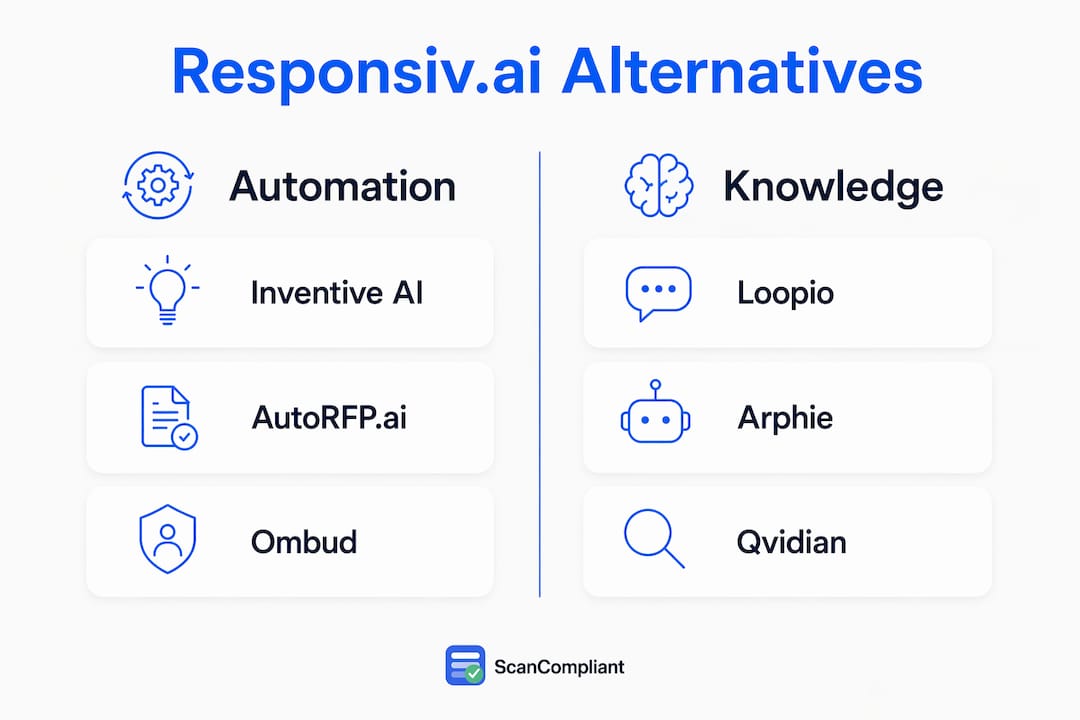
The strongest responsiv.ai alternatives in 2026 are Inventive AI, Loopio, AutoRFP.ai, Arphie, and Qvidian for enterprise RFP and proposal management, with Proposify and PandaDoc covering mid-market needs. The right pick depends on whether your team needs deep regulatory gap analysis, high-volume automation, or a lighter proposal workflow tool.
Before diving in, one distinction matters: Responsiv.ai is a regulatory change management platform, not a general proposal tool. It converts complex laws into actionable tasks with audit trails and gap analysis. Most tools marketed as alternatives are actually RFP response or proposal software. They solve a different problem. If you genuinely need regulatory text shredding and obligation mapping, your shortlist looks different than if you need faster RFP responses.
| Tool | Best For | AI Capabilities | Integration Ease | Support Quality | Trial/Demo |
|---|---|---|---|---|---|
| Inventive AI | High-volume RFP automation | Advanced NLP, 90% faster drafting | Strong CRM/doc integrations | Dedicated onboarding | Demo available |
| AutoRFP.ai | Large-scale RFP and DDQ automation | Semantic search, format-preserving export | API-based integrations | Email and chat | Demo available |
| Loopio | Collaborative knowledge management | AI-assisted answer suggestions | Salesforce, Slack, Google Drive | Strong, tiered plans | Free trial |
| Arphie | Content consistency and QA | AI quality checks, version control | Document management systems | Responsive support | Demo available |
| Proposify | SMB proposal creation | Template AI, drag-and-drop builder | HubSpot, Stripe, Zapier | Chat and email | Free trial |
| Qvidian | Enterprise content governance | Analytics, content tagging | Salesforce, SharePoint | Enterprise SLAs | Demo available |
| SparrowGenie | Mid-market affordability | AI response drafting | Standard API | Email support | Demo available |
| Autogen AI | Legal and compliance drafting | Clause-level AI, risk spotting | Document systems | Dedicated CSM | Demo available |
| RocketDocs | Workflow-integrated proposals | Versioning, workflow automation | CRM and DMS | Tiered support | Demo available |
| Tribble AI | Sales and legal speed | Real-time drafting, risk detection | CRM integrations | Chat support | Demo available |
| 1up | Team collaboration | Dashboard tracking, collaboration | Slack, Google Workspace | Email and chat | Free trial |
| SiftHub | Analytics-driven proposals | Data analytics integration | API and CRM | Email support | Demo available |
| PandaDoc | All-in-one doc workflows | Template AI, e-signature | — | Tiered, responsive | Free trial |
| QorusDocs | Sales content reuse | AI content discovery | Microsoft 365, Salesforce | Dedicated support | Demo available |
| Ombud | Regulated industry compliance | Compliance tracking, audit trails | Enterprise DMS | Enterprise support | Demo available |
| Tribble | — | — | — | — | — |
Inventive AI and AutoRFP.ai lead for pure automation volume. Loopio wins on collaborative knowledge management. Ombud is the closest match for teams that need compliance tracking and audit trails alongside RFP workflows.
How do these alternatives compare on features, pricing, and AI?
Inventive AI vs. AutoRFP.ai: the automation-first pair
Inventive AI positions itself on speed, with vendor claims of 90% faster drafting and high accuracy on automated responses. It suits procurement teams running dozens of RFPs monthly who need first drafts generated without manual copy-paste from a content library. AutoRFP.ai takes a different angle: its semantic search finds the right prior answer even when the new question is worded differently, and it exports responses in the original RFP format, which saves significant reformatting time on complex DDQs and security questionnaires.

Pricing for both is not publicly listed; you’ll need to request a quote. That’s typical for enterprise RFP tools, where seat count and volume drive the final number.
Loopio and Arphie: knowledge management done right
Loopio’s core strength is its answer library. Teams build a searchable repository of approved responses, and the AI surfaces the best match for each new question. Integration with Salesforce, Slack, and Google Drive means proposal work stays inside the tools your team already uses. Arphie adds a layer that Loopio doesn’t emphasize as heavily: AI-driven quality checks that flag inconsistencies before a response goes out. For organizations where brand or regulatory consistency across proposals is a real risk, Arphie’s version control and content governance features are worth the extra scrutiny.
Proposify and PandaDoc: the mid-market workhorses
Proposify is built for speed and simplicity. Its drag-and-drop editor and template library let a small sales team produce polished proposals without a dedicated proposal manager. PandaDoc goes further by folding in e-signature, payment collection, and contract management, making it genuinely useful beyond the proposal stage. If your team needs one tool to handle the full document lifecycle from proposal to signed contract to payment, PandaDoc is the practical choice. Proposify publishes tiered plans; PandaDoc offers a free tier with paid plans for advanced features.
Pro Tip: If you’re evaluating PandaDoc primarily for RFP responses rather than general document workflows, test its content library depth against Loopio’s before committing. PandaDoc’s RFP-specific features are lighter than its proposal and contract capabilities.
Qvidian and Ombud: enterprise compliance and governance
Qvidian targets large organizations where proposal content governance is as important as speed. Its analytics show which content performs well in won deals, which helps content managers prune the library over time. Ombud is the most compliance-forward option on this list. It tracks obligations, maintains audit trails, and is built for regulated industries where a proposal error can trigger a regulatory finding. If your organization operates in financial services, healthcare, or insurance and needs audit-ready compliance documentation alongside RFP workflows, Ombud deserves a close look.
Autogen AI, Tribble AI, and SiftHub: specialized use cases
Autogen AI focuses on legal document generation with clause-level AI and risk flagging. It’s the right fit for legal and compliance teams that draft contracts and regulatory submissions, not just sales proposals. Tribble AI targets sales and legal teams that need real-time drafting assistance during live negotiations. SiftHub differentiates on analytics: it tracks which proposal sections correlate with wins and losses, giving data-driven teams a feedback loop that most RFP tools lack.
QorusDocs, RocketDocs, SparrowGenie, and 1up
QorusDocs integrates tightly with Microsoft 365 and Salesforce, making it the natural choice for organizations already deep in the Microsoft ecosystem. Its AI surfaces relevant content from across SharePoint and OneDrive without requiring users to maintain a separate library. RocketDocs emphasizes workflow automation: routing, approvals, and version control are its core differentiators. SparrowGenie is positioned as the cost-effective mid-market option, with AI drafting capabilities at a lower price point than enterprise platforms. 1up focuses on team collaboration, with dashboard-level progress tracking that keeps proposal managers informed without chasing contributors for status updates.
A critical distinction: RFP tools vs. regulatory change management
Regulatory defensibility requires more than fast drafting. Responsiv.ai’s core function is mapping regulatory updates to internal policy gaps with timestamped audit trails, a capability that none of the RFP tools above replicate. If your evaluation started because you need regulatory change management for financial services or insurance compliance, the tools in this list solve a different problem. True RCM alternatives include enterprise GRC platforms that offer regulatory text shredding and obligation tracking. Evaluators who substitute a proposal tool for an RCM platform often discover the gap during an audit, not before.
How to choose the best Responsiv.ai alternative for your organization
The single biggest mistake buyers make is conflating proposal speed with regulatory compliance capability. Before you shortlist, decide which problem you’re actually solving.
Key evaluation criteria:
- Automation depth: Does the tool generate full draft responses, or does it only surface suggested content for humans to assemble? Inventive AI and AutoRFP.ai lean toward full automation; Loopio and QorusDocs lean toward assisted retrieval.
- AI sophistication: Semantic search matters more than keyword matching for large content libraries. Test each vendor’s search with a question phrased differently from how the answer is stored.
- Integration ecosystem: Integration with existing systems outweighs raw AI speed for enterprise teams. A tool that doesn’t connect to your CRM or document management system creates manual work that erases the automation benefit.
- Regulatory defensibility: If you need audit trails and obligation mapping, look at Ombud or enterprise GRC platforms, not general proposal tools.
- Audit trail capability: Any tool handling sensitive regulatory data should produce timestamped, exportable records of who approved what and when.
- Security credentials: SOC 2 compliance is the baseline for tools handling sensitive regulatory or procurement data. Ask every vendor for their current certification status before signing.
- Scalability: A tool that works for a five-person team may not handle a 200-person procurement organization without significant customization costs.
Pro Tip: When requesting a demo, bring three real RFP questions from a recent submission and ask the vendor to show the tool answering them live. Vendors who redirect to scripted demos are often hiding gaps in their AI’s actual performance.
Pricing transparency varies widely. Proposify and PandaDoc publish their rates; most enterprise tools require a sales conversation. Factor in per-seat costs, volume limits, and contract length when comparing total cost. A tool with a lower monthly rate but a three-year lock-in may cost more than a flexible annual subscription at a higher price point.
Onboarding quality predicts long-term adoption. Ask each vendor how long implementation typically takes, whether a dedicated customer success manager is included, and what the process looks like for migrating an existing content library. Tools with strong onboarding support, like Loopio and Qvidian, tend to show faster time-to-value than self-serve platforms.
Scancompliant addresses a compliance gap these RFP tools leave open
The RFP and proposal tools covered above handle procurement workflows well. What they don’t address is the marketing compliance risk that telehealth and direct-to-consumer health brands face every time they publish content.
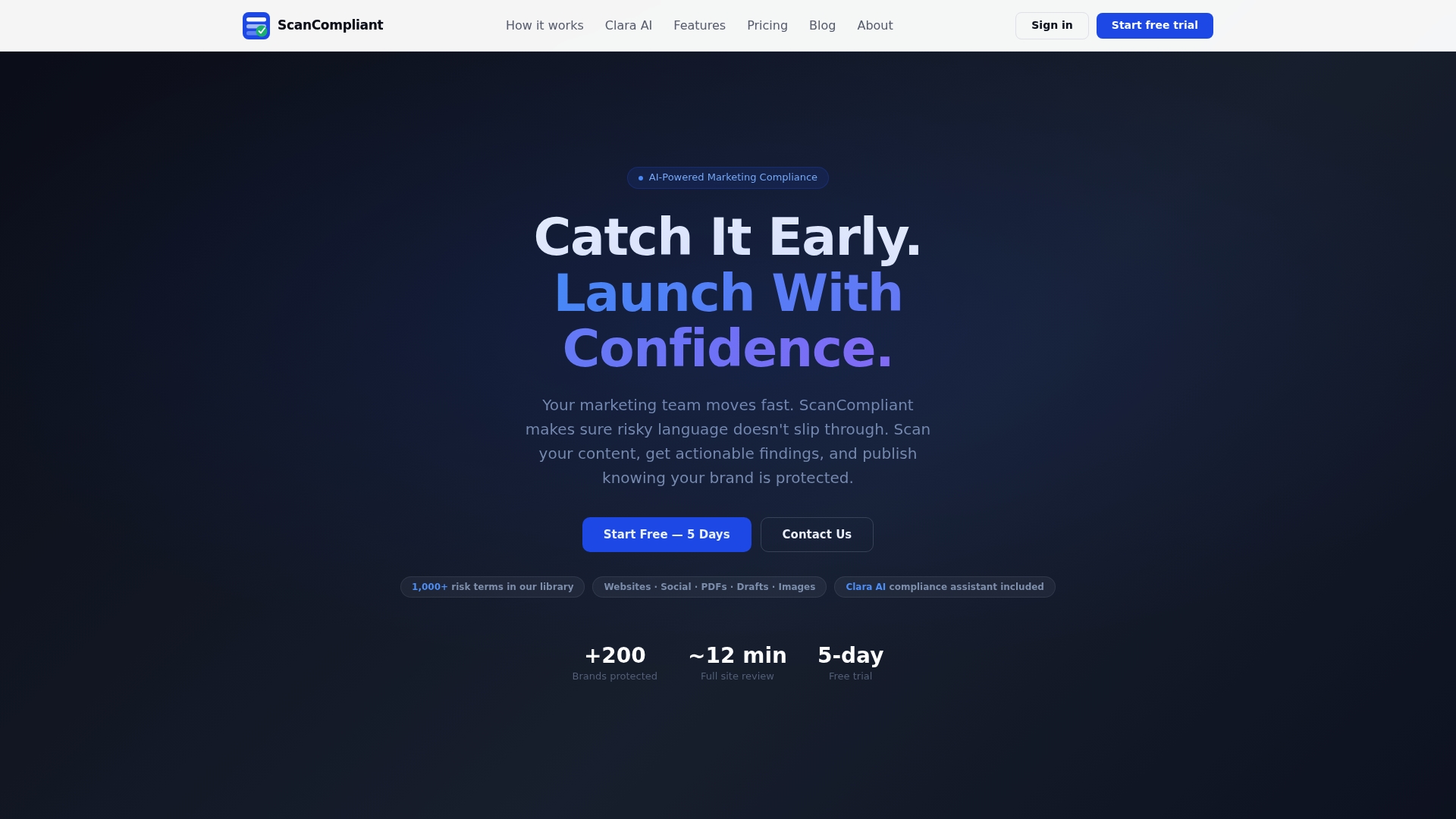
Scancompliant is built for exactly that gap. It scans marketing content against FDA and FTC requirements before publication, flagging risky claims that human reviewers routinely miss. Its database covers over 1,000 risk terms, and it has already protected more than 200 brands with documented compliance review trails. For regulatory and marketing teams at DTC health companies, that audit trail is the same kind of defensibility that Ombud provides for RFP workflows, applied to content marketing instead.
If your organization uses one of the RFP tools above for procurement and also publishes health or wellness marketing content, Scancompliant fills the compliance layer those tools don’t touch. You can review Scancompliant’s pricing to assess fit alongside your existing software budget.
Key takeaways
The best Responsiv.ai alternative depends on whether you need RFP automation, proposal management, or true regulatory change management, and conflating these categories is the most common and costly evaluation mistake.
| Point | Details |
|---|---|
| Clarify the problem first | RFP tools and regulatory change management platforms solve different problems; choose based on your actual compliance need. |
| Prioritize integration fit | A tool that connects to your CRM and document systems delivers more value than one with faster AI but no ecosystem fit. |
| Demand security credentials | SOC 2 certification is the baseline for any tool handling sensitive regulatory or procurement data. |
| Match tool to org size | Inventive AI and Qvidian suit enterprise volume; Proposify and PandaDoc fit smaller teams with lighter workflows. |
| Scancompliant for content risk | For telehealth and DTC health brands, Scancompliant adds marketing compliance scanning that RFP tools don’t provide. |