
A healthcare brand compliance program is a structured system that ensures all marketing content, messaging, and brand assets meet FDA, FTC, and OIG regulatory standards while reducing legal and reputational risk. The industry term for this discipline is “compliance program management,” and the healthcare brand compliance program best practices outlined here translate that framework into daily marketing workflows. Regulators in 2026 assess programs based on documented, measurable evidence of ongoing operations, not just the existence of written policies. That shift changes everything for marketing and compliance teams.
1. Build written policies that govern brand messaging
Written policies are the foundation of any effective brand compliance program. They translate complex regulatory requirements from the OIG, FDA, and FTC into clear, role-specific rules that marketing teams can actually follow. Without written policies, compliance decisions become inconsistent and indefensible during audits.
Policies must cover more than legal disclaimers. They should define approved messaging tone, claim categories, visual identity standards, and the review process for new content. Annual comprehensive reviews of brand assets, including logos and messaging, are the minimum standard for keeping policies current with regulatory changes.
A centralized, digital policy library gives every team member access to the current approved version. Version control prevents teams from working off outdated guidance, which is one of the most common sources of noncompliance in healthcare marketing.
- Define claim categories: therapeutic claims, outcome claims, and comparative claims each carry different regulatory risk levels.
- Assign policy ownership to a named individual, not a department.
- Set a review calendar tied to known regulatory update cycles.
Pro Tip: Include visual identity elements, such as logo usage rules and approved color palettes, directly inside your compliance policies. Brand consistency and regulatory compliance reinforce each other when they share the same document.
2. Designate compliance leadership with real authority
Compliance leadership determines whether a program functions or just exists on paper. A designated compliance officer must have direct authority over brand messaging decisions, not just advisory input. Operational accountability for compliance now extends beyond the compliance team to marketing, IT, and legal.

The most effective programs use a compliance committee that includes representatives from marketing, legal, IT, and senior leadership. This structure prevents siloed decisions and catches regulatory risks that a single reviewer would miss. A RACI model (Responsible, Accountable, Consulted, Informed) makes accountability visible and auditable.
Leadership visibility into compliance metrics matters as much as the metrics themselves. When senior leaders review compliance dashboards monthly, teams treat compliance as a priority rather than a formality.
- Assign a named compliance officer with documented authority over marketing content.
- Form a cross-functional committee that meets on a defined schedule.
- Use a RACI model to clarify who approves, reviews, and escalates content decisions.
- Share compliance metrics with senior leadership monthly.
3. Apply risk-based policies tailored to your organization
Generic compliance policies fail because they ignore the specific risk profile of each organization. Tailored programs that adapt controls to specific marketing contexts and organizational risk profiles outperform one-size-fits-all approaches. A telehealth brand running direct-to-consumer ads faces different regulatory exposure than a hospital system publishing educational content.
Start with a formal risk assessment that maps your marketing channels, content types, and audience segments to applicable regulations. Paid social media advertising, for example, carries higher FTC scrutiny than a published white paper. Your policies and review workflows should reflect those differences.
Risk-prioritized compliance delivers stronger organizational buy-in because teams understand why certain content requires more review. When the rationale is clear, compliance feels like protection rather than obstruction.
4. Train teams continuously, not just annually
Annual compliance training is the minimum legal requirement. It is not sufficient to change behavior. 2026 OIG standards emphasize ongoing, measurable training programs linked to compliance outcomes, not just completion rates. That distinction separates programs that pass audits from programs that prevent violations.
Role-specific training works better than generic sessions. A copywriter needs to understand FTC endorsement guidelines. A campaign manager needs to understand FDA off-label promotion rules. Giving both the same training wastes time and misses the specific risks each role creates.
Document every training session, including attendance, assessment scores, and follow-up actions. Those records become your defense during a regulatory investigation. Regulators look for evidence that training changed behavior, not just that it happened.
- Run quarterly micro-training sessions focused on recent regulatory updates.
- Use scenario-based assessments that test judgment, not just recall.
- Track completion rates and assessment scores by role and department.
- Tie training outcomes to performance reviews for marketing and compliance staff.
Pro Tip: Integrate compliance coaching directly into campaign planning meetings. When a compliance officer joins the creative brief review, teams catch risky claims before they reach copy, not after.
5. Build communication channels that support safe reporting
Open communication is a core element of every effective compliance program. Anonymous reporting mechanisms, such as hotlines or web-based forms, give marketing staff a safe way to flag concerns without fear of retaliation. Organizations that skip this step create a culture where problems stay hidden until they become violations.
Effective reporting channels share four characteristics:
- Accessibility. Every employee knows how to access the reporting tool without asking a manager.
- Anonymity. Reports can be submitted without identifying the reporter.
- Documentation. Every report receives a logged response and a documented investigation outcome.
- Follow-through. Teams see that reports lead to action, which reinforces the value of speaking up.
Building a culture that encourages proactive reporting requires visible leadership support. When compliance officers publicly acknowledge and act on reports, teams learn that the system works. That trust is what makes reporting channels effective rather than decorative.
6. Monitor content continuously and audit on a risk schedule
Continuous monitoring and periodic auditing serve different functions. Monitoring catches problems in real time as content moves through production. Auditing evaluates whether your compliance program is working as designed. A documented audit workplan focused on current enforcement priorities improves regulatory resilience and gives you a defensible record.
The table below shows how monitoring and auditing differ in practice:
| Method | Frequency | Purpose | Output |
|---|---|---|---|
| Continuous content monitoring | Ongoing | Catch risky claims before publication | Real-time flags and corrections |
| Scheduled compliance audits | Quarterly or annually | Evaluate program effectiveness | Audit report with findings |
| Targeted risk audits | As needed | Investigate specific high-risk areas | Root cause analysis and corrective plan |
Corrective action plans and root cause analysis prevent issues from recurring and build a defensible compliance posture. Documenting the “why” behind each violation, not just the “what,” is what regulators look for during investigations.
- Maintain a live audit workplan updated with current FDA and FTC enforcement priorities.
- Require root cause analysis for every corrective action, not just a fix.
- Apply consistent disciplinary standards so enforcement feels fair and predictable.
- Use content compliance audits to evaluate brand messaging against regulatory benchmarks on a defined schedule.
7. Integrate compliance early in content development
Compliance by design means involving compliance review at the campaign planning stage, not the final approval stage. Aligning marketing and compliance teams early avoids costly rework and produces brand messages that are both compliant and effective. Late-stage compliance review is the single biggest source of content delays in healthcare marketing.
The practical fix is a content review workflow that includes a compliance checkpoint at the brief stage. Before a copywriter writes a single word, the campaign brief should confirm which claim categories are approved, which channels are in scope, and which regulatory standards apply. That 15-minute checkpoint eliminates hours of revision later.
Automated quality controls integrated into marketing workflows enable continuous compliance and audit readiness without slowing production. Scancompliant’s AI-powered platform scans content against more than 1,000 risk terms and delivers prioritized findings in minutes, giving marketing teams a compliance check that fits inside a normal content calendar.
Key Takeaways
Effective healthcare brand compliance programs require documented, operational evidence across every element, from written policies to corrective actions, not just the existence of a compliance plan.
| Point | Details |
|---|---|
| Operationalize every element | Regulators assess programs based on documented evidence of function, not just written policies. |
| Train continuously by role | Role-specific, ongoing training changes behavior and creates audit-ready documentation. |
| Monitor and audit separately | Continuous monitoring catches real-time risks; scheduled audits evaluate program effectiveness. |
| Integrate compliance early | Involving compliance at the brief stage prevents costly rework and content delays. |
| Tailor policies to your risk profile | Risk-based policies aligned to your channels and audience outperform generic frameworks. |
What I’ve learned from watching compliance programs fail
The most common failure I see is treating compliance as a document rather than a practice. Organizations spend months writing a compliance manual, publish it to a shared drive, and then consider the program complete. Regulators do not. They look for evidence that the program runs every day, in every content decision, across every team.
The second failure is separating marketing and compliance into opposing camps. When compliance officers show up only to reject content, marketing teams learn to route around them. The programs that work are the ones where a compliance officer sits in the campaign kickoff meeting and helps shape the brief. That shift from gatekeeper to collaborator changes the entire dynamic.
The third failure is underestimating how fast regulations move. FDA guidance on digital health claims, FTC rules on endorsements, and OIG enforcement priorities all shifted in 2025 and will shift again. A compliance program that does not include a mechanism for tracking regulatory updates is already behind. The teams that build regulatory monitoring into their weekly workflow are the ones that stay ahead of enforcement, not just ahead of violations.
Technology matters here, but only when it fits the workflow. An AI scanning tool that marketing teams actually use in production is worth more than an enterprise platform that sits unused because it requires a separate login and a 20-minute review process. The best compliance programs are the ones that make doing the right thing the easiest path.
— Compliant Team
How Scancompliant supports your compliance program
Healthcare marketing teams that want to move from static policies to a living compliance program need tools that fit inside their existing content workflows.
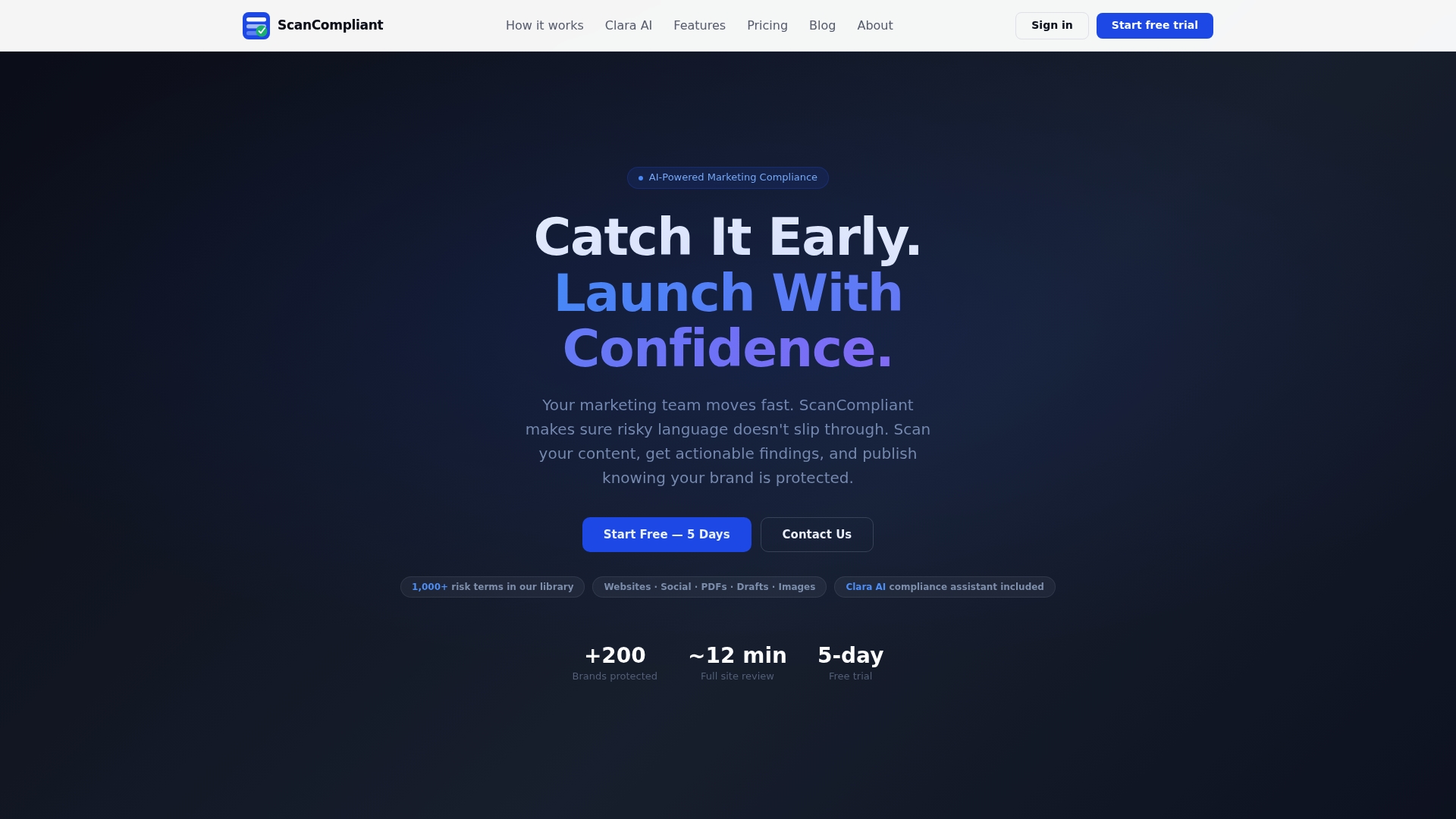
Scancompliant’s AI-powered platform scans marketing content against more than 1,000 risk terms, identifies risky language before publication, and delivers a documented compliance trail that holds up under regulatory scrutiny. The platform has already protected more than 200 brands, giving marketing and compliance teams faster review cycles without sacrificing accuracy. For teams building or strengthening a healthcare compliance program, Scancompliant provides the real-time scanning and audit documentation that regulators expect to see in 2026.
FAQ
What are the seven elements of a healthcare compliance program?
The OIG defines seven core elements: written policies and procedures, compliance leadership, training and education, open communication channels, auditing and monitoring, disciplinary standards, and corrective action. 2026 OIG guidance requires programs to demonstrate each element through documented, measurable evidence.
How often should healthcare brand compliance policies be reviewed?
Policies should be reviewed at least annually and updated whenever significant regulatory changes occur. Annual reviews of brand assets, including messaging standards and visual identity guidelines, are the minimum standard for maintaining regulatory alignment.
What is the difference between compliance monitoring and a compliance audit?
Monitoring is continuous and catches risks in real time as content moves through production. Auditing is periodic and evaluates whether the compliance program itself is functioning as designed. Both are required for a defensible compliance posture.
Why does compliance training need to be role-specific?
Generic training misses the specific regulatory risks each role creates. A copywriter faces different FTC and FDA exposure than a campaign manager or a social media coordinator. Role-specific training tied to measurable outcomes is what 2026 standards require for audit readiness.
How does early compliance integration reduce marketing risk?
Involving compliance at the campaign brief stage prevents risky claims from entering the content pipeline. Early alignment between marketing and compliance teams eliminates costly late-stage revisions and produces brand messages that are both effective and compliant.
Recommended
- Risk-Prioritized Compliance for Healthcare Marketers: 2026 Guide – scancompliant.com
- Telehealth Email Marketing Compliance Tips for 2026 – scancompliant.com
- How Content Compliance Audits Work for Healthcare Teams – scancompliant.com
- Compliant Content Release in Healthcare Marketing: 2026 Guide – scancompliant.com