
Advertising for medical devices in the United States must be truthful, substantiated, and confined to the device’s cleared or approved intended use. The FDA governs labeling and restricted-device promotion, the FTC polices deceptive claims on non-restricted devices, and the DOJ can pursue criminal misbranding charges when violations are severe. Miss any piece of that framework and you risk a warning letter at best, a seizure or prosecution at worst.
TL;DR:
- Promotional claims must directly link to clinical evidence supporting the specific intended use listed in FDA clearance, avoiding broader or unapproved benefits.
- Marketing materials across websites, social media, and broadcast channels are all regulated as labeling, requiring consistent truthful claims and full risk disclosure.
- Enforcement activity is active, with the FDA and FTC issuing hundreds of sanctions for overstated claims, buried risks, and off-label promotion, especially in creative content.
- Compliance workflows should include claim-to-evidence mapping, pre-approval processes, and automated content scans to prevent violations before publication.
- Cross-border marketing requires market-specific claim reviews and local legal oversight to avoid violations in international jurisdictions.
Table of Contents
- Who Regulates Medical Device Advertising: FDA, FTC, and DOJ
- Intended Use, On-Label Claims, and the Off-Label Trap
- Channel Rules: Websites, Social Media, Influencers, and Broadcast
- Enforcement Activity: What the Numbers Signal for Your Risk Model
- A Pre-Publish Compliance Checklist That Actually Works
- Form 2253: When You Have to Send Materials to the FDA
- Quick Fixes for Common Ad Copy Mistakes
- Marketing Medical Devices Abroad: When U.S. Rules Aren’t Enough
- How Device Class Changes What You’re Allowed to Claim
- Digital Advertising Tech Is Outrunning the Rulebook
- Why Compliance Review Needs to Move as Fast as Marketing Does
- Faster, Documented Compliance Reviews With Scancompliant
- Where to Go Deeper
- Sources
Who Regulates Medical Device Advertising: FDA, FTC, and DOJ
Two agencies split the work, and the split trips up more marketing teams than any single rule. The FDA has jurisdiction over device labeling and over advertising for restricted devices, meaning anything that requires a prescription or professional supervision. The FTC handles truth-in-advertising enforcement for devices that fall outside FDA’s restricted category, chasing false or unsubstantiated claims the way it would for any consumer product.
The two agencies do not work in silos. Between 2018 and 2022, the FDA reported 255 enforcement actions tied to medical device advertising, while the FTC logged 67 over the same period, a scale of activity that shows both agencies stay active, not dormant, in this space, according to a GAO review of federal device advertising oversight.
The practical fallout for your team:
- Company websites, brochures, and even linked third-party pages often count as labeling in FDA’s eyes, not just “marketing.”
- A claim that’s fine on a non-restricted device can be a violation the moment it appears next to a prescription device.
- Legal and marketing review need to happen together, not in sequence, because a copywriter’s word choice can trigger a different agency’s jurisdiction entirely.
Intended Use, On-Label Claims, and the Off-Label Trap
Every device carries a cleared or approved “intended use,” the specific condition, population, or purpose the FDA reviewed before clearance. Marketing copy that implies a broader use, a different population, or an unapproved benefit doesn’t just risk a fine. It can legally expand the device’s intended use, which triggers new premarket requirements the manufacturer never planned for.
Off-label promotion is where this gets serious. Promoting a device for a use outside its cleared indication can create misbranding exposure under the Federal Food, Drug, and Cosmetic Act, and the FFDCA operates on strict liability. Intent doesn’t matter the way it might in a fraud case. The claim exists, or it doesn’t.
Substantiation standards follow a clear hierarchy:
- Safety and efficacy claims need to trace directly back to the clinical data that supported clearance or approval.
- Comparative claims (“faster than,” “more accurate than”) require head-to-head evidence, not marketing inference from separate studies.
- Superiority claims carry the heaviest evidentiary burden and are the most common trigger for FTC scrutiny on non-restricted devices.
Pro Tip: Build a one-page “claim to evidence” map for every device before a single ad goes live. If you can’t point to the exact clinical section backing a claim in under thirty seconds, the claim isn’t ready to publish.
Channel Rules: Websites, Social Media, Influencers, and Broadcast
Different channels carry different mechanics, but the underlying obligation, truthful and on-label, never changes.
- Websites and owned content. The FDA treats company websites, product pages, videos, and mobile apps as labeling. That means linked pages fall under your responsibility, even when a third party hosts them.
- Social media. A character limit doesn’t waive the risk-disclosure requirement. Reposting a customer’s glowing comment or letting an influencer describe unapproved benefits can create liability as if your company wrote it directly.
- Broadcast advertising. Restricted-device ads must disclose intended use and key risks within a brief statement, then make full package labeling available through a toll-free number, a printed ad, or a web URL, so viewers who want the complete risk picture can get it.
The common thread across all three: brevity is never an excuse to drop risk information. It only changes how you deliver the fuller version.
Enforcement Activity: What the Numbers Signal for Your Risk Model
255 FDA actions and 67 FTC actions in five years is not background noise. It’s a signal that both agencies treat medical device advertising as an active enforcement priority, not a low-risk backwater, per the GAO’s federal oversight report.
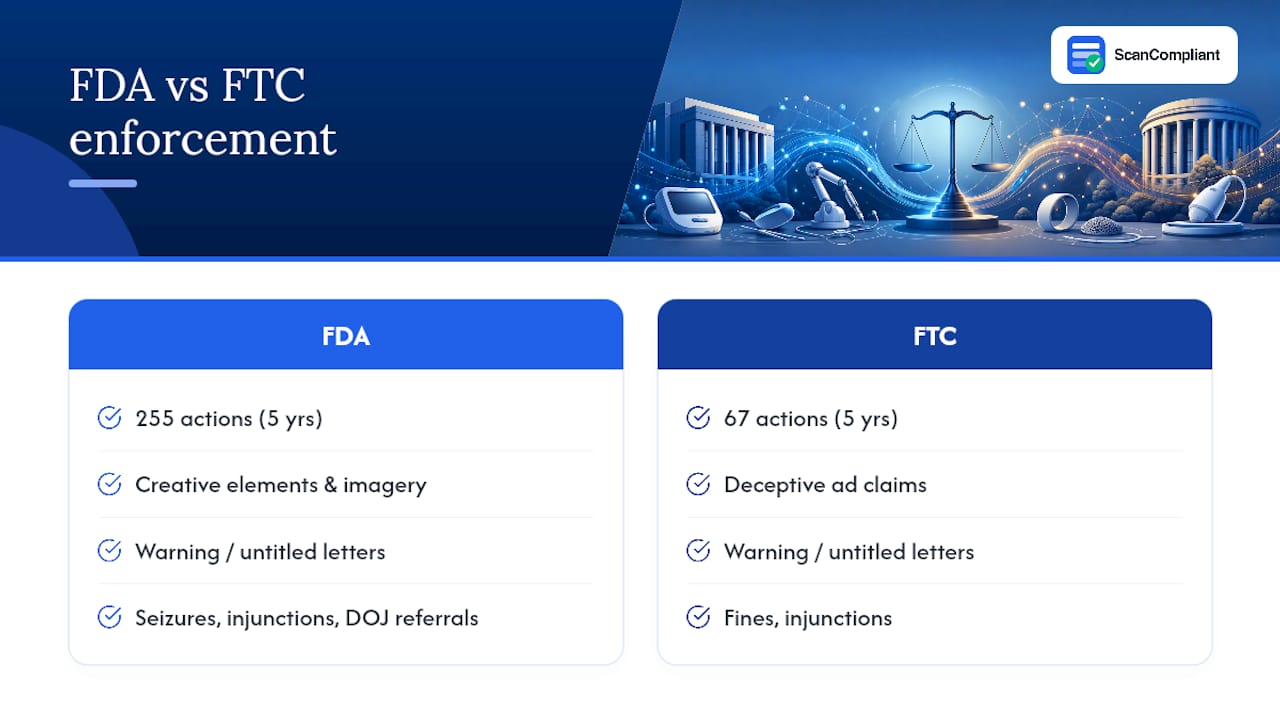
The recurring triggers are predictable: claims that overstate benefit, risk information buried or omitted, off-label promotion dressed up as “patient education,” and social posts where the visual and tonal impression outweighs the fine print. Recent scrutiny has expanded into creative elements themselves, imagery, music, and editing choices that shape the overall impression a consumer walks away with.
Consequences scale with severity. Warning letters and untitled letters handle most first offenses. Seizures and injunctions follow repeated or willful violations. DOJ referrals, and the criminal exposure that comes with them, are reserved for the worst cases of deliberate misbranding.
A Pre-Publish Compliance Checklist That Actually Works
Most compliance failures aren’t dramatic. They’re small gaps, a claim nobody double-checked, a script an influencer edited after approval, a linked page nobody reviewed. A structured workflow closes those gaps before publication instead of after a warning letter.
Start with a central claim register. Every public claim, whether on a landing page or a fifteen-second social clip, should map to the specific document and section that substantiates it. This one habit prevents most internal disputes and stops off-label language from slipping through unnoticed.
- Map every claim to evidence before creative work begins, not after.
- Run a clinical evidence check against the current cleared or approved labeling, not a prior version.
- Review creative elements, not just text, since imagery and tone shape the overall impression.
- Approve influencer scripts in writing before anything airs or posts.
- Verify every linked page, since FDA holds you responsible for content you link to.
- Confirm full risk information is accessible wherever the primary piece is space-constrained.
Pro Tip: Assign one person the sole authority to sign off on final claim language. Split ownership across five people means five different interpretations of “close enough.”
Ongoing monitoring matters as much as the pre-publish gate. Automated content scans, a documented audit trail, and a clear takedown procedure for anything flagged post-publication all reduce the window between “something’s wrong” and “it’s fixed.” Someone on the team also needs clear ownership of Form 2253 filings when required. A solid regulatory review checklist built for healthcare marketing teams gives this structure a repeatable home instead of a one-off exercise.
Form 2253: When You Have to Send Materials to the FDA
Manufacturers of prescription or restricted devices must submit specimens of promotional labeling and advertising to the FDA using Form 2253 at initial dissemination. Interactive or real-time promotional media, think dynamic web content or frequently updated social assets, can often be submitted on a quarterly basis instead of piece by piece, per FDA regulatory guidance on promotional submissions. Keep dated archives of every submitted piece. When an enforcement inquiry lands on your desk, a clean submission history is the fastest way to demonstrate good faith.
Quick Fixes for Common Ad Copy Mistakes
Use the exact cleared indication language rather than a looser paraphrase that implies a wider population or better outcome. Treat every repost, testimonial, and influencer caption as company-authored unless it’s been fully vetted, because that’s how the FDA sees it.
- Stick to cleared phrasing; avoid words like “prevents” or “cures” unless the labeling says so.
- Pre-approve influencer and UGC content in writing before it goes live.
- If a platform’s format won’t fit a full risk statement, skip the specific claim entirely or add a clear, prominent link to complete labeling.
Marketing Medical Devices Abroad: When U.S. Rules Aren’t Enough
A campaign compliant with FDA and FTC standards can still violate the rules in another market the moment it crosses a border. The European Union’s Medical Device Regulation, the UK’s MHRA advertising rules, and similar frameworks in Canada and Australia each set their own limits on comparative claims, testimonials, and direct-to-consumer promotion.
The safest approach treats every market as its own compliance project rather than a translation exercise. A claim substantiated for U.S. clearance may not meet the evidentiary bar a foreign regulator expects, particularly for comparative or superiority language. Build a market-by-market claim review into your launch timeline the same way you’d build in a translation review, because catching a violation before launch is dramatically cheaper than a post-launch takedown across five countries at once.
Two practices reduce cross-border risk substantially. First, maintain separate claim registers per market rather than one global document, since a claim cleared for U.S. audiences may need different substantiation or softer language elsewhere. Second, route any global campaign through local regulatory counsel before the creative is finalized, not after. Consumer device categories that straddle wellness and medical claims, like at-home beauty and skincare devices, face this exact tension: a device marketed as a “beauty tool” domestically can trip FDA clearance thresholds the moment its claims start sounding medical, a dynamic explored in this consumer guide to FDA clearance for beauty devices. The same claim creep happens internationally, just under a different regulator’s microscope.
How Device Class Changes What You’re Allowed to Claim
Class I, II, and III devices don’t just face different premarket pathways. They face meaningfully different advertising latitude, and treating them identically in a marketing review is a common source of unnecessary risk.
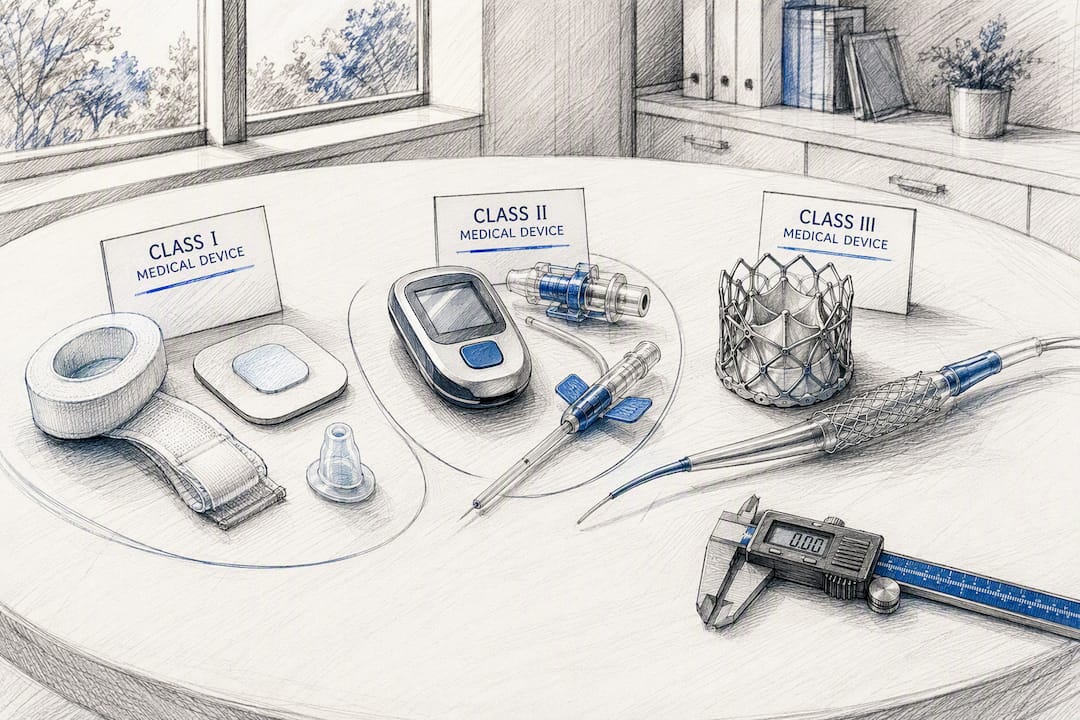
Class I devices, things like bandages or basic reusable exam tools, carry the lightest regulatory burden and correspondingly the most marketing flexibility, provided claims stay within general controls and don’t imply performance nobody tested. Class II devices, the largest category and the one most digital health and DTC brands work with, generally require 510(k) clearance, and every advertising claim needs to trace back to what that clearance actually covers, not what the device could plausibly do. Class III devices, the highest-risk category requiring premarket approval, face the tightest scrutiny of all. These are often the restricted devices that trigger FDA’s advertising jurisdiction directly, meaning even routine promotional pieces may need Form 2253 submission and brief-statement risk disclosure.
The practical takeaway for marketing teams juggling a multi-device portfolio: a claim template that works for a Class I product will almost certainly need retooling for a Class II device, and a Class III device may need an entirely separate review track with legal sign-off built into every asset, not just the launch campaign.
Digital Advertising Tech Is Outrunning the Rulebook
Programmatic ad placement, AI-generated creative variants, and algorithmically personalized social content are creating compliance gaps that didn’t exist a few years ago. When an ad platform auto-generates dozens of headline variations from one approved base ad, who reviewed the fortieth variant that swapped “may help” for “helps”?
That gap is exactly where recent enforcement attention has moved. Regulators are paying closer attention to how creative elements, tone, pacing, background music, an image’s implied before-and-after, shape the overall consumer impression, sometimes more than the literal text does. A perfectly qualified sentence sitting under an image that visually promises a dramatic outcome can still add up to a misleading impression in the eyes of a reviewer.
Two digital-specific risks deserve direct attention: dynamic creative optimization that spins new copy variants without a human compliance check, and short-form video where a risk disclosure gets clipped for pacing before it airs. Both require the same fix, a review gate that catches automated or algorithmically generated content before it publishes, not after a platform’s engagement algorithm has already put it in front of ten thousand people. Teams that treat digital ad tech as self-policing are the ones showing up in next year’s enforcement statistics.
Why Compliance Review Needs to Move as Fast as Marketing Does
Legal review has always been the bottleneck marketing teams love to complain about, and honestly, they’re not wrong to. The old model, a compliance officer manually reading every landing page and social caption, was never built for a world where a marketing team publishes daily and a platform algorithm can turn one approved ad into forty variants overnight.
What’s changed isn’t the underlying law. FDA’s intended-use doctrine and FTC’s truth-in-advertising standard are decades old. What’s changed is the volume and speed of content that has to pass through that same legal filter, and manual review simply hasn’t scaled with it. A risk-term database that flags implied claims automatically, paired with a documented review trail, doesn’t replace legal judgment. It gives legal judgment somewhere useful to land instead of burning hours hunting for the needle in a hundred-page content calendar.
— Compliant Team
Faster, Documented Compliance Reviews With Scancompliant
Scancompliant gets your marketing content in front of regulators’ expectations before it ever reaches theirs. Instead of a manual line-by-line legal read on every landing page, social caption, and product listing, the platform scans your content against a database of more than 1,000 risk terms, flags implied and explicit claims a human reviewer might skim past, and suggests compliant rewrites in plain English.

The result for regulatory and marketing teams is a faster approval cycle without cutting corners on FDA and FTC obligations. Every scan creates a documented trail, so when an enforcement inquiry or an internal audit asks “who reviewed this and when,” you have an answer instead of a scramble. More than 200 brands already use it to keep claim language consistent across websites, social posts, and product listings without slowing down publishing schedules. If your team wants to see how a scan handles your own current content, start with the Scancompliant platform and check the security and data handling details if PHI exposure is part of your evaluation.
Where to Go Deeper
- GAO report on federal oversight of medical device advertising
- Morgan Lewis analysis on FDA scrutiny of device marketing
- FDA general controls and labeling guidance
- FDA broadcast brief-statement guidance (govinfo)
This article is general information, not a substitute for advice from a qualified lawyer. Consult a qualified legal professional about your own circumstances before acting on anything here.
Sources
- Medical Advertising: Federal Oversight of Devices | U.S. GAO
- Marketing Medical Devices: Navigating Increased FDA Scrutiny | Morgan Lewis
- FDA — General controls for medical devices (labeling and regulatory controls)
- Consumer-directed broadcast advertisement guidance (FDA) — brief statement procedures (govinfo)