
X prohibits promotion of medical and pharmaceutical products by default, permitting only a short list of documented exceptions: telehealth providers, NABP-accredited pharmacies, FDA-cleared devices, and pharma advertisers who meet specific labeling requirements. Before writing a single line of creative, confirm your category qualifies for an exception and start account verification and prior authorization, since that review runs on its own clock and will bottleneck launch dates far more than copywriting ever will.
TL;DR:
- Only a limited set of healthcare categories, such as licensed pharmaceuticals, accredited telehealth, FDA-approved devices, NABP-licensed pharmacies, and certain supplements, can qualify for exceptions on X.
- Health-related targeting is highly restricted, forbidding custom audiences based on health conditions or inferred interests, and disabling health-specific conversion tracking across categories.
- Disease treatment or cure claims are strictly prohibited, while structure/function claims with supporting evidence are more likely to be approved, especially for pharmaceuticals.
- Verification involves detailed, category-specific documentation and must be completed before launching, with incomplete submissions causing delays that hinder campaign timelines.
- Pre-approval and ongoing policy monitoring, including scanning for risk terms with tools like ScanCompliant, are essential to avoid rejection triggers and maintain compliance.
Table of Contents
- What Does X’s Healthcare and Medical Advertising Policy Cover?
- Which Health Categories Get Approved on X?
- What Targeting and Measurement Restrictions Apply?
- Which Claims and Creative Elements Get Ads Rejected?
- How Do You Get Account Verification and Pre-Approval?
- Building an Audit-Ready Compliance Checklist
- How Does Enforcement and the Appeals Process Work?
- Where Should You Monitor Ongoing Policy Changes?
- Why Verification Isn’t the Finish Line
- How ScanCompliant Fits Into Your X Ads Workflow
- Where to Verify Current Policy Details
- Sources
What Does X’s Healthcare and Medical Advertising Policy Cover?
X’s healthcare and pharmaceutical policy sits inside the platform’s broader Ads Policies framework, and it works as a blanket ban with named carve-outs rather than a permissive rulebook with occasional restrictions. That structure matters operationally: if your product or service isn’t on the exceptions list, no amount of clever disclaimers gets it approved.
X ties restrictions to two variables: the specific product or service being advertised, and the country being targeted, so a supplement ad cleared for one market can still get rejected in another. Healthcare content also intersects with Ad Quality standards and Restricted Content rules, meaning a technically permitted health ad can still fail review for unrelated creative issues like misleading formatting or unverified claims.
The policy language lives in a few connected places advertisers need to track together:
- The core healthcare and pharmaceutical products policy page
- The general X Ads policies hub covering account eligibility and enforcement
- Country-specific addenda that override or narrow the global default
Global policy sets the floor. Country-level rules can raise it. Teams that only read the global page and skip local variations are the ones who get blindsided mid-campaign.
Which Health Categories Get Approved on X?
Not every health-adjacent business needs to fight for an exception. Five categories carry defined, if narrow, paths to approval, and each comes with its own documentation burden.
- Prescription pharmaceuticals. Rx advertisers face location-based restrictions and must include required safety labeling in creative. Expect X to ask for evidence of regulatory clearance in the target market before running any drug-branded ad, and expect stricter treatment than OTC categories.
- Telehealth platforms. Providers must demonstrate licensing that matches the states or countries they’re targeting. Because clinician licensure is state-specific in the US, a telehealth brand advertising nationally often needs to segment campaigns by region rather than run one blanket ad set. Prior authorization is common here even after account verification.
- Medical devices. Approval hinges on clearance class. A Class I device with minimal regulatory oversight moves faster than a Class II or III device requiring FDA 510(k) or PMA documentation, and higher-risk devices almost always need pre-approval before the ad account can run related creative.
- Pharmacies. X distinguishes between NABP-accredited online pharmacies and traditional brick-and-mortar operations advertising local services. Online pharmacies lacking NABP credentials face near-automatic rejection, since credential absence is one of the easiest triggers for automated review to catch.
- Supplements and nutraceuticals. These get more latitude than drugs but only for structure/function claims (“supports joint health”) rather than disease claims (“treats arthritis”). Rejections here spike when advertisers imply a therapeutic outcome without the pharma-level evidence to back it, which X won’t accept from a supplement listing regardless of intent.
Analyses of the 2026 exceptions structure confirm this same core list: telemedicine, pharmacies, and FDA-approved devices remain the primary carve-outs, with verification and prior approval as recurring prerequisites across all of them.
What Targeting and Measurement Restrictions Apply?
X bans custom audiences built on health status and disables health-related conversion events for advertisers in restricted categories, which changes how you plan attribution before you build anything else.
Inferred-health targeting categories face the same ban even when you never directly collect health data. Interest signals tied to conditions like depression or anxiety are off-limits for segmentation, a restriction industry guidance flags specifically around mental health content, where diagnostic language and inferred-status targeting both trigger review.
Here’s what that means for your measurement stack:
- No custom audience uploads built from CRM health data or diagnosis history
- No conversion events tagged to health-specific actions (prescription refills, symptom checkers, diagnosis funnels)
- Broad demographic and contextual targeting still works, but health-inferred interest categories don’t
- Server-side event tracking with consented first-party data becomes your main attribution path once platform-side health events are disabled
Industry commentary on 2026 enforcement notes platforms have tightened these measurement restrictions specifically for healthcare advertisers, which means the gap between what you could measure in 2023 and what you can measure now keeps widening. Plan your attribution model before creative freeze, not after your first campaign underperforms and you go looking for why.
Which Claims and Creative Elements Get Ads Rejected?
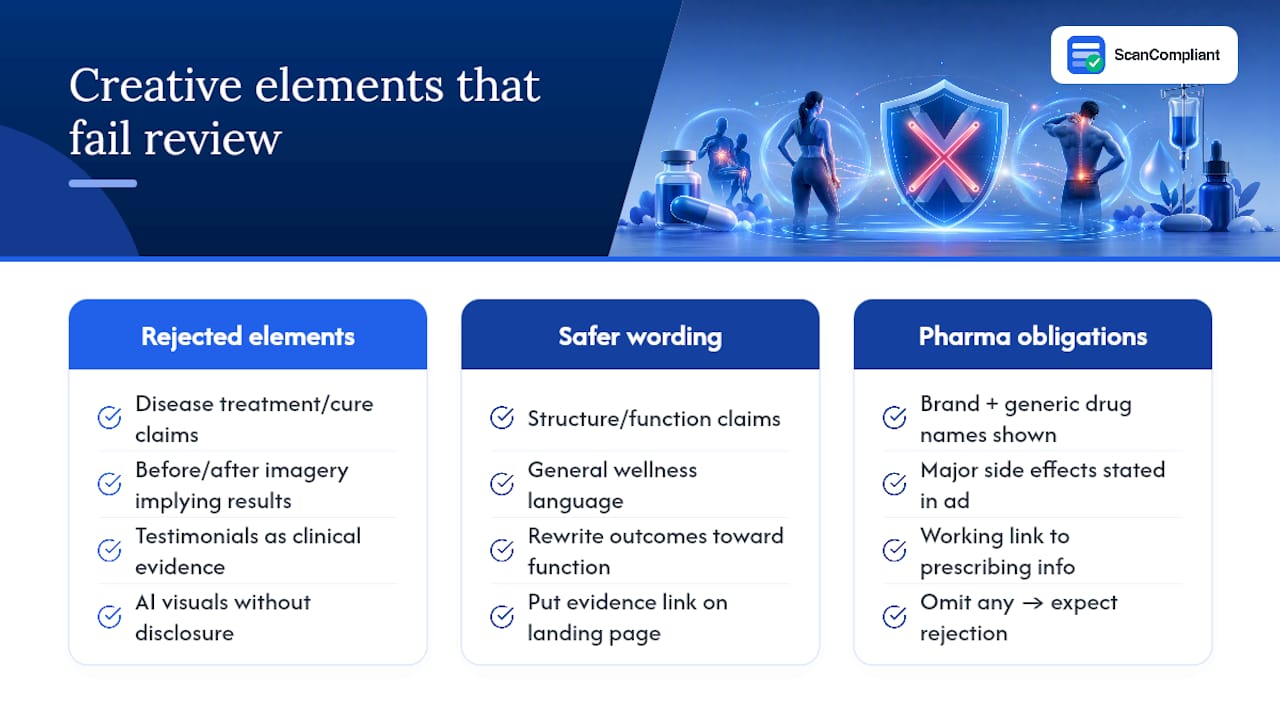
Disease treatment and cure claims are the fastest way to lose an ad, full stop. “Cures anxiety” or “treats diabetes” gets flagged whether the product is a supplement, a device, or a wellness app, unless you’re a pharma advertiser who has met the platform’s evidence requirements for that exact claim.
Structure/function claims and general wellness language survive review far more often. “Supports healthy blood sugar levels” reads differently to a reviewer than “reverses type 2 diabetes,” even when the underlying product is identical.
Pharma ads carry extra creative obligations: generic drug names alongside brand names, major side effects stated in the ad itself (not buried on the landing page), and a working link to full prescribing information. Skip any one of these and expect rejection regardless of how compliant the core message reads.
Visual and testimonial rules matter just as much as copy. Before/after imagery implying guaranteed results, patient testimonials framed as clinical evidence, and AI-generated visuals without disclosure all draw scrutiny. Remediation guidance consistently points toward the same fix: move the claim from disease/treatment framing to structure/function framing, then back it with an evidence link on the landing page rather than in the ad itself.
Rejected: “Finally, a supplement that treats chronic inflammation.”
Approved: “Formulated to support your body’s natural inflammatory response. See the research.”
Pro Tip: Run every disease-adjacent claim through a simple test: could a reasonable reviewer read this as promising a cure? If yes, rewrite toward function, not outcome, before submission.
How Do You Get Account Verification and Pre-Approval?
Verified Organizations status is the entry ticket for healthcare-adjacent ad accounts, and X’s own ads policy documentation makes clear that advertisers remain responsible for legal compliance regardless of what the platform approves.
Documentation to prepare before you request review:
- FDA 510(k) or PMA summary for medical devices
- Full prescribing information for any pharmaceutical product
- NABP credentials for online pharmacy operations
- State-by-state licensing records for telehealth providers
- Business registration matching the Verified Organizations application
Turnaround expectations vary by category complexity, and pharma and device categories generally take longer than pharmacy or telehealth submissions because the documentation review runs deeper. The single most common delay isn’t creative rejection. It’s incomplete documentation triggering an administrative pause that resets your place in the review pipeline. Submit every required document on the first pass rather than trickling them in as X asks.
Building an Audit-Ready Compliance Checklist
A pre-launch checklist catches most rejection triggers before they reach a reviewer, and it gives you a paper trail if you need to appeal later.
- Confirm category eligibility against the exceptions list before drafting anything.
- Assemble documentation: clearance summaries, licensing records, NABP credentials, or prescribing information depending on category.
- Audit landing pages for required disclosures, side-effect language, and links to full prescribing information.
- Screen creative copy for disease/treatment claims and rewrite toward structure/function framing.
- Check targeting settings for banned health-based audiences or disabled conversion events.
- Log every approval step with timestamps, so an appeal has a documented history to reference instead of a guess at what changed.
The claim-remediation pattern that works most consistently: shift disease-framed language to structure/function language, then add an evidence link on the landing page rather than layering more disclaimers into the ad copy itself. That single move resolves a large share of first-pass rejections without touching the product’s actual marketing message.
Manual review of every ad against a running list of risk terms is slow and inconsistent between reviewers. Platforms like ScanCompliant scan against a database of over 1,000 risk terms and flag implied claims a rushed human reviewer might miss, cutting review cycles from days to minutes while keeping a dated record of every check for later audits. For a walkthrough of the specific checklist items regulatory teams use before submission, the regulatory review checklist for healthcare marketing breaks down each step in more detail.
How Does Enforcement and the Appeals Process Work?
Automated systems flag the obvious violations, disease claims, missing disclosures, banned targeting, while manual reviewers handle the ambiguous cases where context matters. That two-layer system means the same ad copy can pass automated screening and still get pulled in manual review, particularly for high-risk categories like pharma and mental health.
The most common rejection triggers, per current enforcement analysis, are missing credentials (NABP, state licensing), disease/cure language in supplement or wellness ads, and health-based targeting that slipped past account setup. Each has a specific fix:
- Missing credentials → resubmit with the exact document type requested, not a substitute
- Disease claims → rewrite to structure/function and resubmit with an evidence link
- Banned targeting → rebuild the audience using contextual or demographic signals instead of inferred health interests
Effective appeals include the specific policy section referenced in the rejection, the corrected creative or documentation, and a brief explanation of what changed. Appeals with vague pushback (“we think this was flagged incorrectly”) succeed far less often than appeals that show exactly what was fixed and why it now complies.
Where Should You Monitor Ongoing Policy Changes?
Three places deserve a recurring calendar entry, not a one-time bookmark: the X Ads policies hub, the dedicated healthcare and pharmaceutical policy page, and any internal policy change log your legal team tracks.
- Assign one person as policy watch owner with a quarterly review cadence
- Lock creative templates once approved, so small copy tweaks don’t require re-review from scratch
- Run a quarterly audit against live campaigns, not just new submissions
- Map every policy update to your production workflow within a week of publication, before new creative goes into the queue
Best practices for ongoing governance work best when policy monitoring is a scheduled task, not a reaction to a rejected campaign.
Why Verification Isn’t the Finish Line
Getting verified and pre-approved feels like clearing the hard part. It isn’t. Regulatory observers point out that platform approval sits on top of your FDA and FTC obligations, not in place of them, and the real friction point is speed mismatch: social creative moves in days, pharma legal review moves in weeks.
The teams that avoid rejection loops build two habits early. They run automated scans before creative freeze, catching risky phrasing while a rewrite still costs an afternoon instead of a missed launch date. And they create pre-approved templates for repeatable formats, so routine campaigns skip the full review cycle while genuinely new claims still get scrutinized. Document every approval step along the way. When an appeal is necessary, a clean timeline beats a persuasive argument every time.
— Compliant Team
How ScanCompliant Fits Into Your X Ads Workflow
Every checklist item above, disease claims, missing disclosures, banned targeting signals, is exactly what ScanCompliant scans for before a campaign ever reaches X’s review queue.
The platform checks websites, social copy, and landing pages against a database of more than 1,000 risk terms, catching implied claims and structure/function violations that a rushed manual review often misses. It doesn’t just flag problems. It suggests compliant rewrites in plain English and logs a dated record of every scan, so when a reviewer or an internal auditor asks what changed and why, you have the answer already documented instead of reconstructing it after the fact. That documented trail is the same asset that makes appeals faster and internal audits painless. Regulatory and marketing teams at telehealth and DTC health brands use it specifically to close the gap between fast-moving social creative and slower legal review cycles, the exact friction point that causes most rejection loops in the first place. If you have a campaign or landing page heading toward submission, run it through a free trial scan on ScanCompliant before you draft the final creative, not after it comes back rejected.
Where to Verify Current Policy Details
Bookmark these before your next campaign, not after a rejection forces you to search mid-crisis.
- X’s healthcare and pharmaceutical policy for the current exceptions list and country variations
- X Ads policies hub for account eligibility and enforcement rules
- 2026 enforcement analysis for measurement and targeting implications
- Misleading health claims guide for claim-type breakdowns and rewrite patterns
Sources
- Health and pharmaceutical products and services
- X Ads policies
- 2026 Health Advertising Policies on Social Media
- X (Twitter) Ads Policy 2026: Every Rule + Rejection Fixes
Recommended
- Telehealth Email Marketing Compliance Tips for 2026 – scancompliant.com
- Marketing Compliance Software Features: 2026 Guide – scancompliant.com
- Compliant Content Release in Healthcare Marketing: 2026 Guide – scancompliant.com
- Correcting Non-Compliant Product Descriptions for Health Brands – scancompliant.com