
Before-and-after images are legal in telehealth and DTC health marketing, but only under one controlling condition: the ad’s net impression must be truthful and backed by competent evidence. If the results shown beat what a typical patient can expect, federal law requires a clear, conspicuous disclosure stating the typical outcome, placed right next to the image or testimonial. Miss that condition and you’re looking at FTC or FDA enforcement, not just a strongly worded email.
TL;DR:
- Before-and-after images must show typical results or include a clear, adjacent disclosure of the typical outcome supported by evidence.
- Disclosures must be placed immediately next to the image or testimonial in a font size and contrast that stands out to viewers, avoiding buried or vague statements.
- Claims implying drug or treatment effects, especially for prescription or compounded products, require support from human clinical trials with specific endpoints.
- Agencies evaluate the overall net impression of an ad, so misleading results or exaggerated claims can trigger enforcement regardless of disclaimers or fine print.
- Automated compliance tools can help review and document before-and-after assets quickly, reducing risks and speeding approval processes.
Table of Contents
- What Are Before-and-After Rules, and How Do They Apply Right Now?
- What Do FTC and FDA Actually Require, and Where Do They Overlap?
- What Counts as Real Evidence for a Before-and-After Claim?
- How Do You Write a Disclosure That Actually Passes the ‘Clear and Conspicuous’ Test?
- How Should Social Platforms and Influencer Content Handle Disclosures?
- What Triggers Enforcement, and What Happens If It Lands on Your Desk?
- How Should Teams Build a Pre-Publish Review Workflow?
- Compliant Team Perspective: Why Strict Controls Actually Protect Everyone
- Get Before-and-After Content Approved Faster With Scancompliant
- Sources
- FAQ
What Are Before-and-After Rules, and How Do They Apply Right Now?
Before-and-after rules aren’t a single statute. They’re a working combination of Federal Trade Commission (FTC) advertising law and Food and Drug Administration (FDA) drug and device rules, applied to a specific type of visual claim. A photo pairing a “before” and “after” state functions as a testimonial even without a caption, and regulators judge it the same way they judge any other performance claim: by what an ordinary consumer would take away from it.
That’s the practical starting point for any team running a compliance review today. Before you touch fonts or disclosure language, run the checklist below.
- Check typicality first. Confirm the pictured result reflects what a normal patient sees, not the best outcome your brand has ever produced.
- Match the claim to the evidence. If a photo implies a specific weight-loss amount or timeline, you need a study or dataset that supports that exact claim.
- Place disclosures immediately adjacent. A qualifying statement three screens away or in an 8-point footnote doesn’t count under FTC guidance.
- Scrub brand-adjacent language. Never imply a compounded or unapproved product is equivalent to an FDA-approved drug.
- Document your substantiation file. Keep the study citation, sample size, and summary attached to the asset, not floating in someone’s inbox.
- Confirm influencer disclosures are unavoidable. “Material connection” disclosures need to sit where a viewer can’t scroll past them.
Pro Tip: Build a one-page “asset passport” for every before-and-after image: source of the photo, consent status, substantiation citation, and disclosure text. If a regulator asks, you want that answer in thirty seconds, not three days.
What Do FTC and FDA Actually Require, and Where Do They Overlap?

The FTC and FDA split responsibility but land on the same core question: does the ad mislead a reasonable consumer? The FTC evaluates advertising broadly under Section 5 of the FTC Act. The FDA governs claims about drugs, devices, and anything implying diagnosis, treatment, or cure.
FTC’s standard centers on net impression and competent and reliable scientific evidence. Under the Health Products Compliance Guidance, the agency looks at headlines, images, and fine print together, not in isolation. If the overall impression overstates the product’s effect, a disclaimer buried below the fold won’t fix it. The FTC Endorsement Guides add that a testimonial highlighting a dramatic result is read as representative of what most users can expect, unless properly qualified.
FDA rules kick in once marketing touches a drug or device claim, especially for prescription products. Under the CCN Final Rule, amending 21 CFR 202.1, DTC broadcast ads must present the major statement of risks in a clear, conspicuous, and neutral way, matching the tone of the benefit claims. For compounded drugs, implying equivalence to an FDA-approved product can constitute misbranding.
- Supplements answer mainly to the FTC unless a claim strays into disease treatment territory.
- Telehealth services marketing prescription or compounded drugs answer to both agencies simultaneously.
- Devices carry FDA labeling exposure on top of FTC advertising exposure.
What Counts as Real Evidence for a Before-and-After Claim?
Regulators expect evidence proportionate to the claim. A vague wellness claim needs less support than “lose 15 pounds in eight weeks,” which implies a specific, measurable outcome. For anything read as a medical or treatment claim, agencies expect human clinical trials with clinically meaningful endpoints, not testimonials, anecdotes, or animal data dressed up as proof.
- Identify the implied claim first. Read the image and copy together and write down, in one sentence, what a viewer would believe the product does.
- Match evidence tier to claim strength. A cosmetic-adjacent claim might rely on a well-designed consumer study; a treatment-effect claim needs a randomized controlled trial.
- Compare the dramatic case to the study average. If your testimonial shows a 40-pound loss but your trial’s average was 12, that gap has to show up in the disclosure.
- Log study design details. Population size, duration, control group, and limitations belong in the file, not just the headline number.
Evidence gap check: A single dramatic testimonial photo, without an adjacent statement of the study average, is one of the fastest ways to fail the FTC’s net-impression test. The agency has repeatedly found that omitting the typical result changes what the ad implies, even when nothing in the copy is technically false.
How Do You Write a Disclosure That Actually Passes the ‘Clear and Conspicuous’ Test?
Placement beats wording. A disclosure has to sit immediately next to the image or testimonial it qualifies, in a font size and contrast that a viewer can’t reasonably miss. Burying it in a footer, a separate landing page, or a scrolling ticker generally fails.
- Use a specific, evidence-based statement: “In an 8-week clinical trial, average weight loss was 9.2 lbs; individual results varied.”
- Match font size and duration to the surrounding claim. If the “after” number is bold and large, the disclosure can’t be a whisper.
- Avoid generic phrases like “results may vary.” FTC examples consistently treat this as insufficient because it doesn’t tell the viewer what typical actually looks like.
Pro Tip: If you wouldn’t feel comfortable reading the disclosure out loud at the same volume and pace as the main claim, it’s not conspicuous enough.
How Should Social Platforms and Influencer Content Handle Disclosures?
Short-form video and silent autoplay change the math. A disclosure that works on a static webpage often disappears on a 15-second Reel with the sound off. The FTC’s own guidance on endorsements makes clear that disclosure effectiveness depends on the actual viewing context, not the best-case scenario.
- Superimpose disclosure text directly on the video frame, not just in the caption.
- Repeat the disclosure at intervals in longer-form video rather than showing it once at the start.
- Put material-connection disclosures at the beginning of a post, not buried after several paragraphs.
- Require in influencer contracts: access to substantiation data, a required disclosure format, and content review rights before it goes live. A pre-publish playbook for creator partnerships is worth building into onboarding.
An influencer sharing a brand-supplied before-and-after photo still has to disclose the paid or gifted relationship, and the post can’t imply personal use that never happened.
What Triggers Enforcement, and What Happens If It Lands on Your Desk?
The clearest recent pattern involves telehealth GLP-1 marketing. In 2025, the FDA sent warning letters to 30 telehealth companies over misleading before-and-after imagery and brand-adjacent phrasing implying their compounded products were equivalent to FDA-approved drugs. Foley & Lardner’s analysis of the wave points to a repeatable lesson: scrub any language that borrows an approved drug’s credibility for an unapproved or compounded product.
- Freeze the flagged content immediately across every channel it appeared on, including archived social posts.
- Preserve internal communications and substantiation files before anyone edits or deletes anything.
- Assemble your evidence file for the specific claims cited, not the whole campaign.
- Get legal counsel involved before drafting any response.
Pro Tip: Treat a warning letter deadline as the floor, not the target. Agencies notice when a company’s fix is cosmetic rather than structural. Consequences range from a warning letter and required corrective advertising to civil penalties and forced removal of listings, especially when the same issue repeats after a first notice. Similar exposure applies to medical device advertising that implies clearance status the product doesn’t have.
How Should Teams Build a Pre-Publish Review Workflow?
A workflow beats a checklist because it forces the same five checks on every asset, every time, regardless of who’s under deadline pressure.
- Claim mapping. Write down the literal and implied claim in every image and caption before review starts.
- Evidence attach. Link each claim to its supporting study or data source directly in the review file.
- Disclosure check. Confirm placement, font size, and wording against the net-impression standard.
- Influencer and material-connection check. Verify disclosure format and visibility for every third-party post.
- Final signoff and archive. Store the approved version with its substantiation trail for future audits.
| Workflow step | What it catches |
|---|---|
| Claim mapping | Implied claims hiding in imagery, not just copy |
| Evidence attach | Weak or missing substantiation before publish |
| Disclosure check | Disclosures too small, too vague, or too far away |
| Influencer check | Undisclosed brand relationships and false first-hand use |
| Signoff and archive | No audit trail if a regulator asks later |
An AI-assisted scanning platform can run this sequence, checking copy and imagery against a database of risk terms, flagging implied claims a manual reviewer might miss, and returning prioritized findings in minutes rather than days. Such platforms have supported compliance reviews for many brands, generating a documented trail regulators expect to see if they ever ask.
Compliant Team Perspective: Why Strict Controls Actually Protect Everyone
Tight before-and-after controls aren’t red tape standing between marketing and results. They’re what keeps a strong campaign from becoming a warning letter. Regulated marketing reduces litigation exposure and protects the patients who see the ad and expect it to be true. Teams that operationalize these checks, instead of relearning them after each enforcement wave, actually approve creative faster because reviewers aren’t guessing. Agency guidance and platform policy shift constantly, so this can’t be a one-time audit. It has to be a habit.
— Compliant Team
Get Before-and-After Content Approved Faster With Scancompliant
Certain compliance platforms help regulatory and marketing teams catch risks like implied equivalence claims, missing or undersized disclosures, and testimonial language that overstates typical results more quickly than manual review, improving accuracy much like Emsculpt NEO results illustrations clarify typical aesthetic treatment outcomes.
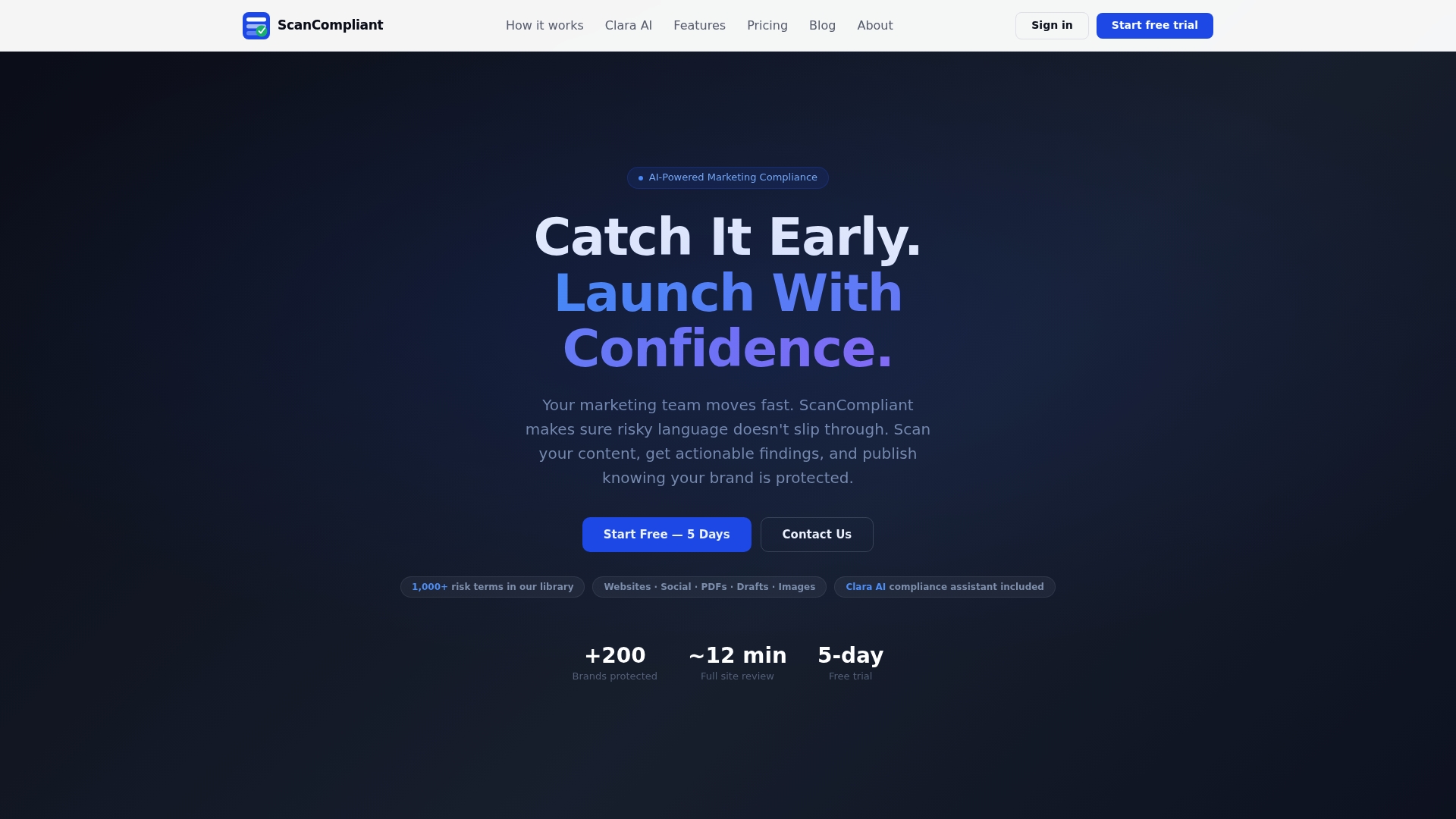
Some platforms scan website copy, social posts, and product listings for regulatory risks, returning prioritized findings with suggested rewrites. Automated flagging of risky terms and claims, along with logging reviews, can create a documented compliance trail that helps marketing and legal teams work more smoothly under deadline pressure. If your team is still reviewing before-and-after assets manually, start a Scancompliant trial and run your next campaign through it before it goes live.
This article is general information, not a substitute for advice from a qualified lawyer. Consult a qualified legal professional about your own circumstances before acting on anything here.
Sources
- Health Products Compliance Guidance | Federal Trade Commission
- CCN final rule materials (FDA)
- Guides Concerning the Use of Endorsements and Testimonials in Advertising
- GLP‑1 Compliance: FDA targets telehealth marketing in 30 new warning letters | Foley & Lardner LLP
FAQ
Are Before-and-After Photos Legal in Telehealth Ads?
Yes, if the net impression is truthful, the depicted result is typical or clearly disclosed as atypical, and the claim is backed by competent evidence under FTC standards.
What Makes a Before-and-After Image Misleading?
An image is misleading when it implies a result most consumers won’t achieve without a clear, adjacent disclosure stating the typical outcome supported by evidence.
Does ‘Results May Vary’ Satisfy Disclosure Requirements?
Generally no. FTC examples show vague phrases like this rarely change the ad’s net impression; an adjacent, specific statistic about typical results works better.
Can an Influencer Post a Brand’s Before-and-After Photo?
Only with a conspicuous material-connection disclosure, and the post can’t imply personal use of the product unless that use actually happened.
How Can Teams Speed Up Before-and-After Compliance Reviews?
Tools like Scancompliant scan for implied claims and risky language before publication, returning prioritized findings and a documented review trail in minutes instead of days.