
Any health-related advertising claim, spoken or implied, has to be truthful, non-deceptive, and backed by a reasonable basis before it ever reaches a consumer. For treatment, mitigation, or cure claims, that basis usually means human clinical evidence, not a testimonial or a lab result from a petri dish. If your team can’t point to that evidence right now, pause the claim, pull together your documentation, and run it through a pre-publish compliance check before it goes live.
TL;DR:
- Claims about serious health conditions require at least one randomized, double-blind, well-controlled clinical trial with statistically significant results to be properly supported.
- Any imagery or testimonials that imply efficacy or treatment must be backed by the same level of evidence as written claims to avoid liability.
- The “net impression” of an ad, including tone and visual cues, determines whether a claim needs substantiation, especially for implied or softer messages.
- Starting October 2024, the FTC bans fake reviews, incentivized positive reviews, and the suppression of negative feedback, increasing scrutiny on influencer and testimonial content.
- Using a pre-publish compliance checklist or scanning tools can help marketers catch risky language, implied claims, and testimonial red flags before content goes live.
Table of Contents
- What “Truthful, Non-Deceptive” and “Reasonable Basis” Mean Under FTC Advertising Rules
- What Counts as Competent and Reliable Scientific Evidence for Health Claims
- Common Risky Claims and Safer Rewrite Options
- The FTC’s 2024 Reviews and Testimonials Rule, Explained for Marketers
- Who’s Liable, and What Documentation You Need on File
- A Pre-Publish Audit Checklist for Health Advertising Claims
- Compliant Team’s Take on Where Health Advertisers Get This Wrong
- How ScanCompliant Helps Marketing Teams Move Faster Without Cutting Corners
- Key FTC Resources Worth Bookmarking
- Sources
- FAQ
What “Truthful, Non-Deceptive” and “Reasonable Basis” Mean Under FTC Advertising Rules
Section 5 of the FTC Act bans “unfair or deceptive acts or practices,” and the agency’s substantiation policy builds directly on that language. Every claim needs a reasonable basis before you publish it, not after a customer complains. That basis has to exist at the time the ad runs.
The tricky part isn’t the claim you wrote; it’s the claim your audience hears. The FTC judges advertising by its “net impression,” meaning the overall message a reasonable consumer takes away, including anything implied by imagery, tone, or context. A supplement ad that never says “cures anxiety” but pairs a serene testimonial with soft lighting and the phrase “finally feel like yourself again” can still trigger liability if consumers reasonably infer a treatment claim.
Some factors push the evidentiary bar higher:
- Claims about serious or life-threatening conditions
- Products marketed to vulnerable populations, including chronically ill or elderly consumers
- Claims that could delay someone from seeking real medical treatment
- Statements framed as backed by “research” or “clinical studies” without naming either
The FTC’s health products compliance guidance makes clear that health claims sit in a higher-risk category almost automatically, simply because the potential for consumer harm is greater than with, say, a claim about laundry detergent.
What Counts as Competent and Reliable Scientific Evidence for Health Claims
For serious disease treatment or mitigation claims, the FTC’s baseline is at least one randomized, well-controlled, double-blind human clinical trial with results that reach statistical significance. That’s not a suggestion. It’s the substantiation floor described in the FTC’s substantiation policy statement, which holds that if your ad claims a specific level of proof, you need to actually have that level of proof on file.
Statistic to remember: the FTC’s own health products compliance guidance states that claims about treating or mitigating serious disease typically require at least one randomized, double-blind, well-controlled human trial with statistically significant results.
Where evidence falls short of that standard:
- Observational studies, animal models, and in-vitro research can support general wellness language, but not disease-specific treatment claims
- A single small trial without a control group rarely satisfies “competent and reliable”
- Cherry-picked endpoints from a larger study misrepresent what the research actually found
If your evidence is early-stage, say so plainly. “Preliminary research suggests” is honest. “Clinically proven to treat” when you have one uncontrolled pilot study is not, even if you genuinely believe the product works.
Common Risky Claims and Safer Rewrite Options
Some phrasing invites scrutiny almost automatically. Here’s how the risk usually breaks down and what to do instead:
- Express disease claims. “Cures anxiety,” “treats diabetes,” or “reverses hair loss” demand the clinical-trial standard above. Rewrite toward what your actual data supports: “may support relaxation” instead of “cures anxiety,” paired with real substantiation for even that softer claim.
- Implied claims through imagery. Before-and-after photos, a white lab coat in a testimonial video, or a chart with no axis labels all imply efficacy without saying a word. Strip imagery that isn’t backed by the same evidence you’d need for the written claim.
- Selective statistics. Quoting “94% improvement” from a subgroup of eight people misleads through omission. Report the full study design, sample size, and endpoint, or don’t cite the number at all.
Pro Tip: Run every draft past a simple test: would a stranger with no context assume this product treats a medical condition? If yes, you need clinical-grade evidence to back it, even if you never used the word “treat.”
The FTC’s 2024 Reviews and Testimonials Rule, Explained for Marketers
Effective October 21, 2024, the FTC’s rule banning fake reviews and testimonials prohibits several practices that used to live in a gray zone. Knowing violations can trigger civil penalties, and “knowing” gets interpreted broadly when a brand controls the review pipeline.
The rule targets:
- Fabricated or AI-generated reviews that don’t reflect a real customer’s experience
- Incentivized reviews conditioned on a positive rating (free product in exchange for five stars, for example)
- Buying fake followers or engagement to fake influence
- Suppressing or hiding negative reviews on your own site
An influencer’s Instagram post about your supplement isn’t separate from your brand’s advertising. It’s a brand claim that needs the same substantiation and disclosure standards as your own website copy. Document every incentive you offer, require written disclosure language from influencers before posting, and watch for review patterns that look too clean to be organic.
Who’s Liable, and What Documentation You Need on File
Liability doesn’t stop at the advertiser. The FTC’s guidance on internet advertising makes clear that agencies and other third parties share responsibility and shouldn’t simply take a client’s word that claims are substantiated. Agencies that review the underlying evidence and still greenlight a deceptive claim carry real exposure.
A defensible compliance trail should include:
- The specific evidence file backing each claim, including study design and sample size
- Sign-off from whoever reviewed the science, with a timestamp
- Version history of every ad asset, not just the final approved copy
- Records of the approval chain from draft to publish
The FTC’s Notice of Penalty Offenses on substantiation raises the stakes further: once a company receives that notice, repeating a listed practice opens the door to civil penalties, not just a warning letter.
| Risk area | What to keep on file | Why it matters |
|---|---|---|
| Clinical claims | Study design, sample size, endpoints | Proves reasonable basis existed before publication |
| Testimonials/influencers | Incentive disclosures, posting agreements | Required under the 2024 reviews rule |
| Approval chain | Timestamped sign-offs, asset versions | Demonstrates a documented trail if the FTC inquires |
A Pre-Publish Audit Checklist for Health Advertising Claims
Before anything with a health claim goes live, run it through this sequence:
- Identify every claim, express and implied, and map each to a specific piece of evidence.
- Confirm the study design, checking that it matches the level of proof the ad implies.
- Check endorsements and incentives tied to any testimonial, influencer post, or review featured in the ad.
- Verify disclosures are clear and conspicuous, not buried in a footnote a reasonable consumer would miss.
- Store the evidence and every approval in one place your team can retrieve fast if regulators ask.
A scanner built for this job should flag risk terms (words like “cure,” “treat,” or “guaranteed”), catch implied claims hiding in softer language, and surface testimonial red flags before legal ever sees the draft. ScanCompliant’s pre-publish compliance check approach follows roughly this same sequence.
Pro Tip: Build this checklist into your content calendar as a required step, not an optional one. The teams that skip it under deadline pressure are the ones who end up explaining a warning letter to leadership.

Compliant Team’s Take on Where Health Advertisers Get This Wrong
Most brands don’t get burned by the claim they debated in a legal review meeting. They get burned by the claim nobody flagged, the one buried in a social caption, an influencer’s off-script comment, or a “supports” phrase that reads as harmless until you apply the net impression test. Compliant Team has watched this pattern repeat across telehealth and supplement marketing: the risky language rarely comes from the hero headline. It comes from the fine print, the caption, and the quote nobody double-checked.
Scanning platforms exist because human reviewers, no matter how careful, miss patterns at scale. A database tracking more than 1,000 risk terms can help review content efficiently, catching the phrasing that slips past a tired reviewer at 6 p.m. before a launch. Speed matters here. Compliance that takes three days to complete gets skipped when a campaign is due tomorrow.
— Compliant Team
How ScanCompliant Helps Marketing Teams Move Faster Without Cutting Corners
Manual compliance review means someone reads every landing page, every social caption, and every influencer script by hand, hoping they catch the implied claim buried in paragraph three. An AI scan can read your content like an FTC reviewer would, flagging risky terms, implied health claims, and testimonial red flags in minutes instead of days.
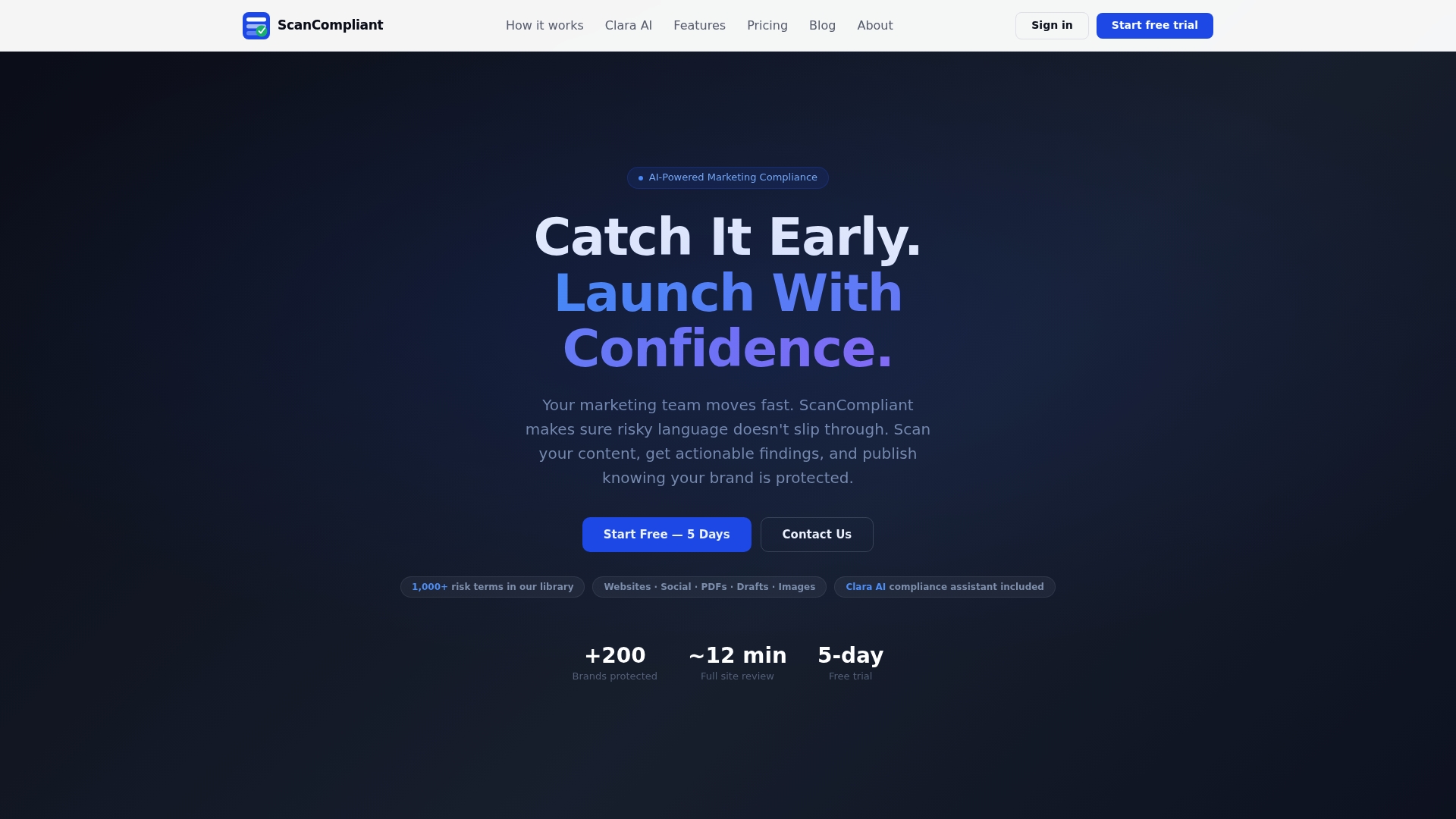
Such a platform can prioritize findings so your team fixes the highest-risk language first, suggest compliant rewrites in plain English, and keep a documented record of every scan and approval, providing an audit trail regulators may expect to see. It can be designed specifically for telehealth, supplement, and DTC health brands, recognizing phrasing patterns unique to health claims.
Run it before your next product launch, before an influencer campaign goes live, or anytime a new health claim enters your content pipeline. Visit ScanCompliant to start a trial and see what it catches in your existing content.
Key FTC Resources Worth Bookmarking
Keep these close: the health products compliance guidance, the Notice of Penalty Offenses, the Reviews and Testimonials Rule, and internet advertising guidance. For channel-specific disclosure nuance, KlyrMedia’s healthcare advertising guide is a useful supplement, and ScanCompliant’s compliance blog covers ongoing case examples.
This article is general information, not a substitute for advice from a qualified doctor. Consult a qualified healthcare professional about your own circumstances before acting on anything here.
FAQ
What Is the FTC Standard for Health Advertising Claims?
Claims must be truthful, non-deceptive, and supported by a reasonable basis before publication, with serious disease treatment claims typically requiring randomized, double-blind, well-controlled human clinical trials.
Are Implied Health Claims Treated the Same as Express Claims?
Yes. The FTC evaluates the “net impression” an ad creates, so imagery, testimonials, and softer wording like “supports” can trigger the same substantiation requirements as an explicit claim.
What Changed With the 2024 FTC Reviews and Testimonials Rule?
It banned fake reviews, reviews incentivized on positive sentiment, fake engagement metrics, and suppression of negative reviews, with civil penalties possible for knowing violations.
Can My Agency Be Held Liable for My Company’s False Claims?
Yes. Agencies and other third parties share responsibility and are expected to review substantiation materials rather than rely solely on the advertiser’s word.
How Can Marketers Catch Risky Claims Before Publishing?
Running content through a structured pre-publish checklist, or a scanning tool like ScanCompliant that flags risk terms and implied claims, catches issues human reviewers often miss under deadline pressure.