
Supplement labels in the United States can carry three legal types of claims: health claims, nutrient content claims, and structure/function claims. Only certain health claims get FDA preauthorization. Structure/function claims need a mandatory FDA disclaimer and a 30-day notification to the agency before or after first use. Nutrient content claims like “high in” or “excellent source of” require the ingredient to hit at least 20% of the Daily Reference Value per serving. FDA and FTC both police this territory, and they don’t always agree on jurisdiction.
TL;DR:
- Nutrient content claims must meet the 20% Daily Reference Value threshold per serving to be legally valid; falling short invalidates the claim regardless of intent.
- Companies must have substantiation on file before publishing any structure/function claim, notify the FDA within 30 days, and include the required disclaimer on labels.
- The FDA enforces claim compliance after market release, while the FTC monitors advertising and promotional content across channels, increasing enforcement complexity.
- Misleading implied disease claims or inconsistent messaging across marketing channels can trigger regulatory actions from both agencies, with remedies ranging from warnings to legal bans.
- Consumers can report misleading claims to the FDA or FTC, and third-party certifications can indicate better compliance but do not directly regulate marketing claims.
Table of Contents
- What Are the Three Types of Dietary Supplement Label Claims?
- What Must a Supplement Company Do to Legally Use a Claim?
- Who Enforces Dietary Supplement Claims and Why?
- How Can You Tell If a Supplement Claim Is Legitimate?
- A Practical Compliance Checklist for Marketing and Regulatory Teams
- How Do U.S. and EU Rules on Supplement Claims Differ?
- What’s Changed Recently in Dietary Supplement Claims Rules?
- What Can Consumers Do About False Supplement Claims?
- Balancing Compliant Language With Effective Marketing
- How Scancompliant Helps Brands Catch Risky Claims Before Publication
- Sources
What Are the Three Types of Dietary Supplement Label Claims?
Every legal claim on a supplement bottle falls into one of three buckets defined by FDA’s labeling framework. Mixing them up, or blending their language, is how brands end up in regulatory trouble.
Health claims describe a relationship between a nutrient and reduced disease risk. “Calcium may reduce the risk of osteoporosis” is a classic example, and it only works because FDA has specifically authorized that exact relationship after reviewing the science.
Nutrient content claims describe how much of a nutrient is in the product, using regulated terms like “high,” “excellent source,” or “rich in.” These are numeric, not narrative. Say “high in vitamin D” and the label has to back it up with math, not marketing copy.
Structure/function claims describe how an ingredient affects the body’s normal structure or function, without mentioning a disease. “Builds strong bones” or “supports immune health” both qualify. These claims are permitted without FDA preapproval, but they carry the heaviest documentation burden of the three.
- Health claim: preauthorized, disease-risk language, strict wording
- Nutrient content claim: numeric threshold, no disease language at all
- Structure/function claim: no preapproval, but substantiation and disclaimer required
The trap is the “implied” disease claim. A product called “ArthriEase” with joint pain testimonials on the label can trigger drug-level scrutiny even without ever using the word “arthritis,” because 21 CFR 101.93 considers context, not just text.
What Must a Supplement Company Do to Legally Use a Claim?
FDA calls the evidence standard “competent and reliable scientific substantiation.” That phrase has real teeth. It means the studies, data, or expert consensus supporting a claim must exist before the claim goes on a label or a landing page, not afterward as a defense if someone asks.
Structure/function claims come with three specific obligations under the Small Entity Compliance Guide:
- Have substantiation on file before the claim is published anywhere
- Notify FDA within 30 days of first marketing the claim
- Print the mandatory disclaimer on the label
That disclaimer isn’t optional boilerplate. It has to read: “This statement has not been evaluated by the Food and Drug Administration. This product is not intended to diagnose, treat, cure, or prevent any disease.” Leave it off and the product becomes misbranded even if the underlying claim is perfectly true and well supported.
Statistic Callout: A nutrient content claim like “excellent source of calcium” is only legal when the product delivers at least 20% of the Daily Reference Value for that nutrient per serving. Fall short of that threshold and the claim is false on its face, regardless of intent.
Here’s the detail brands miss most: FDA does not preapprove supplement labels the way it clears a new drug. There’s no stamp of approval before a product hits shelves. Enforcement happens after the fact, through misbranding and substantiation reviews, which means the burden sits entirely on the manufacturer to get it right the first time.
Who Enforces Dietary Supplement Claims and Why?
Two federal agencies split this job, and they don’t work from the same playbook. FDA governs labeling and decides whether a statement crosses the line into an unapproved drug claim. FTC governs advertising and goes after claims that are false or deceptive to consumers, wherever those claims appear, including ads, emails, and influencer posts.
A legal analysis from the Congressional Research Service lays out how these authorities overlap under the FD&C Act and DSHEA, and the overlap is exactly why brands get caught off guard by two agencies at once.
Enforcement usually starts with one of these triggers:
- An implied disease claim buried in product naming, imagery, or testimonials rather than the label text itself
- A missing or altered structure/function disclaimer
- A claim with no substantiation file to back it up when asked
- Inconsistent claims across channels, where the website says more than the label does
That last one catches a lot of brands. FDA and FTC both look at the full marketing picture, not just the printed label, so a compliant bottle sitting next to an aggressive Instagram caption doesn’t stay compliant for long.
Remedies escalate from a warning letter, to a formal consent order, to civil penalties, and in serious cases, product seizure or an injunction against future sales.
How Can You Tell If a Supplement Claim Is Legitimate?
Reading a supplement label critically takes about thirty seconds once you know what to look for. Start with the amount per serving and compare it against the claim. If a label says “high in zinc” but the Supplement Facts panel shows a trace amount, something doesn’t add up.
- Check that any structure/function claim carries the mandatory FDA disclaimer
- Look for specific ingredient amounts, not just vague percentages
- Be skeptical of words like “detox,” “boosts,” or “supports” with no explanation of what that means physiologically
- Notice if before-and-after photos appear without any cited study behind them
Pro Tip: If a product claims to treat, cure, or prevent a named disease anywhere in its marketing, including social media captions, that’s a claim requiring drug-level approval it almost certainly doesn’t have. Treat that as a hard red flag, not a gray area.
For a second opinion, the NIH Office of Dietary Supplements publishes plain-language consumer guidance that’s a useful gut check before buying, and you can also explore when supplements are truly necessary in Do You Really Need a Supplement? – Pure Blue.
A Practical Compliance Checklist for Marketing and Regulatory Teams
Getting supplement claims right isn’t a one-time review. It’s a repeatable process, and the brands that avoid warning letters tend to run the same checks every time new copy goes live.
- Build a substantiation folder for every claim, with studies, protocols, or expert statements attached before the claim is published, not after
- Confirm the 30-day FDA notification has been filed for any new structure/function claim and keep the receipt
- Verify the mandatory disclaimer appears wherever the claim appears, including product pages and packaging inserts
- Review website, email, and social copy for consistency with the approved label language
- Scan for implied-disease language hiding in imagery, product names, or customer testimonials
Manual review catches obvious problems, but subtle ones slip through constantly. A landing page might say “clinically proven to reduce inflammation” while the label sticks to compliant structure/function language, and nobody notices the mismatch until FDA does. Automated scanning tools built for cross-channel compliance review can flag that kind of drift across dozens of pages faster than a human reviewer working line by line.
Pro Tip: Keep a dated log of every compliance review, including who checked it and what was flagged. If FDA or FTC ever asks, a documented review trail is often more persuasive than the substantiation itself.
Recordkeeping matters more than most teams realize. Studies, notification receipts, and review logs aren’t paperwork for its own sake. They’re the file that proves the process was followed when someone questions it later. Teams building out this workflow often find it useful to study common warning letter triggers to see exactly what gets flagged in practice.

How Do U.S. and EU Rules on Supplement Claims Differ?
The European Union runs a far more centralized system than the U.S. Under EU law, health claims for foods and supplements must appear on an approved list maintained at the EU level, built from a single scientific review process managed by the European Food Safety Authority. If a claim isn’t on that list, it generally can’t be used, full stop.
The U.S. system is more permissive on the front end and stricter on the back end. Structure/function claims don’t need preapproval, but they need substantiation on file, a 30-day notification, and a disclaimer, with enforcement happening after publication rather than before.
That difference changes how much legal exposure a brand carries at launch. A U.S. supplement company can go to market with a structure/function claim almost immediately, as long as the substantiation exists internally. A comparable EU product often has to wait for its claim to already sit on the approved list, or avoid making the claim at all.
For DTC brands selling across borders, this gap creates real friction. A claim like “supports healthy metabolism” might be perfectly usable in the U.S. with proper substantiation, while the same phrase in EU markets needs to trace back to an authorized entry or gets stripped from the packaging entirely. Brands operating internationally usually end up running two separate claim libraries rather than translating one.

What’s Changed Recently in Dietary Supplement Claims Rules?
FDA has sharpened its focus on the gap between what’s printed on a label and what’s said everywhere else. Regulators increasingly treat websites, social captions, and influencer content as part of the “label” for enforcement purposes, applying the same structure/function versus disease-claim analysis to a TikTok video that they’d apply to the bottle itself.
That shift matters because it closes an old loophole. Brands used to keep label language conservative while letting marketing copy run hotter, betting that FDA would only ever review the printed label. That bet doesn’t pay off anymore. The agency’s own guidance on structure/function claims makes clear that context across all marketing materials factors into whether a claim is legal.
There’s also renewed attention on the nutrient deficiency disease exception, a nuanced rule allowing a claim like “vitamin C prevents scurvy” only when the label also states how common that deficiency actually is in the United States. Miss that second half of the requirement and an otherwise accurate claim becomes noncompliant.
FTC has been similarly active on advertising claims tied to weight loss and cognitive performance, categories where the agency has historically demanded a higher substantiation bar than a typical structure/function claim would require. Brands making claims in those categories should assume extra scrutiny, not less.
What Can Consumers Do About False Supplement Claims?
Consumers aren’t without options when a supplement claim turns out to be misleading. FDA accepts reports through its MedWatch adverse event system for safety issues, and separately fields complaints about labeling violations through its consumer complaint channels.
FTC handles deceptive advertising complaints, and its enforcement actions have resulted in refunds, injunctions, and forced changes to marketing language for supplement companies that overstated what their products could do.
State attorneys general add another layer of recourse, particularly for claims that cross into fraud territory. Several states have pursued their own actions against supplement marketers independent of federal enforcement, especially in weight loss and sexual health categories where complaints tend to cluster.
For a purchase-level dispute, most retailers, including major online marketplaces, have return policies that apply when a product’s marketing clearly misrepresented what’s inside. Documenting the specific claim, where it appeared, and how the product failed to deliver strengthens any complaint, whether it goes to a retailer, FTC, or a state regulator.
Third-party quality certifications don’t police claims directly, but they add a layer of accountability worth checking before buying, since a manufacturer willing to submit to outside testing is often more careful about its marketing language too.
Balancing Compliant Language With Effective Marketing
The tradeoff between legally airtight copy and copy that actually converts is real, and pretending otherwise doesn’t help anyone. The brands that manage it well don’t treat compliance as a brake on creativity. They treat it as a constraint that sharpens the writing, the same way a strict word count forces a better sentence.
The database of risk terms for marketing compliance tracking covers a wide range, and the pattern that shows up again and again is that the riskiest language usually isn’t in the label. It’s in the ad copy nobody cross-checked against the disclaimer. Building claim review into the creative process, not after it, is the difference between catching that early and finding out from a warning letter.
— Compliant Team
How Scancompliant Helps Brands Catch Risky Claims Before Publication
There are platforms that give regulatory and marketing teams a faster way to catch claims that human reviewers might miss. These tools can scan websites, social posts, documents, and product listings for FDA and FTC risk language, flag implied disease claims and missing disclaimers, and prioritize findings so teams can fix the highest-risk items first instead of triaging everything at once.
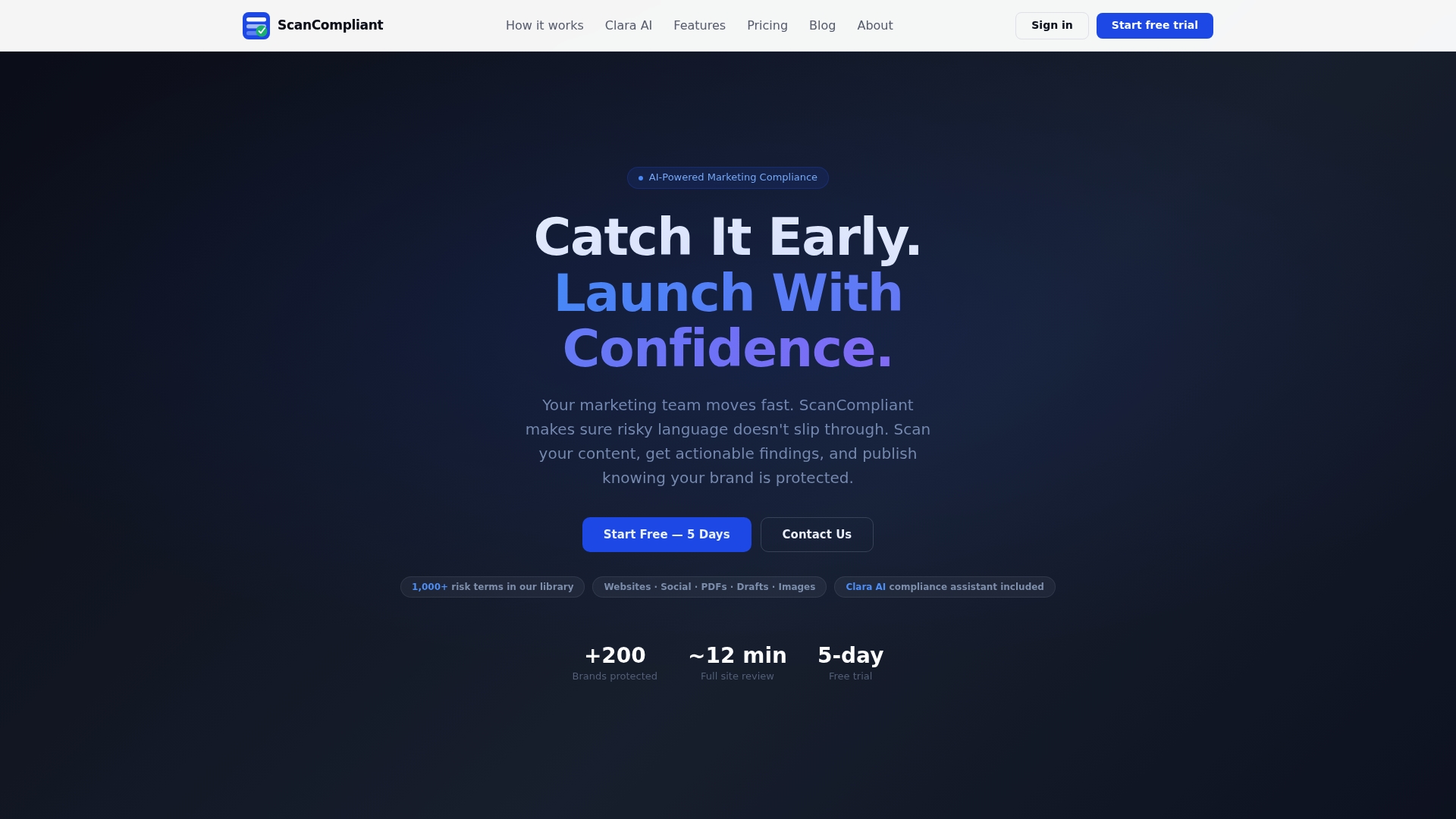
It maps directly onto the checklist that matters most: disclaimer presence, cross-channel consistency, and a documented review trail if a regulator ever asks. Instead of one person manually comparing label copy against ten different marketing channels, the scan surfaces the mismatch in minutes and suggests compliant rewrite options on the spot. For teams juggling frequent content updates across supplement or telehealth product lines, that speed is the difference between catching a problem before launch and explaining it after. Start a trial at Scancompliant to see how a scan handles your current product pages.
This article is general information, not a substitute for advice from a qualified doctor. Consult a qualified healthcare professional about your own circumstances before acting on anything here.
Sources
- Dietary Supplement Labeling Guide: Chapter VI — Claims (FDA)
- 21 CFR § 101.93 – Certain types of statements for dietary supplements (Legal Information Institute)