
Disclaimers work in U.S. courts, but only under specific conditions: the language must be conspicuous, the other party must have genuinely assented to it, and its scope must fall within what the law allows a party to waive. Courts routinely strike down disclaimers that are buried, one-sided, or aimed at shielding gross negligence, intentional misconduct, or statutory consumer protections. Behavioral research adds a harder truth: most passive, boilerplate disclaimers don’t even register with the people reading them, let alone hold up if challenged.
TL;DR:
- Disclaimers must be conspicuous, clearly assent to, and within the scope permitted by law; buried or overly broad disclaimers are easily invalidated.
- Behavioral studies show passive disclaimers in footers are ineffective, and active acknowledgment at decision points significantly improves recognition and enforceability.
- Legal limits include public policy, gross negligence, unconscionability, and statutory restrictions like the Magnuson-Moss Act, which disclaimers cannot override.
- Effectiveness varies greatly by industry, with healthcare and financial disclaimers facing stricter scrutiny and requiring more precise, validated language.
- Disclaimers should be complemented by warnings and informed consent forms, while thorough review and testing prevent underlying claims from undermining legal protections.
Table of Contents
- Disclaimer Effectiveness Starts With How Courts Read Contract Terms
- The Legal Ceiling: When a Disclaimer Can’t Save You
- What the Research Actually Shows About Disclaimer Effectiveness
- How to Draft and Place Disclaimers So They Hold Up
- A Working Checklist Before You Rely on a Disclaimer
- Why Most Readers Never Actually Process a Disclaimer
- Disclaimer Effectiveness Varies Sharply by Industry
- Disclaimer Enforceability Changes Depending on the State
- Disclaimers Are One Layer, Not the Whole Risk Strategy
- Compliant Team Perspective: Disclaimers Are a Control, Not a Cure
- How Scancompliant Helps Catch What Disclaimers Alone Can’t Fix
- Sources
Disclaimer Effectiveness Starts With How Courts Read Contract Terms
Courts don’t treat a disclaimer as magic language that erases liability on sight. They treat it as a contract term, and contract terms get tested against three pillars: conspicuousness, clarity, and assent. Miss anyone, and the disclaimer is vulnerable no matter how airtight the wording sounds to the lawyer who drafted it.
Conspicuousness borrows from the Uniform Commercial Code’s standard: would a reasonable person actually notice this? Courts look at font size, color contrast, placement relative to the main text, and whether the disclaimer sits in a spot a signer would naturally pass over. A liability waiver printed in six-point gray type at the bottom of a receipt fails this test almost automatically, according to legal analysts who track how courts evaluate disclaimer disputes.
Assent is the second pillar, and it splits sharply between two models:
- Clickwrap agreements, where a user must affirmatively click “I agree” before proceeding, generally hold up because they create a documented, active moment of consent.
- Browsewrap disclaimers, buried in a footer link a visitor never has to click, routinely fail because there’s no proof the person ever saw or accepted the terms.
- Signed waivers, common in gyms, medical practices, and adventure tourism, tend to fare best when the signer had time to read the document and it wasn’t slipped in among unrelated paperwork.
Timing matters too. A disclaimer presented after the transaction, like a warning printed on a receipt handed over after payment, generally doesn’t count as part of the deal. Courts want the disclaimer in front of the person before they commit, not after.
The Legal Ceiling: When a Disclaimer Can’t Save You
Even a beautifully drafted, conspicuous, signed disclaimer has a ceiling. Several doctrines override contract language entirely, regardless of how clearly it was presented.
Public policy sets the outer boundary. Courts will not let a business contract away liability for intentional harm, reckless conduct, or violations of duties owed to the public, such as basic safety obligations in healthcare or transportation.
Gross negligence and fraud carve-outs are the next layer, and state law varies meaningfully here. Some states allow waivers for ordinary negligence but void anything attempting to cover gross negligence or willful misconduct. Others draw the line differently depending on the industry, particularly in recreational activities versus professional services.
Unconscionability comes in two flavors, and courts often need both to strike a clause:
- Procedural unconscionability looks at the bargaining process, unequal power, no chance to negotiate, take-it-or-leave-it terms buried in fine print.
- Substantive unconscionability looks at the actual terms, whether the disclaimer is so one-sided it shocks the conscience.
Federal statutory floors add another layer businesses frequently underestimate. The Magnuson-Moss Warranty Act restricts how consumer product warranties can be disclaimed, and the Consumer Product Safety Act limits waivers tied to safety defects. Both the FTC and CFPB have separately pursued companies whose disclaimers tried to disclaim away disclosures those agencies consider mandatory. Courts have consistently found that overreaching waivers or hidden notices remain vulnerable to challenge no matter how much legal effort went into the drafting.
What the Research Actually Shows About Disclaimer Effectiveness
The legal doctrine is one thing. The behavioral data is another, and it’s not flattering to how most disclaimers get written.
A synthesis of 18 experimental studies on advertising disclaimers found that mandated disclaimers were ineffective or actively harmful in the majority of the studies reviewed, meaning consumers walked away more confused, not less. Instead of clarifying risk, passive disclaimer language often adds noise that readers tune out or misread entirely.
The pattern across these experiments is consistent: when a disclaimer is passive, small, or disconnected from the moment of decision, it tends to get skipped. When it requires an active step, ticking a box, retyping a phrase, or otherwise pausing the reader, comprehension improves measurably.
Separate randomized experiments on trademark affiliation disclaimers back this up directly. Requiring users to actively acknowledge a disclaimer rather than simply display it reduced consumer confusion to levels courts found legally acceptable, a result passive versions couldn’t match.
The practical takeaway is blunt: if your disclaimer sits in a footer nobody scrolls to, treat its legal value as marginal at best. Point-of-decision placement with an active acknowledgement step is what actually moves comprehension, not the wording itself.
How to Draft and Place Disclaimers So They Hold Up
Enforceability comes down to design choices you control long before a dispute ever reaches a courtroom.
- Make it visually impossible to miss. Bold text, contrasting color, isolation from surrounding paragraphs, and placement near the action it governs, not buried three scrolls down or in a linked terms page nobody opens.
- Write in plain language with a narrow target. Name the specific risk or claim being disclaimed instead of reaching for sweeping “no liability for anything ever” language, which courts treat with suspicion precisely because it tries to cover too much ground.
- Force an active step. A checkbox, a signature, a “type your name to confirm” field, anything that creates a timestamped record that the person actually engaged with the language rather than scrolled past it.
- Keep the scope tight and coordinated. A disclaimer shouldn’t contradict a warranty elsewhere in the same document, and it should line up with your insurance coverage and any regulatory disclosures required for your industry.
Pro Tip: Test your disclaimer placement the way the OECD recommends for online disclosures: put it exactly at the point where the person is about to make a decision, not before and not after. A disclaimer shown too early gets forgotten; shown too late, it’s already irrelevant.
A Working Checklist Before You Rely on a Disclaimer
Before any team leans on a disclaimer as its primary risk control, it’s worth running through a short, disciplined review rather than assuming the boilerplate language will hold.
- Identify the specific risk the disclaimer is meant to address, not a vague catch-all.
- Confirm which state’s law governs, since gross negligence and unconscionability standards shift meaningfully across jurisdictions.
- Test conspicuousness honestly: would someone skimming the page actually notice this?
- Document assent with timestamps, checkboxes, or signatures rather than relying on presence alone.
- Narrow the scope to what’s legally permissible to waive in that context.
- Check statutory compliance against Magnuson-Moss, CPSA, and any FTC-specific disclosure rules for the industry.
- Confirm whether insurance or indemnity agreements need to move in tandem with the disclaimer language.
| Risk level | Typical context | What’s usually needed beyond a disclaimer |
|---|---|---|
| Low | General informational content, non-safety claims | Conspicuous disclaimer with clear scope |
| Medium | Consumer goods, service outcomes | Disclaimer plus documented active assent |
| High | Health claims, safety-related products, regulated financial advice | Disclaimer plus warnings, consent forms, and regulatory review |
Consumer-facing goods, anything touching physical safety, and regulated health or financial claims almost always need stronger controls than a disclaimer alone. That’s the point where legal counsel should get looped in before publication, not after a complaint arrives.
Why Most Readers Never Actually Process a Disclaimer
Attention is the first casualty. People scanning a webpage or product label allocate a fraction of a second to anything that looks like legal boilerplate, and disclaimers are visually coded to look exactly like boilerplate: small text, gray color, dense wording. The brain filters it out before comprehension even starts.
Comprehension is the second problem, and it’s separate from attention. Even when someone reads the words, dense legal phrasing like “notwithstanding the foregoing” or “to the fullest extent permitted by law” doesn’t map cleanly onto how ordinary people process risk. A disclaimer can be seen and still not understood.
Perceived fairness plays a quieter role that a lot of drafters miss entirely. When a disclaimer feels like it’s protecting the company at the reader’s expense, whether that’s accurate or not, people discount it mentally, treating it as corporate cover rather than a genuine risk disclosure. That perception gap matters in litigation too: juries and judges bring the same skepticism to overreaching disclaimer language that consumers do.
The fix isn’t longer disclaimers. It’s disclaimers that respect how attention and comprehension actually work, short, specific, positioned where a decision is being made, and framed as genuine information rather than a liability shield in disguise.

Disclaimer Effectiveness Varies Sharply by Industry
A disclaimer that satisfies a software company won’t come close to satisfying a regulator reviewing a supplement ad. Industry context changes what “effective” even means.
In healthcare and telehealth, disclaimers face the steepest scrutiny because the stakes involve physical harm and because the FTC and FDA actively police implied claims, making targeted healthcare advertising for effective patient growth strategies crucial to compliance. A disclaimer stating “results may vary” does almost nothing to offset an ad that visually implies guaranteed outcomes. Understanding how misleading health claims interact with disclaimer language matters more in this space than in almost any other category, since implied claims can undercut even a well-drafted disclaimer.
In finance, disclaimers around investment risk are heavily standardized by regulators, and courts tend to give them more weight when they mirror language regulators have already blessed, like standard risk-of-loss disclosures.
In online services, disclaimers face the browsewrap versus clickwrap problem most acutely, since so much of the interaction happens without any human reviewing the terms in real time.
Disclaimer Enforceability Changes Depending on the State
State law is the variable most national brands underestimate. A disclaimer drafted for California enforcement standards won’t automatically translate to New York or Texas, because gross negligence definitions, unconscionability thresholds, and public policy carve-outs diverge across jurisdictions.
Some states apply a strict conspicuousness test drawn almost directly from UCC language. Others layer in consumer protection statutes that override contract terms regardless of how clearly the disclaimer was presented. A handful of states are notably hostile to liability waivers in specific sectors, recreational activities and healthcare being the most common flashpoints, while treating the same language more permissively in ordinary commercial contracts.
For companies operating across multiple states, this means a single national disclaimer template is a risk, not a shortcut. The safer approach is building a base disclaimer that meets the strictest applicable state standard, then layering state-specific addenda where local law demands something more protective for the consumer. Legal teams reviewing multistate marketing should treat jurisdiction as a first-order question, not an afterthought handled after the creative is already finalized.
Disclaimers Are One Layer, Not the Whole Risk Strategy
Disclaimers work best as part of a system, not as a standalone shield. Warnings, informed consent forms, and disclosures each serve a distinct function, and treating them interchangeably is where a lot of risk management breaks down.
A warning is meant to change behavior in the moment, “wear eye protection,” “do not operate while drowsy.” A disclaimer is meant to allocate legal risk after the fact. A consent form, particularly in healthcare and clinical contexts, documents that a specific risk was explained and understood before a procedure or treatment began. These aren’t substitutes for each other, and courts generally know the difference even when marketing teams don’t.

The strongest risk communication stacks these mechanisms deliberately: a warning at the point of physical risk, a disclaimer covering the legal scope of what’s being offered, and a consent form for anything involving informed medical or financial decision-making. Relying on a disclaimer to do a warning’s job, or vice versa, is a common gap that shows up repeatedly in litigation over health content liability for telehealth and DTC health brands specifically.
Compliant Team Perspective: Disclaimers Are a Control, Not a Cure
The biggest mistake we see is treating a disclaimer as a substitute for fixing the underlying claim. If the surrounding marketing copy implies a guaranteed result, no disclaimer language rescues that ad, because courts and regulators read the whole picture, not just the fine print. Disclaimers work as one control among several, alongside accurate claims, proper substantiation, and documented review.
That’s where undetected claims quietly do the most damage. A rewritten headline or a single testimonial slipped into a product page can undercut a disclaimer that would otherwise hold up fine on its own. Automated scanning tools exist precisely to catch that mismatch before it goes live, flagging implied guarantees a human reviewer might read past on a tight deadline.
— Compliant Team
How Scancompliant Helps Catch What Disclaimers Alone Can’t Fix
A compliance scanning platform scans marketing content, websites, and social posts for language patterns that may undermine disclaimers before they cause a problem. It checks against a database of risk terms tied to FDA and FTC enforcement patterns, then flags risky claims with plain-English explanations and suggested rewrites, so regulatory and marketing teams don’t have to guess whether a phrase quietly contradicts the disclaimer sitting three paragraphs below it.
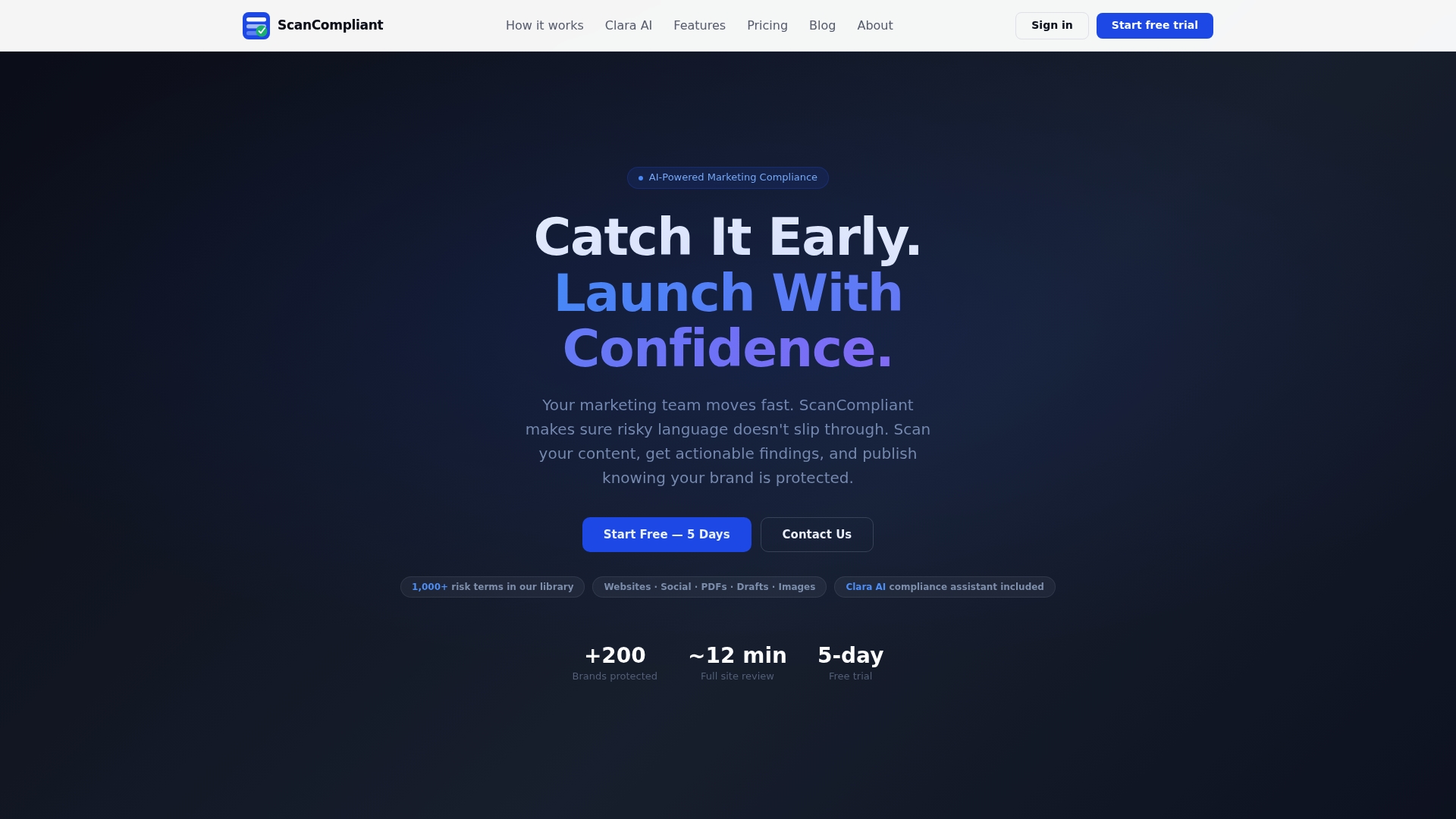
That matters directly for the checklist above. Confirming conspicuity, narrowing scope, and documenting review are all easier when a platform flags ambiguous claims automatically instead of relying on a manual pass that misses subtle wording. The platform has been used by numerous brands in telehealth and direct-to-consumer health, helping teams achieve faster review cycles and maintain a documented compliance trail if a claim ever gets challenged. If your disclaimers are doing more legal lifting than your surrounding copy can support, start with a Scancompliant scan and see what it catches before your next campaign goes live.
This article is general information, not a substitute for advice from a qualified lawyer. Consult a qualified legal professional about your own circumstances before acting on anything here.
Sources
- Evidence on the Effects of Mandatory Disclaimers in Advertising
- Can disclaimers of affiliation dispel trademark confusion? Evidence from two randomized experiments
- Do disclaimers hold up in court? What courts look for – LegalClarity
- Enhancing online disclosure effectiveness (OECD)