
Puffery is exaggerated opinion no reasonable consumer would take literally, and it’s generally not actionable. An objective claim states something measurable, and once you make one, you have to substantiate it or risk action from the Federal Trade Commission (FTC), the National Advertising Division (NAD), or a competitor’s lawyer. The catch: courts split by circuit, and context can turn “the best” into a claim regulators treat as fact.
TL;DR:
- Claims involving health, specific numbers, or competitor comparisons are high-risk and require pre-substantiation before publication.
- Jurisdictional differences mean identical language can be considered puffery in one circuit but actionable in another, emphasizing caution.
- A claims review process should include a three-part test, documented decision-making, and ongoing rechecks for edits to ensure consistent compliance.
- Disclaimers do not validate unprotected puffery, and vague terms like “natural” often invite regulatory challenges without clear standards.
- Automated tools like ScanCompliant can effectively flag risky claims early, simplifying ongoing compliance and documentation efforts.
Table of Contents
- What’s the Difference Between Puffery and Claims?
- How Do Courts Decide If a Claim Is Puffery?
- Why Do Puffery Rulings Differ Across Federal Circuits?
- What Do the FTC and NAD Look for When Reviewing Claims?
- How Do You Build a Claims Review Checklist?
- What Marketers Get Wrong About Puffery
- How ScanCompliant Fits Into a Claims Review Workflow
- Where to Verify These Rules Yourself
- Sources
What’s the Difference Between Puffery and Claims?
Puffery is subjective bragging: “world’s best coffee,” “you’ll love it.” No one can measure “love,” so no one can sue over it. An objective claim is verifiable: “reduces cholesterol noticeably” or “lasts twice as long as the leading brand.” Someone can test that. If it’s false, someone can prove it.
The harder problem is implied claims; for example, many products like those from Organic Fuel illustrate how product language may raise substantiation issues in practice. A supplement label showing a before/after photo never says “this product causes weight loss,” but the visual and the net impression of the packaging can say it anyway. The FTC and courts treat implied claims exactly like express ones when the overall impression communicates a factual promise.
Watch for these signal patterns in copy review:
- Superlatives paired with a number (“the strongest formula, multiple times the potency”)
- Comparative language against a named or implied competitor
- Health or efficacy language tied to a body function or outcome
- “Natural,” “clinically proven,” or “doctor recommended” without a defined standard
- Visuals or testimonials that imply a result the text never states outright
Subjective vs objective claims sounds like an academic distinction until a plaintiff’s attorney reads your product page the way a reasonable consumer/01%3A_Information_Literacy_Critical_Thinking_and_Society/1.03%3A_Objective_vs._Subjective_Information) would.
How Do Courts Decide If a Claim Is Puffery?
Three tests dominate. The reasonable consumer test asks whether an ordinary buyer would take the statement as fact or dismiss it as sales talk. “Rated #1 in customer satisfaction” reads differently next to a fabricated award badge than it does in a slogan with no supporting graphic.
The measurability test is more mechanical: can the claim be proven true or false? “Best-tasting” is opinion. “Reduces inflammation by 30%” is a number, and numbers get tested in court. That single distinction decides most puffery disputes before a jury ever hears the case.
Net impression is the one marketers underestimate. The FTC has said plainly that literal truth doesn’t protect an ad if the overall presentation misleads the audience. A technically accurate statistic, shown next to imagery that exaggerates its meaning, still violates the standard.
Quick test for your team: if you can imagine a lab report proving or disproving the statement, treat it as an objective claim. If the only proof would be a survey of people’s feelings about the phrase, it’s probably puffery.
- Reasonable consumer test: how would an ordinary buyer interpret this, in context?
- Measurability test: is there a number, standard, or comparison that could be fact checked?
- Net impression test: does the whole ad, including images and layout, add up to a factual promise?
Why Do Puffery Rulings Differ Across Federal Circuits?
There’s no single federal definition of puffery, and that gap creates real jurisdictional risk. Circuits weigh the reasonable consumer and measurability tests differently, so identical language can survive dismissal in one circuit and get tossed as actionable in another. A few representative examples show the pattern:
- French’s Food Co. (NAD Report #6119, 2017). The NAD found that similar superlative language could be treated as puffery in one part of an ad and as an actionable comparative claim elsewhere in the same campaign, depending on surrounding imagery and context.
- Renfro v. Champion Petfoods (Tenth Circuit). The court examined pet food marketing language about ingredient quality and sourcing, illustrating how specific, checkable claims about sourcing or content get treated differently than general quality language.
- Song v. Champion (D. Minn.). A related district court case over similar pet food labeling shows how claims framed around ingredient freshness or quality can draw scrutiny even when the language sounds aspirational on its face.
The heuristic that holds up across circuits: assume any claim tied to a measurable characteristic is risky unless you can defend it with real data. Legal commentary increasingly shows plaintiffs surviving early dismissal when a claim reads as specific rather than aspirational, so the safe assumption has shifted toward caution.
What Do the FTC and NAD Look for When Reviewing Claims?
The FTC’s enforcement priority is substantiation paired with net impression. It doesn’t chase generic bragging. It goes after unsubstantiated claims that shape a buying decision, and its own guidance frames puffery as largely outside its jurisdiction precisely because reasonable people don’t rely on it as fact.
NAD operates differently. It’s a self-regulatory body that mostly reviews claims after a competitor challenges them, and its case history is one of the best places to see how similar wording gets sorted into “opinion” or “fact” bins.
Certain categories draw scrutiny regardless of forum:
- Health and efficacy claims, especially anything implying a treatment or outcome
- Superiority claims that name or imply a specific competitor
- Environmental or “natural” language without a defined standard behind it
- Claims backed only by a small internal study or a single anecdote
Adequate substantiation generally means evidence that existed before the claim was published, not evidence assembled after a challenge arrives.
How Do You Build a Claims Review Checklist?
A workable review process doesn’t need to be complicated, but it needs to be consistent enough to survive an inquiry two years after the copy went live.
- Run the three-part test. Ask whether a reasonable consumer would read the statement as fact, whether it’s measurable, and what the net impression communicates once images and layout are added back in.
- Set escalation triggers. Any claim involving health outcomes, competitor comparisons, or specific numbers goes to legal or compliance before publication, not after.
- Collect real evidence. Lab results, third-party testing, or documented internal data, gathered before the claim runs, not sourced retroactively once someone complains.
- Log the decision. Note who reviewed the claim, what evidence they saw, and why they classified it as puffery or objective fact. That record often matters more than the original ad copy if a regulator asks questions later.
- Recheck at each edit. A claim reviewed once during launch can become risky after a redesign adds a chart, a badge, or a testimonial that changes the net impression.
Pro Tip: *Treat every superlative next to a number as an objective claim by default.
Reviewing hundreds of pages of marketing copy by hand is slow, and subtle implied claims are exactly what tired human reviewers miss on the fifth read-through of the day. Automated scanning against a large risk-term library can flag that pattern before it ever reaches a regulator’s desk, which is where a structured regulatory review checklist earns its keep inside a marketing team’s workflow.

What Marketers Get Wrong About Puffery
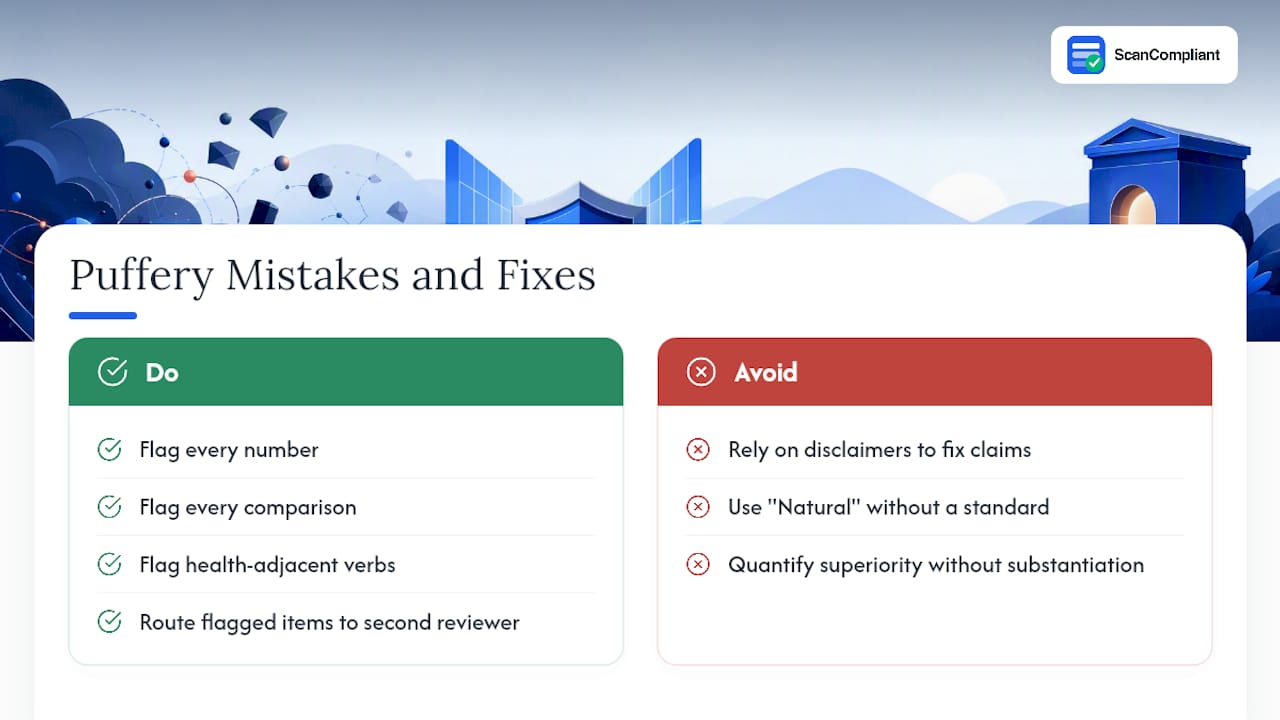
Three mistakes show up constantly in claims we’d flag for review. Teams lean on disclaimers to rescue language that was never protected puffery to begin with, a disclaimer doesn’t fix a claim, it just documents that you knew it was risky. “Natural” gets used as a marketing shortcut with no defined standard behind it, which is precisely the kind of vague-but-implied claim that draws NAD challenges. And superiority language gets quantified just enough to become actionable, “40% more effective,” without the substantiation file to back it up.
If your team is new to claims review, start narrower than you think you need to: flag every number, every comparison, and every health-adjacent verb, and route those three categories to a second reviewer before anything else. That single filter catches most of the risk that slips through in normal editorial workflows.
— Compliant Team
How ScanCompliant Fits Into a Claims Review Workflow
Turning the checklist above into a habit is where most teams stall, especially when marketing is publishing faster than legal can read. The platform scans website copy, social posts, and product listings against a database of numerous risk terms, flags implied and explicit claims a tired reviewer might miss, and explains each flagged phrase in plain language rather than legal jargon.

That output slots directly into the escalation and recordkeeping steps from the checklist: prioritized findings become the pre-publish gate, and the scan results themselves become part of the documented decision trail if a regulator ever asks how a claim got approved. For teams juggling telehealth or supplement marketing across multiple channels, that documentation is often the difference between a quick answer and a drawn-out inquiry. Review the ScanCompliant platform to see how a pre-publish scan fits into your existing content calendar before your next campaign goes live.
Where to Verify These Rules Yourself
Start with the FTC’s own explanation of substantiation and net impression, then read the circuit-by-circuit puffery analysis for jurisdictional nuance. Cornell’s Wex entry on false advertising covers the legal basics in plain language, and ScanCompliant’s guide on misleading health claims applies these rules directly to DTC health marketing.
This article is general information, not a substitute for advice from a qualified lawyer. Consult a qualified legal professional about your own circumstances before acting on anything here.
Sources
- Myths and Half-Truths About Deceptive Advertising | Federal Trade Commission
- 5 Key Takeaways | Puffery Versus Objective Claims in Advertising: Five Takeaways from the 2024 National Advertising Division Annual Conference
- A circuit-by-circuit review of the false-ad puffery defense
- Mere Puffery vs False Advertising: Recent Trends | ArentFox Schiff
- false advertising | Wex | US Law | LII / Legal Information Institute