
Compliance criteria standardization is defined as the process of converting informal, inconsistent review practices into documented, testable rules that every member of a marketing team applies the same way, every time. For telehealth and DTC health brands, this process is not optional. The FDA and FTC both enforce marketing claims actively, and TCPA regulations now require teams to process consumer opt-out requests within 10 business days. That deadline is a concrete example of what standardizing compliance criteria for a marketing team actually means in practice: a written rule, a defined owner, and a measurable outcome. Without that structure, enforcement is inconsistent, review cycles drag, and regulatory exposure compounds quietly until it becomes a crisis.
What core components are required to standardize compliance criteria?
Formal documentation is the foundation of every effective compliance program. Undocumented rules exist only in the heads of the people who created them, and those people change roles, leave companies, or simply forget. Compliance criteria must be written down, version-controlled, and accessible to every reviewer before any standardization effort can succeed.

Beyond documentation, marketing teams need a structured way to prioritize which risks matter most. A 5×5 likelihood-by-impact scoring matrix gives teams a consistent method for ranking regulatory gaps by both probability and severity. This approach prevents teams from treating a minor formatting issue with the same urgency as an unsubstantiated health claim, which wastes time and dilutes focus on genuine risk.
The third component is the right toolset. Effective compliance programs layer multiple solutions across four categories:
- Consent management platforms to capture and store opt-in records
- Workflow automation tools to route content through defined approval steps
- Audit trail software to create a timestamped record of every review decision
- AI content scanners to flag risky language before human reviewers see the copy
Each tool category serves a different function. Consent management protects against TCPA violations. Audit trails create the documentation trail regulators expect during an investigation. AI scanners catch the subtle phrasing that human reviewers miss under deadline pressure.
| Tool Category | Primary Function | Best Use Case |
|---|---|---|
| Consent management | Captures and stores opt-in records | Email and SMS marketing campaigns |
| Workflow automation | Routes content through approval steps | Multi-stage content production |
| Audit trail software | Timestamps every review decision | Regulatory investigations and audits |
| AI content scanners | Flags risky language before publication | High-volume DTC health content |
Pro Tip: Before selecting any tool, document your compliance criteria in writing first. AI compliance tools require formally documented rules to function correctly. Tribal knowledge cannot be configured into a system.
How to implement a structured process for standardizing compliance criteria
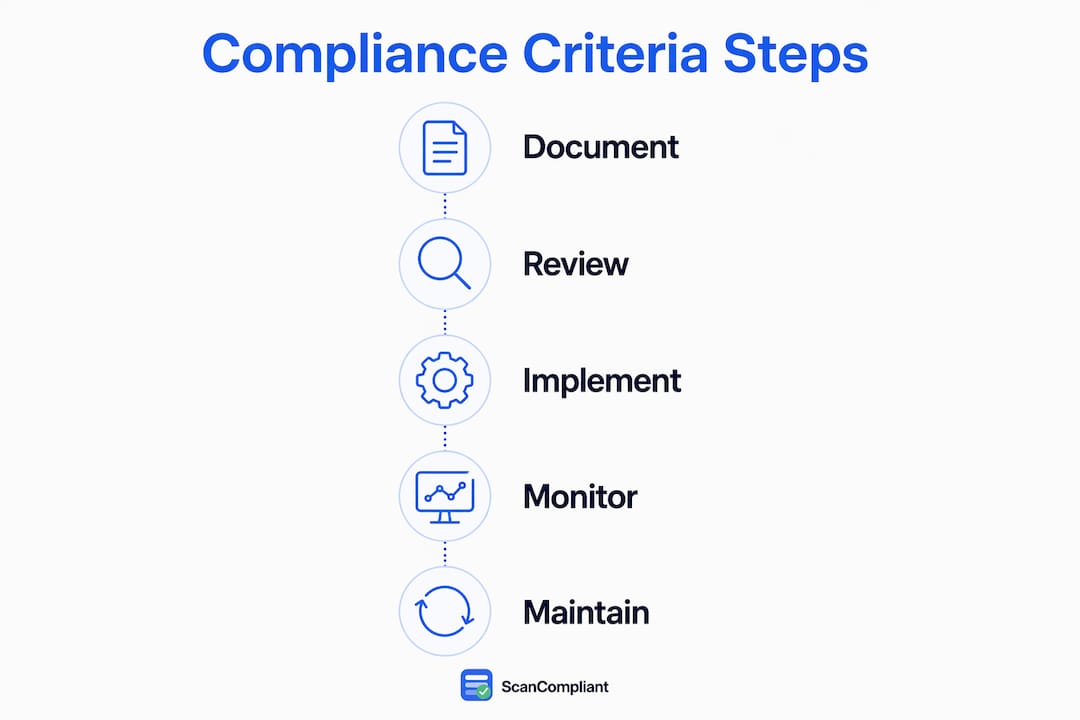
A structured implementation follows a defined sequence. Skipping steps creates gaps that surface later as inconsistent enforcement or failed audits.
-
Form a cross-functional working group. Include legal, regulatory, compliance, and marketing from the start. Each function sees different risks. Legal spots liability exposure. Regulatory knows enforcement patterns. Marketing knows where the production pressure points are. Executive sponsorship is also required. Without it, compliance criteria get deprioritized when campaign deadlines arrive.
-
Map regulations to content types. List every regulation that applies to your marketing activities, including FDA guidelines on health claims, FTC rules on endorsements and testimonials, and TCPA requirements for consumer communications. Then map each regulation to the specific content types your team produces: landing pages, email sequences, paid social ads, influencer briefs, and SMS campaigns each carry different risk profiles.
-
Write testable, pass/fail criteria. Every compliance rule must be written so that any reviewer, including an AI system, can determine compliance without asking for clarification. A rule that says “avoid misleading claims” fails this test. A rule that says “do not use the word ‘cure’ in reference to any condition without FDA-approved language” passes it. Clear pass/fail criteria prevent review friction and eliminate the back-and-forth that slows content production.
-
Define roles and approval workflows. Specify who reviews what, in what order, and what happens when a compliance flag is raised. A telehealth brand running paid search ads needs a different approval chain than one publishing a clinical blog post. Document both. Assign named owners, not job titles, to each step.
-
Deploy automation to enforce criteria at scale. Manual tracking fails under deadline pressure. Automated compliance tools reduce human error and accelerate approvals compared to spreadsheet-based tracking. Configure your AI scanner with the documented criteria from step three. Run a pilot on one content type before rolling out across all channels.
- Validate criteria with an independent reviewer before system configuration
- Train all team members on the new workflow before the first live campaign
- Document the pilot results and adjust criteria based on findings
What common challenges arise when standardizing compliance criteria?
The most common failure point is tribal knowledge. Marketing teams in telehealth and DTC health brands often rely on one or two experienced reviewers who carry compliance rules in their heads. When those people are unavailable, enforcement becomes inconsistent. The solution is knowledge capture: structured interviews, documented decision logs, and a formal criteria library that does not depend on any individual.
The second challenge is underestimating organizational readiness for automation. Many teams invest in AI compliance tools before completing the documentation work those tools require. The result is a system that flags the wrong things, misses real risks, and loses the trust of the marketing team within weeks. Readiness assessment must come before tool selection.
A compliance criterion that cannot be interpreted clearly and unambiguously by a reviewer or AI tool signals a design flaw. Ambiguous rules lead to delayed approvals, inconsistent enforcement, and a false sense of security. Fix the rule before configuring the system.
Creating unambiguous pass/fail criteria is harder than it sounds. Teams frequently write criteria that feel clear in a meeting but produce conflicting interpretations in practice. The fix is cold validation: have someone with no prior context read the criterion and attempt to apply it to three real content examples. If they ask a clarifying question, the criterion needs revision.
Pro Tip: Schedule a compliance criteria review with your legal team every time a major regulatory update is announced. Do not wait for the next scheduled cycle. Regulatory enforcement in telehealth moves faster than annual review calendars.
Maintaining team accountability over time is the final common challenge. Compliance fatigue sets in when teams see criteria as obstacles rather than guardrails. Clear ownership, visible metrics on compliance pass rates, and regular training updates keep the program active and respected.
What are the best practices for maintaining compliance criteria over time?
Compliance criteria decay without scheduled maintenance. Regulations change, enforcement priorities shift, and marketing tactics evolve. A criteria library that was accurate in january may be incomplete by july.
High-risk organizations such as telehealth and DTC health brands should review their compliance criteria every six months. Standard environments can operate on a 12-month cycle. The six-month cadence reflects the pace at which FDA and FTC enforcement guidance actually changes in health marketing.
Ongoing maintenance requires four practices working together:
- Scheduled policy reviews with a named owner and a fixed calendar date, not a vague “quarterly” commitment
- Audit trail analysis to identify which criteria generate the most flags, which signals either a genuine risk pattern or a poorly written rule
- Regulatory update integration so that new FTC guidance or TCPA amendments are reflected in the criteria library within 30 days of publication
- Version control so that every change to a criterion is dated, attributed, and retrievable during an audit
The comparison below shows the difference between a maintenance program that works and one that fails quietly.
| Practice | Active program | Passive program |
|---|---|---|
| Review cadence | Every 6 months, named owner | “When we get to it” |
| Criteria updates | Triggered by regulatory changes | Annual, if remembered |
| Audit trail use | Analyzed monthly for patterns | Stored but never reviewed |
| Training | Updated with each criteria revision | One-time onboarding only |
| Version control | Dated, attributed, retrievable | Overwritten without record |
Feedback loops from content compliance audits are the most underused maintenance tool. Every flagged piece of content is a data point. Patterns in flags reveal where criteria need tightening, where training has gaps, and where production processes create compliance shortcuts. Teams that analyze this data improve faster than those that treat each flag as an isolated incident.
Key Takeaways
Standardizing compliance criteria requires documented, testable rules, cross-functional ownership, and scheduled maintenance cycles to protect telehealth and DTC health brands from regulatory exposure.
| Point | Details |
|---|---|
| Document before automating | Write criteria in formal, testable language before configuring any AI or workflow tool. |
| Use a scoring matrix | A 5×5 likelihood-by-impact model helps teams prioritize high-stakes regulatory gaps over minor issues. |
| Apply 6-month review cycles | High-risk sectors like telehealth require criteria reviews every six months, not annually. |
| Validate with cold testing | Have an independent reviewer apply each criterion to real content before it goes live. |
| Build audit trail habits | Analyze compliance flags monthly to identify patterns and improve criteria over time. |
Why most compliance programs fail before they start
The teams I see struggle most with compliance standardization share one trait: they treat documentation as a formality rather than the actual product. They hold the kickoff meeting, assign the working group, and then produce a criteria document that reads like a policy memo. It uses words like “appropriate” and “reasonable.” Nobody can enforce those words consistently, and nobody does.
The telehealth brands that get this right write criteria that read like software requirements. Every rule has a subject, a condition, and a measurable outcome. When Scancompliant scans a piece of content against a well-written criterion, it returns a clear finding in minutes. When it scans against a vague one, it returns noise. The quality of your criteria determines the quality of your compliance program, full stop.
The other pattern I see consistently is the assumption that buying a tool solves the problem. It does not. A regulatory review checklist built on undocumented tribal knowledge produces the same inconsistent results whether a human or an AI applies it. The organizational work of capturing, testing, and formalizing criteria must happen first. Technology then multiplies the effectiveness of that work. It does not replace it.
The regulatory environment for DTC health marketing is not getting simpler. TCPA enforcement is active. FTC scrutiny of health claims is increasing. Teams that build a documented, testable, and maintained compliance criteria program now will spend less time in reactive mode and more time producing content that actually reaches patients.
— Compliant Team
How Scancompliant supports compliance criteria standardization
Marketing teams at telehealth and DTC health brands need more than a checklist. They need a system that applies their compliance criteria consistently, at the speed their content production demands.
Scancompliant is an AI-powered content scanning platform built for exactly this environment. It scans marketing copy against a database of over 1,000 risk terms, delivers prioritized findings in minutes, and creates a documented compliance trail for every piece of content reviewed. More than 200 brands already use it to catch the subtle claims that human reviewers miss under deadline pressure. The platform fits into existing marketing workflows and can be configured to reflect your team’s specific documented criteria. See how it works and find the plan that fits your team’s review volume at Scancompliant pricing.
FAQ
What does standardizing compliance criteria mean for a marketing team?
Standardizing compliance criteria means converting informal review practices into documented, testable rules that every team member applies consistently. The goal is to eliminate inconsistent enforcement and reduce regulatory exposure across all marketing content.
How often should telehealth brands review their compliance criteria?
High-risk organizations like telehealth brands should review compliance criteria every six months. Standard environments can use a 12-month cycle, but telehealth and DTC health brands face faster-moving regulatory enforcement.
What makes a compliance criterion effective?
An effective criterion produces a clear pass or fail result without requiring verbal clarification from the reviewer. If an independent reader cannot apply the rule consistently to real content examples, the criterion needs to be rewritten.
Do AI compliance tools replace the need for documented criteria?
No. AI compliance tools require formally documented criteria to function correctly. Tribal knowledge cannot be configured into a system, and undocumented rules produce inconsistent AI outputs.
What is the TCPA requirement most relevant to DTC health marketing teams?
Under current TCPA guidance, marketing teams must process opt-out requests within 10 business days. This is a concrete, testable compliance criterion that should appear in every DTC health brand’s documented criteria library.
Recommended
- Healthcare Marketing Compliance Training Teams: 2026 Guide – scancompliant.com
- Regulatory Review Checklist for Healthcare Marketing – scancompliant.com
- Top 3 Comply.com Alternatives in Marketing Compliance 2026 – scancompliant.com
- Compliant Content Release in Healthcare Marketing: 2026 Guide – scancompliant.com